Army Releases New Barracks Guide
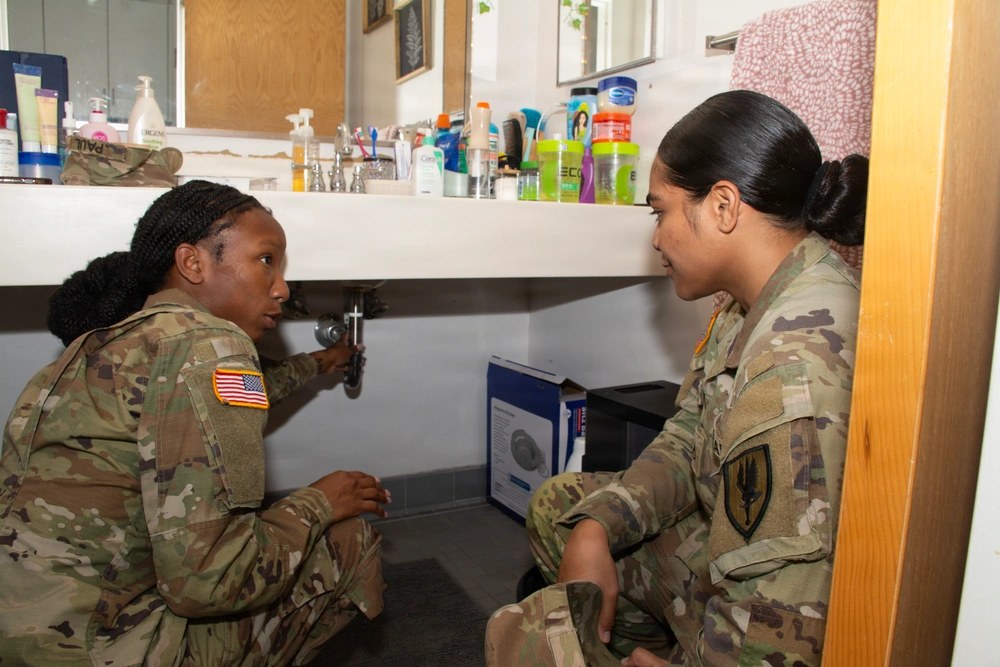
PHOTO CAPTION: An Army NCO shows a soldier how to inspect barracks plumbing for leaks at Fort Rucker, Alabama, Sept. 17, 2026. Army officials say maintenance problems should be submitted through the work-order system for repair. U.S. Army photo by John Drew Hamilton. File photo.
Soldiers at an Army barracks went an entire week without running water before leadership discovered that nobody had submitted a work order to have the problem fixed, according to a senior enlisted leader involved in developing the Army’s new barracks guide.
Command Sgt. Maj. Nema Mobarakzadeh, now the senior enlisted leader of U.S. Army Western Hemisphere Command, described the incident during a call with reporters as an example of the knowledge gaps the Army is trying to address.
Mobarakzadeh said that at a previous command, a battalion sergeant major approached him angry that soldiers in the barracks had been without running water for a week.
Mobarakzadeh asked for the work-order number.
There wasn’t one.
“Not one person in the formation put a request in,” he said.
Mobarakzadeh said he told the battalion sergeant major that the problem could have been addressed much sooner if someone had actually reported it through the proper maintenance system.
Once the issue was submitted, he said, the water problem was fixed the same day.
The Army has not publicly identified the installation where that incident occurred.
Mobarakzadeh said experiences like that helped drive development of the Army’s new NCO’s Barracks Guidebook, a 20-page resource released service-wide this week.
The guide went through 59 drafts before publication and is intended to give noncommissioned officers a single reference for managing soldiers’ living conditions, maintenance problems and barracks standards.
It includes responsibility checklists, links to existing Army regulations and policies, and scenarios involving problems leaders could encounter in the barracks.
Those scenarios range from discovering suspected drugs in a soldier’s room to preparing a barracks building for closure before a unit deploys.
Army officials say the guide is not a new set of regulations.
Instead, it is intended to collect existing responsibilities, procedures and best practices in one place for NCOs who may not have been adequately trained on barracks management earlier in their careers.
Mobarakzadeh said part of the problem can be traced back to the years when civilian barracks managers handled many responsibilities during the Global War on Terror.
That left some NCOs who are now first sergeants and sergeants major without the same experience managing barracks that previous generations may have received earlier in their careers.
He pointed to the old description of NCO responsibilities as “beans, barracks and bullets,” saying barracks management is a responsibility the Army wants its enlisted leaders to reclaim.
The guide was tested during a six-week pilot with the 101st Airborne Division at Fort Campbell, Kentucky.
First sergeants participating in the pilot were asked to study the guide and identify gaps in how units were training leaders to manage barracks.
One company subsequently added barracks-inspection instruction to its in-processing program.
The Army officially released the guide Sept. 29 as part of a broader effort to improve living conditions for soldiers.
The service says the resource is intended to help NCOs identify maintenance problems early, track repairs and advocate for soldiers when problems are not being resolved.
That effort comes as the military continues to face criticism over barracks conditions.
Recent government oversight has identified persistent maintenance backlogs and neglected facilities across the Defense Department, while soldiers at multiple installations have reported problems involving plumbing, mold, heating and air conditioning.
Army leaders also acknowledge that installations often have shortages of public works personnel.
Mobarakzadeh said that means NCOs may need to not only submit maintenance requests, but continue following up and escalating unresolved problems.
The new guide does not transfer responsibility for broken infrastructure from installation maintenance organizations to individual soldiers or NCOs.
But Army officials say leaders cannot get problems fixed if they are not identified, reported and tracked in the first place.
In the case Mobarakzadeh described, soldiers spent a week without running water before anyone took that first step.
Once they did, he said, the problem was repaired that day.
(Source: OAF Nation)