Hegseth's Staff Damages Historic Globe
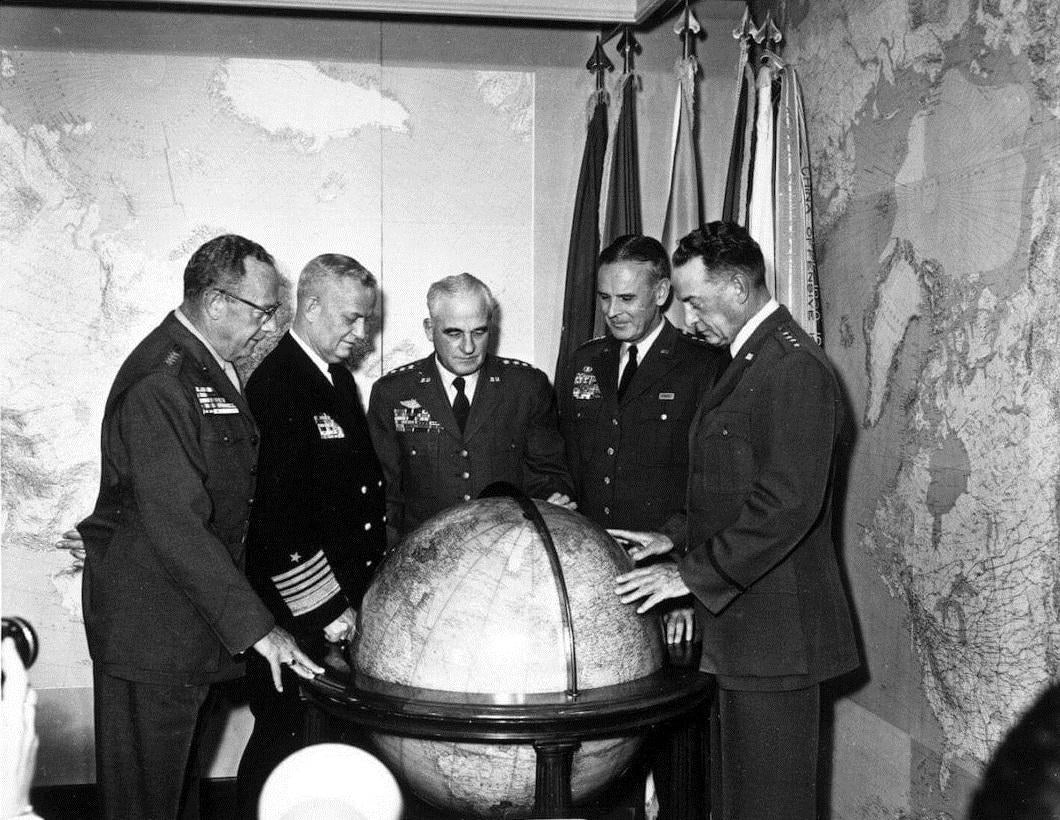
PHOTO CAPTION: Senior U.S. military leaders examine a globe during a briefing at the Pentagon on January 15, 1958. The Army confirmed that members of Defense Secretary Pete Hegseth's staff damaged a different, historically significant globe associated with Gen. Dwight D. Eisenhower during an attempted relocation on February 3, 2026. The damaged artifact is undergoing restoration. (Library of Congress photo via Wikimedia Commons, CC BY-SA 4.0)
Members of Defense Secretary Pete Hegseth's staff damaged a historic globe associated with Gen. Dwight D. Eisenhower after attempting to move the fragile artifact into the secretary's Pentagon office without the usual assistance of military preservation specialists.
The 30-inch globe, dating to the 1930s, was dropped during the attempted relocation on February 3, according to an investigation published Thursday by The Washington Post.
The fall punched a several-inch hole near Antarctica and separated the globe's spherical body from the metal mounting that allowed it to rotate.
The Army confirmed the damage. A Pentagon official subsequently acknowledged the accident and said the globe was undergoing repairs.
Historic Globe Was Being Moved to Hegseth's Office
The artifact was one of two nearly identical globes housed inside the Pentagon and traditionally associated with Eisenhower, who served as a senior Army planner before becoming Supreme Allied Commander in Europe during World War II.
According to the Washington Post, members of Hegseth's office wanted one of the globes relocated to the secretary's workspace because of its historical significance.
Under normal procedures, moving a fragile historical artifact would involve trained curators and preservation specialists.
The Army office responsible for the globe had expected to consult experts from the U.S. Army Center of Military History before relocating it.
However, those specialists were furloughed during a partial government shutdown.
Rather than wait for their return, members of Hegseth's staff attempted the move themselves, according to people familiar with the incident who spoke to the newspaper.
The shutdown ended the same day the globe was damaged.
Globe Fell Onto Its Own Mounting
During the relocation attempt, the staff members lost control of the globe.
It fell onto the metal mounting beneath it, causing the mounting to puncture the globe's fragile shell near Antarctica.
The damage reportedly left a hole several inches wide.
Army spokesman Christopher Surridge confirmed that the spherical portion also detached from the metal mechanism that permitted the globe to rotate.
Photographs obtained by The Washington Post show the damaged artifact, including the hole and broken components.
The globe was never delivered to Hegseth's office following the incident.
The Army has not disclosed the full extent of the required restoration or whether the artifact can be returned to its previous condition.
Pentagon Confirms Accident, Says Repairs Are Underway
After Thursday's reporting, a Pentagon official acknowledged that an accident occurred during the move.
The department described the artifact as a replica of an Eisenhower globe and emphasized that nobody was injured.
It also confirmed that repairs were underway.
The official criticized the attention given to the incident, characterizing the story as inconsequential.
The department did not disclose the cost of restoring the globe or when repairs would be completed.
The Washington Post reported that it remains unclear whether Hegseth personally ordered the relocation or whether another senior official within his office authorized the move.
No finding of deliberate damage has been reported.
Globe Linked to Eisenhower's World War II Planning
The damaged artifact is believed to date to the 1930s.
According to a historical plaque accompanying the globe, it may have been used by Eisenhower while he served in the Army's War Plans Division and Operations Division in early 1942.
The plaque describes that connection as a historical theory rather than a definitively established chain of ownership.
Eisenhower later commanded Allied forces during the Normandy invasion and served as president of the United States from 1953 to 1961.
Another Eisenhower-associated globe remains in the office of the Army chief of staff at the Pentagon. Officials say that artifact bears markings from both Eisenhower and Gen. Omar Bradley.
Other large globes associated with the wartime commander have been preserved at military and presidential-history institutions.
Similar Globe Previously Moved by Professional Specialists
In 2022, another Eisenhower-associated globe was relocated between Army facilities in Alabama.
According to the moving company responsible for that operation, specialists constructed protective packaging and secured the artifact inside a custom crate.
The company described the globe's historical significance as extending beyond its financial value.
That earlier relocation was completed successfully.
The comparison highlights the specialized handling ordinarily involved in moving fragile military artifacts that have survived for generations.
Restoration Cost Remains Unknown
The February accident was not publicly detailed until reporting this month, culminating in Thursday's Washington Post investigation and the Pentagon's acknowledgment.
The Army has confirmed the physical damage, but the department has not disclosed who specifically handled the artifact, what restoration will cost or whether any administrative review resulted from the incident.
For now, the historic globe remains under repair, and the Pentagon has not announced when the restoration will be complete.
(Source: OAF Nation)