Article: Hegseth Plans Special Ops Expansion
Hegseth Plans Special Ops Expansion
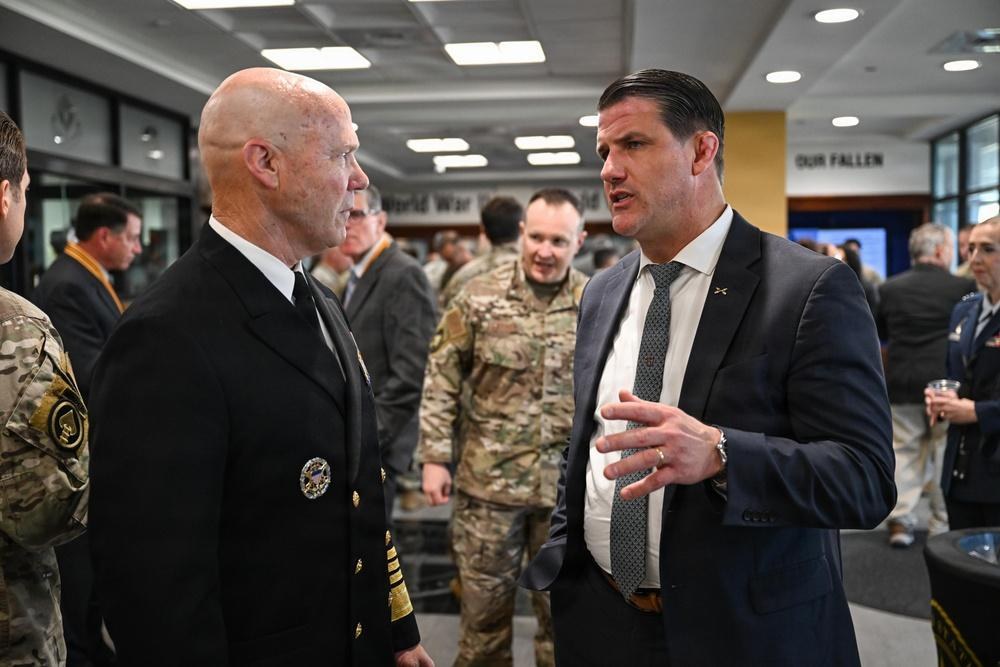
PHOTO CAPTION: U.S. Special Operations Command commander Adm. Frank “Mitch” Bradley speaks with Derrick Anderson, Assistant Secretary of Defense for Special Operations and Low-Intensity Conflict, at MacDill Air Force Base, Florida, on April 15, 2026. Defense Secretary Pete Hegseth has directed changes to expand Anderson's office, including additional personnel, greater access to senior Pentagon decisions and the secondary name Office of Strategic Services. A permanent elevation to undersecretary status would require congressional approval. (U.S. Air Force file photo by Tech. Sgt. Marleah Miller.)
Defense Secretary Pete Hegseth has ordered a significant expansion of the Pentagon office responsible for overseeing U.S. special operations forces, bringing back the historic Office of Strategic Services name and seeking greater influence over military spending, equipment and national defense priorities.
A memorandum dated November 2 and publicly released November 12 directs the department to strengthen its civilian special operations leadership, assign additional personnel and identify at least $45 million annually to support the office's operations.
The plan would also give the office greater access to meetings where senior Pentagon leaders make decisions about military resources and capabilities.
Hegseth wants Congress to go further by elevating the office's senior civilian leader to an undersecretary-level position.
But that permanent change has not been approved.
The initiative is not the recreation of the original World War II intelligence agency, nor does it establish a new military branch.
It is an effort to change how much influence special operations leadership has inside the existing Defense Department.
Why Hegseth Wants to Change the System
The Pentagon already has an assistant secretary responsible for Special Operations and Low-Intensity Conflict.
The position, currently held by Derrick Anderson, provides civilian oversight of the special operations community.
But Hegseth argues that the responsibilities assigned to special operations forces have grown faster than the resources and institutional support provided to them.
In his memorandum, he describes a gap between the demands placed on special operations forces and their funding, equipment and readiness requirements.
His solution is to give their civilian leadership greater access to senior defense officials and more influence over how resources are distributed.
Under the existing structure, special operations missions involve forces drawn from the Army, Navy, Air Force and Marine Corps.
U.S. Special Operations Command coordinates their training, capabilities and operational requirements.
But the military departments remain responsible for many of the personnel, equipment and support functions those forces rely upon.
That can create competition for funding and resources against the conventional forces maintained by the services.
Hegseth wants special operations requirements to receive greater priority when those decisions are made.
The Office of Strategic Services Name Returns
One of the most visible changes is the revival of a famous military and intelligence name.
The original Office of Strategic Services was established in 1942 during World War II.
Under Maj. Gen. William J. Donovan, the OSS conducted intelligence gathering, espionage, sabotage and special operations behind enemy lines.
Its activities helped establish traditions later associated with American intelligence agencies and modern special operations forces.
President Harry Truman dissolved the organization in 1945, transferring its functions among other government organizations.
The Central Intelligence Agency was subsequently established in 1947.
Hegseth is now directing the Pentagon's existing special operations civilian office to use the Office of Strategic Services name.
Its senior civilian position will use the secondary title Assistant Secretary of War for the Office of Strategic Services.
However, this is an administrative naming change, not the legal restoration of the wartime OSS.
The organization will not automatically receive the original OSS's intelligence responsibilities.
The existing office's statutory responsibilities remain in place unless Congress changes them.
A Bigger Seat at the Pentagon Table
The memo goes beyond renaming an office.
It directs that the special operations civilian leadership receive a higher position in the Pentagon's internal order of precedence.
The office is to be treated at the Code 2 level, giving its leader standing alongside senior civilian officials in the department's internal hierarchy.
Hegseth also directs that the office participate in major Pentagon decision-making bodies.
These include the Senior Leaders Council, Joint Requirements Oversight Council, Secretary's Weekly Priorities Review and meetings involving military budgets, sensitive technologies and special access programs.
Those meetings are important because they help determine what equipment the military purchases, which programs receive priority and how the department prepares for future threats.
Previously, special operations leadership did not necessarily hold the same position in those forums as the secretaries responsible for the military departments.
Hegseth wants the office included when those decisions are made.
The move expands internal access and influence.
It does not independently give the assistant secretary every legal power of an Army, Navy or Air Force secretary.
One Hundred Positions and $45 Million Annually
The memorandum also directs the transfer or identification of additional personnel to support the office.
Seventy-five civilian positions are to be transferred within 60 days, including at least five Senior Executive Service positions.
The Joint Staff is directed to identify 25 military positions requiring joint qualifications.
Together, those actions account for 100 additional military and civilian positions associated with the reorganization.
Hegseth also directs the Pentagon comptroller to identify and reallocate at least $45 million annually from operations and maintenance funding.
That money is intended to support the office's day-to-day operations.
It is not a newly announced $45 million fund for direct combat missions, and the memorandum does not establish that the full amount has already been transferred.
The document also specifies that personnel labor costs would be funded separately.
Another provision directs the Pentagon to find consolidated office space for senior special operations civilian leadership.
The overall objective is to give the organization the staffing, administrative resources and institutional access needed to perform a larger oversight role.
Special Operations Could Receive Greater Budget Priority
Hegseth's memorandum also addresses equipment and modernization.
It directs Pentagon planners to give greater consideration to U.S. Special Operations Command's requests during the execution of the fiscal 2027 budget and development of future spending plans.
Those requests concern personnel, modernization, major equipment replacement and operational readiness.
The memo also calls on the military services to prioritize support for special operations requirements wherever feasible.
That includes common equipment platforms and replacing equipment lost in combat.
For special operations personnel, the potential significance lies in whether their requirements receive faster attention and more consistent support.
Special operations units depend on specialized aircraft, communications systems, weapons and other capabilities that can have different requirements from conventional military units.
Hegseth's plan is intended to make those needs more visible in Pentagon budgeting and acquisition decisions.
However, additional funding for those programs would still depend on applicable budget authorities and appropriations.
Why Congress Still Matters
The biggest proposed structural change cannot be completed through an internal memorandum alone.
Hegseth wants Congress to create a permanent Under Secretary of Strategic Services position.
That would formally elevate the civilian special operations office beyond its existing assistant secretary-level status.
The memorandum directs Pentagon legislative officials to prepare the necessary proposals.
Congress would have to authorize the change.
The funding implications are also subject to legal and budget constraints.
Kori Schake, a defense policy expert at the American Enterprise Institute, told Breaking Defense that Hegseth cannot independently create the new statutory position or authorize spending beyond his legal authority.
She also questioned whether special operations should receive a larger share of defense resources, arguing that conventional military capabilities remain essential.
Supporters of a stronger special operations office counter that the growing demands on these forces require greater influence over Pentagon decisions.
The disagreement is not about whether special operations forces are important.
It concerns how the Defense Department should balance investment in specialized forces against the broader Army, Navy, Air Force, Marine Corps and Space Force.
What Happens Next?
Some of Hegseth's directions are intended to take effect immediately.
The Pentagon must begin implementing changes to staffing, internal precedence, office arrangements and participation in senior meetings.
The memo directs administrative actions within 30 days and calls for transferring the designated civilian positions within 60 days.
The proposed undersecretary position, however, requires legislative action.
No new military service has been created, and the existing operational command structure has not been abolished.
What has changed is the administration's stated intention to give civilian special operations leadership a much larger role in Pentagon decisions.
More than eight decades after the original OSS operated behind enemy lines during World War II, the Pentagon is bringing back its name.
The question now is whether the changes will translate into more resources and influence for today's special operations forces, and how Congress will respond to the proposed expansion of their civilian leadership.
(Source: OAF Nation)