Hegseth Blocks Donahue's Promotion
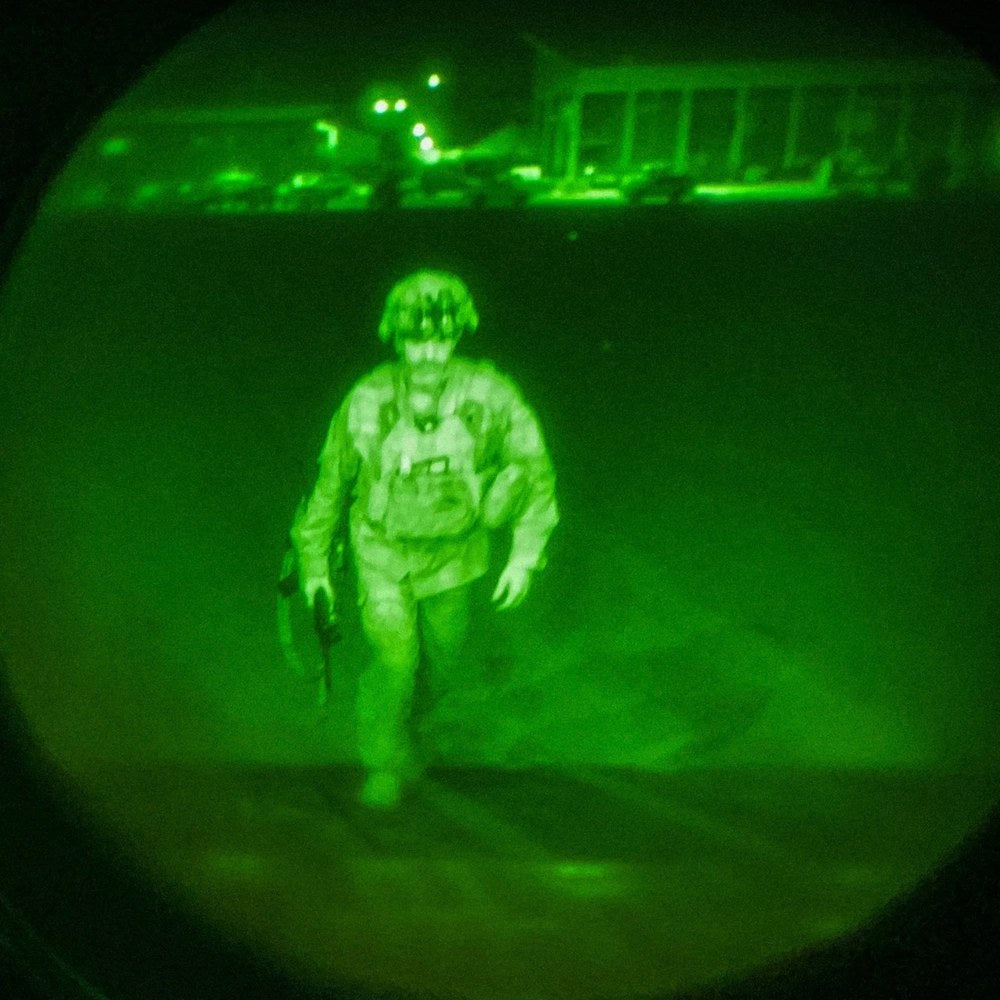
PHOTO CAPTION: Then-Maj. Gen. Christopher Donahue, commander of the 82nd Airborne Division, boards the final U.S. military flight from Kabul, Afghanistan, Aug. 30, 2021. Donahue was the final American service member to leave Afghanistan. U.S. Army photo by Master Sgt. Alexander Burnett.
The grainy night-vision photograph of Gen. Christopher Donahue becoming the final American service member to leave Afghanistan became one of the defining images of the 20-year war's end.
Five years later, that image reportedly became part of an extraordinary fight inside the Pentagon over Donahue's career.
Defense Secretary Pete Hegseth was fixated on Donahue's connection to the chaotic 2021 Afghanistan withdrawal and repeatedly focused on the famous photograph while deciding the general's future, according to a new New York Times investigation based on interviews with more than 40 current and former officials and others familiar with the dispute.
Donahue ultimately retired Aug. 27 after more than three decades in uniform. He had commanded U.S. Army Europe and Africa and was considered by supporters for even higher positions, including commander of U.S. European Command and eventually Army chief of staff.
But according to the Times, Hegseth decided in early 2025 that Donahue should not receive the European Command job.
The defense secretary reportedly believed President Donald Trump wanted senior military officers held accountable for the Afghanistan withdrawal and particularly the deaths of 13 U.S. service members in the Aug. 26, 2021, suicide bombing at Abbey Gate.
Donahue had been one of the senior commanders at Hamid Karzai International Airport during the evacuation, but he was not in charge of security at Abbey Gate when the bombing occurred. Marines controlled the gate at the time.
According to the Times, Donahue had actually warned about the danger there.
Two days before the attack, Donahue visited Abbey Gate and became concerned about the massive crowd packed around the Marines screening people for entry. He later recommended closing the gate early rather than waiting for his 82nd Airborne troops to take control on Aug. 27, the Times reported. Senior leaders ultimately kept it open after British forces requested continued access for evacuation operations.
The suicide bomber struck the following day, killing 11 Marines, one Navy corpsman and one Army soldier.
But another piece of Donahue's association with the withdrawal appears to have stuck with Hegseth: the photograph.
On Aug. 30, 2021, Donahue was the final soldier to board the last American military flight departing Kabul. Army Master Sgt. Alexander Burnett captured the moment using an iPhone through his night-vision device as Donahue walked toward the aircraft.
The picture spread around the world almost immediately.
According to the Times, senior Pentagon officials said Hegseth appeared particularly focused on the image and incorrectly referred to it as a “selfie.”
It wasn't.
Burnett, an Army photographer, took the photograph. Donahue did not take it, request it or control its distribution.
Hegseth's then-chief of staff, Joe Kasper, reportedly tried to make that distinction clear while attempting to save Donahue's career.
Kasper had another Pentagon official prepare a card containing roughly half a dozen facts supporting Donahue. One of the first points reportedly explained that the picture was not a selfie, while another stressed that Marines — not Donahue's paratroopers — controlled Abbey Gate when the bombing occurred.
Kasper handed the card to Hegseth while the two were riding to a White House event in March 2025.
Hegseth looked at it, according to the Times, and responded: “I don't care.”
The battle over Donahue continued for more than a year.
Joint Chiefs Chairman Gen. Dan Caine reportedly supported Donahue for European Command, while Army Secretary Dan Driscoll, then-Army Chief of Staff Gen. Randy George and several Republican senators tried at various points to preserve or advance his career.
The Times reported that Hegseth eventually moved ahead with reducing Donahue's four-star Army Europe and Africa position to a three-star command. Without another four-star assignment, the change effectively put Donahue on a path toward retirement.
In early March, George reportedly called Donahue and told him to submit his retirement paperwork because Hegseth wanted him out.
Donahue's departure had already become public months earlier. The Atlantic reported in June that he would leave U.S. Army Europe and Africa after only about 18 months in the position, making him another prominent senior officer to exit during Hegseth's reshaping of the military leadership.
What wasn't known publicly was the extent of the internal battle over Donahue — or the reported importance Hegseth attached to the image that made the general famous.
The Pentagon declined to answer the Times' specific questions about Donahue and said senior military officers serve at the pleasure of the president and defense secretary.
Donahue retired Aug. 27.
And the photograph that helped define America's final night in Afghanistan remains one of the most recognizable military images of the war.
Sources: The New York Times; The Atlantic; U.S. Army Central; DVIDS
(Source: The New York Times)