Hasan Seeks Execution Delay
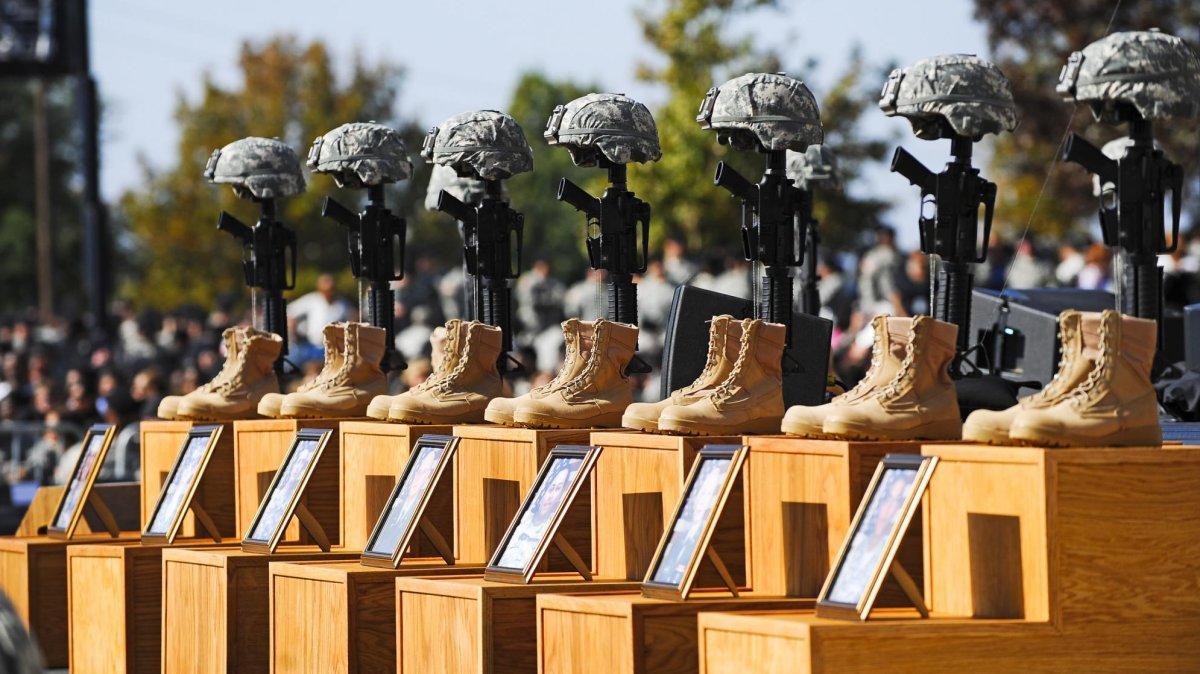
PHOTO CAPTION: A memorial display of rifles, helmets, boots and photographs honors victims of the November 5, 2009, Fort Hood shooting in Texas. Convicted shooter Nidal Hasan is seeking to delay his scheduled December 3, 2026, execution, while three survivors have been denied permission to witness it. (File photo.)
The former Army major convicted of murdering 13 people at Fort Hood in 2009 has asked a federal judge to stop his upcoming execution, while three survivors of the attack have been denied permission to witness it.
Both developments were confirmed Tuesday, November 24, with the execution currently scheduled for December 3.
Nidal Hasan, a former Army psychiatrist sentenced to death for the 2009 shooting, is asking a federal court in Kansas for more time to challenge his conviction and sentence.
Separately, military officials have rejected requests from three survivors who wanted to attend the execution, citing regulations governing who qualifies as a witness, along with security and space restrictions.
For families and survivors who have waited 17 years for the sentence to be carried out, the latest developments introduce new uncertainty.
Hasan Asks Federal Judge to Delay December 3 Execution
Hasan filed a motion Tuesday asking a federal judge to temporarily halt his execution by firing squad.
The request would give him time to pursue a habeas corpus petition, a legal process through which prisoners can challenge whether their conviction or detention violates federal law or constitutional protections.
According to court documents reviewed by Reuters and the Associated Press, Hasan intends to argue that his military trial and death sentence violated his rights.
One of his proposed arguments concerns the military judge's decision to prevent him from claiming that the 2009 killings were justified as a defense of the Taliban against American military operations in Afghanistan.
That argument was prohibited during his original court-martial.
Hasan also intends to challenge aspects of the process used to schedule his execution, including concerns involving earlier plans to broadcast it.
The motion does not mean his execution has been postponed.
U.S. District Judge Anthony Mattivi scheduled a hearing for Wednesday morning, November 25, to consider the request.
Hasan remains imprisoned at Fort Leavenworth, Kansas.
Three Survivors Told They Cannot Witness the Execution
While Hasan seeks additional time in court, three survivors of the Fort Hood shooting have been fighting a separate battle over whether they can witness his execution.
Retired Army Col. Kathy Platoni, retired Maj. C. Alan Hopewell and Julia Wilson requested permission to attend.
The Army initially denied their requests, explaining that the three did not meet the applicable definition of direct victims for the charges on which Hasan was convicted.
The survivors asked military officials to reconsider.
On November 24, they received another rejection.
According to the Associated Press, the military cited security concerns and limited space in its latest decision. Officials also told the three that no further administrative appeal was available.
The survivors argue that they suffered lasting harm from the attack, even though they were not personally struck by gunfire.
They contend that the military should apply a broader definition of victim that recognizes physical, emotional and financial harm.
The Army maintains that military execution regulations determine who is eligible to attend.
'A Bullet Missed Me and Hit My Car'
Hopewell, a retired major who testified during Hasan's court-martial, was at Fort Hood during the attack.
He told the Associated Press that a bullet missed him and struck his vehicle.
Hopewell questioned why surviving a shooting without being physically struck should exclude someone from being recognized as a victim for purposes of witnessing the execution.
Platoni, a retired colonel who helped care for the wounded, described the lasting memories of that day.
She recalled using tablecloths to help injured personnel because necessary medical supplies were unavailable.
She also said she still possesses the blood-stained uniform she wore while trying to help a wounded soldier survive.
Wilson, who was nine months pregnant during the shooting, also expressed frustration with the military's handling of survivors' requests.
Their objections center on the distinction between the people directly wounded by Hasan's gunfire and others who were present, endangered, or involved in the immediate aftermath.
The military's denial concerns attendance at the execution. It does not establish that the three suffered no harm during the attack.
The 2009 Attack and Death Sentence
On November 5, 2009, Hasan opened fire at Fort Hood's Soldier Readiness Processing Center in Texas, killing 12 soldiers and one civilian.
More than 30 other people were wounded by gunfire.
Military police ultimately stopped the attack by shooting Hasan, leaving him paralyzed.
In 2013, a military court-martial convicted him of 13 counts of premeditated murder and numerous counts of attempted murder.
He was sentenced to death.
President Donald Trump approved his execution in October 2026, setting the stage for the military's first execution following a court-martial conviction since 1961.
The planned method is a firing squad.
Defense Secretary Pete Hegseth initially announced plans to livestream the execution, but Trump subsequently canceled that arrangement.
What Happens Next?
The immediate question is whether the federal judge grants Hasan's request for a stay.
If the court issues a stay, the December 3 execution could be delayed while additional legal challenges proceed.
If the request is denied, the scheduled execution may move forward, subject to further court proceedings.
The separate dispute over survivor attendance remains unresolved in a different sense: Military officials have rejected the three individuals' requests and said no further administrative appeal is available.
The survivors continue to maintain that their experiences during the attack deserve recognition.
Seventeen years after the killings, the upcoming execution remains a major moment for the military justice system and those affected by the shooting.
But with a new federal court challenge pending and survivors disputing who is permitted to attend, the final steps toward carrying out the sentence are still being contested.
(Source: OAF Nation)