Gaza Clan Holds Mass Funeral
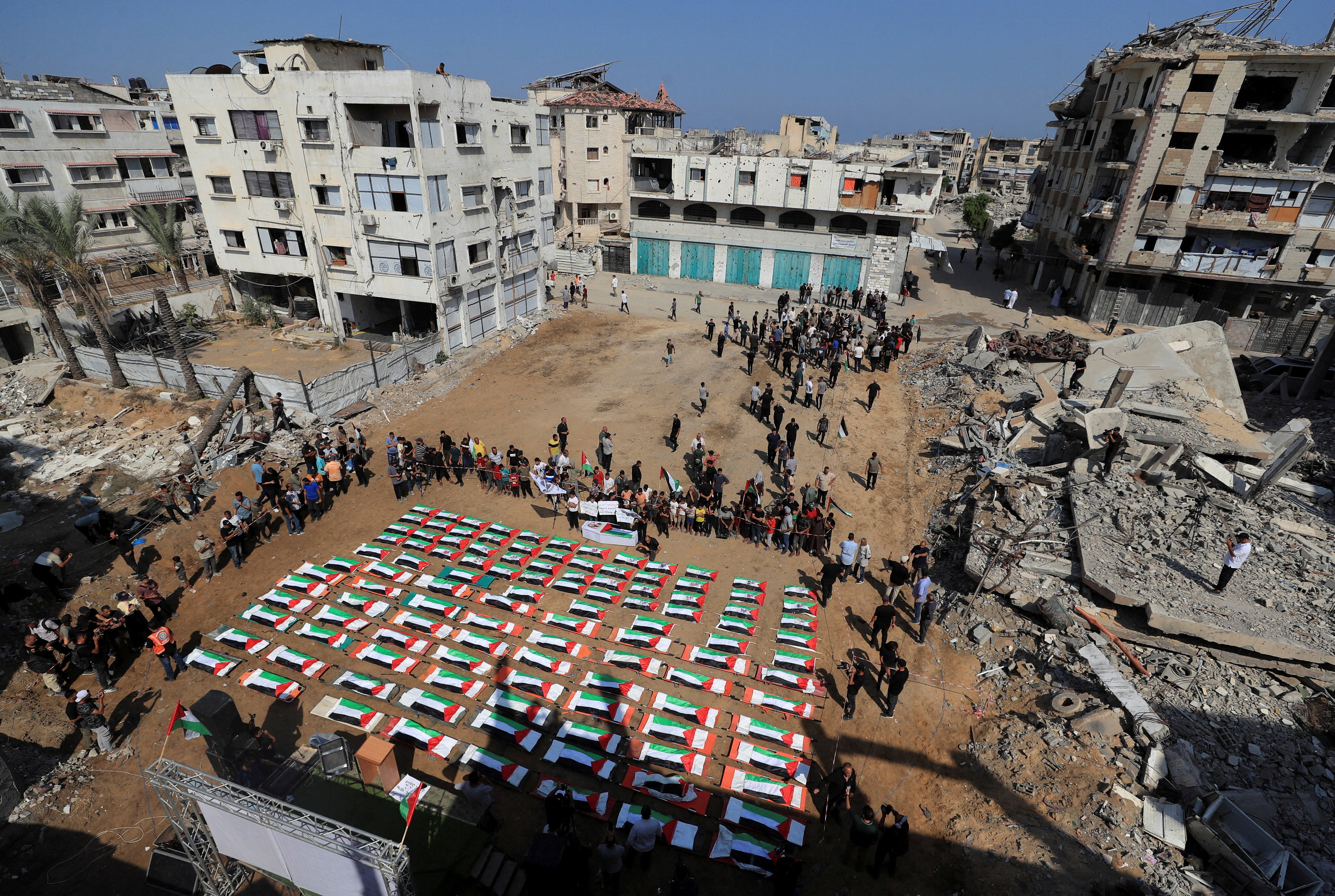
PHOTO CAPTION: Palestinians attend the funeral of 112 members of the Hassayna and Abu Sharia clan, who were killed in an Israeli strike in 2023 and whose remains were recovered from beneath the rubble, according to Gaza's Civil Defense, in Gaza City, August 4, 2026. REUTERS/Dawoud Abu Alkas TPX IMAGES OF THE DAY
CAIRO/GAZA, Aug. 4 — Palestinians in Gaza held a mass funeral Tuesday for 112 members of an extended family whose remains were recovered from beneath rubble nearly three years after an Israeli strike, according to Gaza’s Civil Defense.
The decomposed remains were placed on stretchers and covered with flags before relatives and neighbors carried them through the streets of Gaza City.
Palestinian authorities said 308 members of the Al-Hassayna family, also known as the Abu Sharia clan, were killed on Nov. 22, 2023, when Israeli airstrikes destroyed a group of apartment buildings as residents slept in Gaza City’s Sabra neighborhood.
Around half of those killed had previously been recovered and buried. Authorities said 153 bodies remained beneath the rubble until the latest recovery effort.
A team of 40 workers spent 17 days searching the wreckage and recovered remains identified as belonging to 112 of the missing victims.
Palestinian authorities described Tuesday’s gathering as the largest mass funeral of the Gaza war.
A sign displayed portraits of those killed, including men, women and children.
“This day is mixed with grief, and it has reopened our wounds three years after this massacre,” said Taysir Al-Hassayna, a surviving member of the clan.
“It has brought sorrow back to our children and women. But our consolation is that we believe they are martyrs with God.”
Reuters could not locate a November 2023 Israeli military statement giving Israel’s account of the strike, which occurred during the early weeks of the war.
The Israeli military did not immediately respond to a request for comment.
The war began after Hamas-led fighters attacked Israel on Oct. 7, 2023, killing 1,200 people.
Palestinian health authorities say more than 73,000 Palestinians have been confirmed killed during Israel’s military campaign in Gaza.
Most deaths were recorded after bodies were taken to morgues and buried. Around 8,000 additional people are believed to remain beneath the rubble.
Survivor watches family’s funeral from Cairo
Omar Al-Hassayna, 65, survived the Sabra strike and left Gaza for Egypt several days later.
He wept as he watched footage of Tuesday’s funeral on satellite television in Cairo.
His wife, four adult sons and four grandchildren were killed in the bombing. His grandchildren included two boys and two girls, ranging in age from several months to 4 years old.
“They are pieces of me,” he said. “I have thought about them every single day. I have seen them in my thoughts and in my dreams.”
“The funeral today is the least that could be done for those martyrs,” he added. “It is time for those bodies, those little bodies, to rest in peace.”
Many Gaza residents descend from refugees who came from territory now within Israel. Extended families often live together in clusters of residential buildings, leaving entire clans vulnerable when buildings are struck.
The Hassaynas had lived in the Sabra neighborhood for decades and were part of a prominent clan known across Gaza.
Omar said Israeli strikes hit three residential buildings where extended family members had gathered for shelter during the opening weeks of the war.
Two buildings were completely destroyed, killing nearly everyone inside, he said.
Omar was in the third building, which was partially destroyed. He survived with minor injuries from flying debris, along with two daughters and a son.
Recovery limited to areas outside Israeli control
An October ceasefire that ended major fighting initially left Israeli forces in control of more than half of Gaza. That area has since expanded to roughly two-thirds of the enclave.
Israeli forces have demolished remaining structures and ordered residents to leave areas under their control.
Body-recovery operations can take place only in the remaining third of Gaza, where nearly all of the territory’s more than 2 million residents are now living. Many are displaced in tents or damaged buildings.
Mahmoud Basal, a spokesperson for Gaza’s Civil Defense, said workers identified the Al-Hassayna remains using forensic evidence and information provided by survivors.
Relatives recognized some victims through clothing, injuries and distinctive physical features, Basal said.
Others were identified through bone-fixation plates, jewelry or necklaces bearing their names.
Basal said the recovery team would now move to other accessible areas.
“If we had at least 10 excavators, bulldozers, excavators, and cranes needed for the work, the job could be completed in three months,” he told Reuters.
At the cemetery, mourners passed the shrouded remains over their shoulders before placing them in newly dug graves amid the ruins of Gaza.
(Source: Reuters)