FAA System Failure Disrupts 7,000 Flights
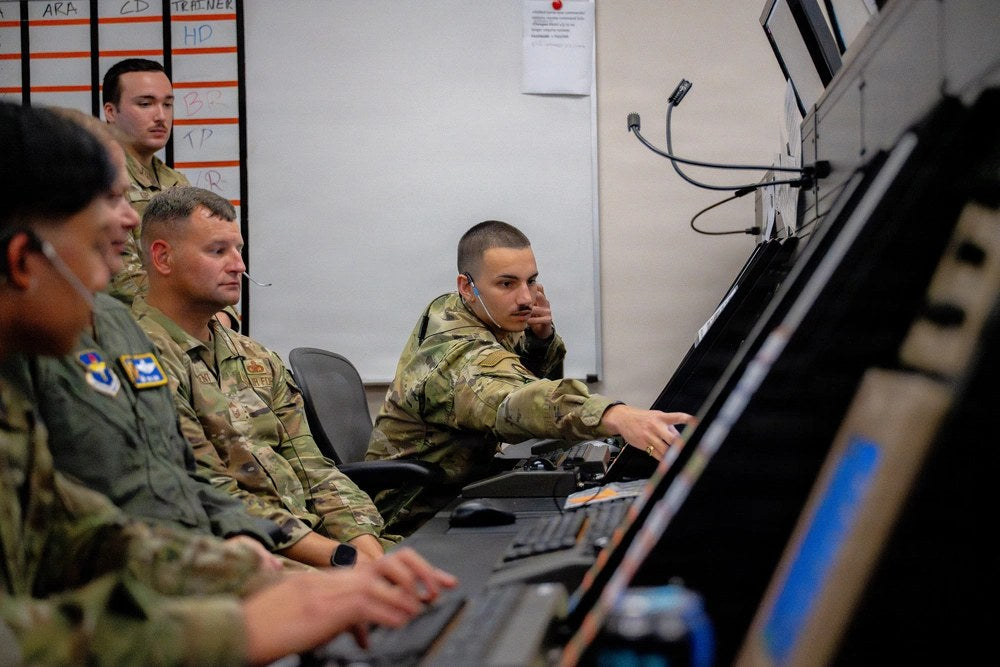
PHOTO CAPTION: Illustrative file photo. Air traffic control personnel work at radar consoles at Altus Air Force Base, Oklahoma, in August 2026. An FAA communications failure on Sept. 21 disrupted roughly 7,000 flights after a primary circuit failed and officials discovered the backup fiber line had also been damaged. (U.S. Air Force photo by Airman 1st Class Emma Wright)
A telecommunications failure in the nation's air traffic control system disrupted roughly 7,000 flights Monday after a primary communications circuit failed and officials discovered that the backup fiber line had also been severed.
The problems hit some of the busiest airports in the country and exposed how a failure involving a relatively small piece of infrastructure can ripple across the national aviation system.
The trouble began Monday morning at the FAA's Philadelphia Terminal Radar Approach Control facility.
FAA Administrator Bryan Bedford said the facility lost its primary communications circuit.
When the system attempted to move to its backup connection, officials discovered that the backup fiber line had a break in it as well.
The damaged fiber was located in New Jersey near rail construction.
Officials initially disagreed over exactly who was responsible for cutting it. Transportation Secretary Sean Duffy initially blamed an Amtrak construction crew, while Amtrak denied responsibility. New Jersey Transit said work was taking place near the damaged line and that investigators were trying to determine how the cable was marked before it was cut.
The communications failure forced the FAA to stop incoming flights at all three major New York area airports, JFK, LaGuardia and Newark.
Philadelphia and Boston were also affected, along with smaller airports in the region.
The problems were not fully resolved for about eight hours.
According to FlightAware data cited by Reuters, approximately 7,000 flights were delayed or canceled nationwide.
About 1,400 of those disruptions occurred at the three major New York area airports.
More than half of scheduled flights at Newark were canceled, and more than 100 incoming flights were diverted to other airports.
Philadelphia also endured repeated ground stops.
One FAA advisory during the disruption showed thousands of minutes of cumulative delay tied specifically to an equipment outage.
Repairs were completed later Monday and normal operations gradually resumed, although officials warned that the backlog would continue affecting passengers after the communications system itself was restored.
Bedford said the FAA stopped flights because controllers would not continue operating without reliable communications.
He said safety remained the priority while technicians worked to restore the system.
The disruption arrives as the federal government is already spending billions of dollars trying to modernize the aging air traffic control system.
Congress approved $12.5 billion last year to begin upgrading air traffic infrastructure and increase controller hiring.
Duffy said another $17.5 billion is needed to complete the modernization effort.
But an entirely separate federal report released Monday raised another concern about the systems used to communicate with aircraft.
The Government Accountability Office said the FAA has identified threats involving radio spectrum interference, spoofing and jamming, but has not completed several risk assessments and mitigation plans needed to address those threats.
GAO also found that the FAA does not have a defined real time monitoring system capable of detecting all spectrum related threats.
As a result, investigators said the agency can often examine an interference incident only after someone reports that it happened.
The watchdog also examined text based communications used by the FAA, pilots and other aviation operators.
GAO found weaknesses involving authentication, encryption and system design that could allow a malicious actor to send fraudulent information.
One example cited by investigators was a fake cancellation of an aircraft clearance, which could create delays or potentially contribute to a safety incident.
GAO issued nine recommendations to the FAA.
Those included completing formal risk assessments, strengthening security documentation, improving real time monitoring and improving coordination with government and private aviation partners.
The Department of Transportation agreed with all nine recommendations.
There is no evidence that spoofing, hacking, jamming or any other cyberattack caused Monday's massive flight disruption.
The outage was tied to a failed communications circuit and a damaged backup fiber line.
The significance of the timing is that on the same day one physical communications failure disrupted thousands of flights, federal auditors separately warned that other parts of the aviation communications system still have unresolved vulnerabilities.
Together, the two developments highlight how dependent the national airspace system remains on communications infrastructure that federal officials are now trying to modernize.
(Source: OAF Nation)