F-16 Crashes in Michigan Training
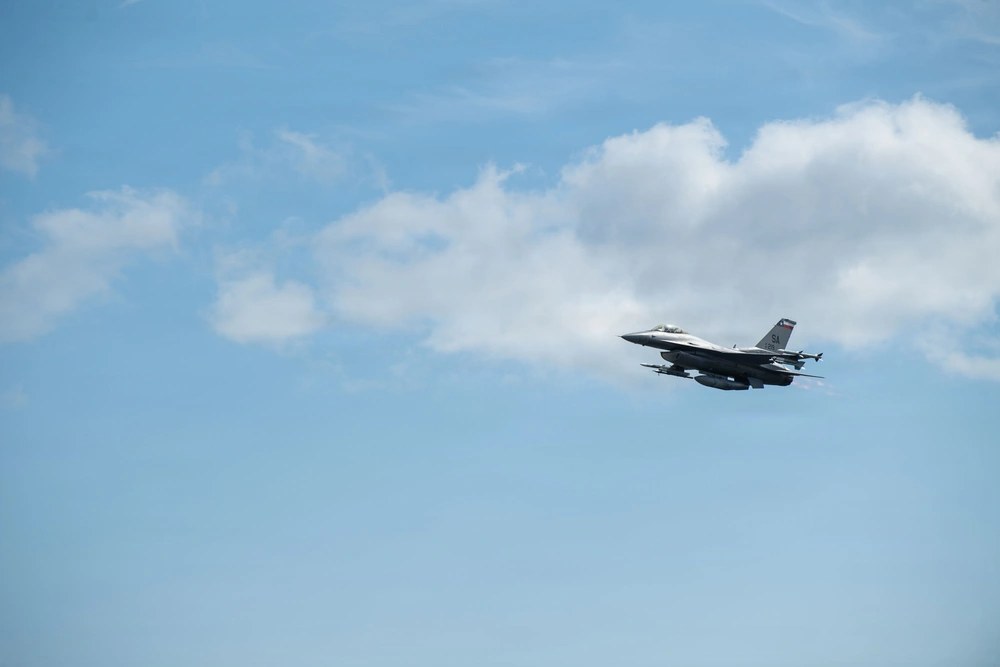
PHOTO CAPTION: Lt. Col. Matthew Morris flies an F-16 Fighting Falcon assigned to the Texas Air National Guard’s 149th Fighter Wing during Operation Northern Cactus at Alpena Combat Readiness Training Center, Michigan, Sept. 14, 2026. (Air National Guard photo by Tech. Sgt. Derek Davis)
A Texas Air National Guard F-16 Fighting Falcon crashed in northern Michigan Thursday afternoon during a training mission, forcing its pilot to eject and prompting authorities to evacuate homes and businesses within roughly a mile of the wreckage.
The aircraft was assigned to the 149th Fighter Wing, based at Joint Base San Antonio-Lackland, Texas, and was flying from the Alpena Combat Readiness Training Center when it went down near Traverse City on Sept. 17. The Texas Military Department confirmed that the pilot successfully ejected and that the accident is under investigation.
Michigan State Police later reported that the pilot was in stable condition at a local hospital and that no other injuries were known. Witnesses described seeing a large fireball and a towering column of black smoke after the aircraft struck a rural field. Nearby homes and a camper were not hit.
Initial radio traffic indicates investigators will likely examine the possibility of a bird strike.
Audio captured by LiveATC reportedly includes the pilot of the second F-16 telling air traffic control that his wingman may have struck a bird and would need to eject. The transmission is preliminary evidence, however, and military officials have not announced a cause for the crash.
The accident also created a hazardous-material response on the ground.
Michigan State Police ordered residential and business properties within a one-mile radius of County Road 633 and Blair Townhall Road evacuated because of what authorities described as a hazardous chemical spill associated with the crash. A temporary shelter was established for displaced residents. The evacuation order was lifted later Thursday evening.
F-16s use hydrazine, a highly toxic fuel in the aircraft's Emergency Power Unit. The system can provide emergency hydraulic and electrical power if normal aircraft systems fail. Authorities initially did not publicly identify the substance involved in the spill, although local reporting later identified hydrazine as having been released.
The Texas unit was in Michigan for Operation Northern Cactus, an annual training event designed to test the 149th Fighter Wing's ability to deploy personnel and aircraft, establish operations at an unfamiliar location and sustain missions away from its home station. Air National Guard imagery shows the wing conducting F-16 operations at Alpena in the days immediately before the crash.
All Texas Air National Guard aircraft participating in the training were grounded immediately following the accident, according to a U.S. official cited by ABC News.
The investigation into the loss of the aircraft remains ongoing.
(Source: OAF Nation)