DOE Appeals Hanford Worker Claims
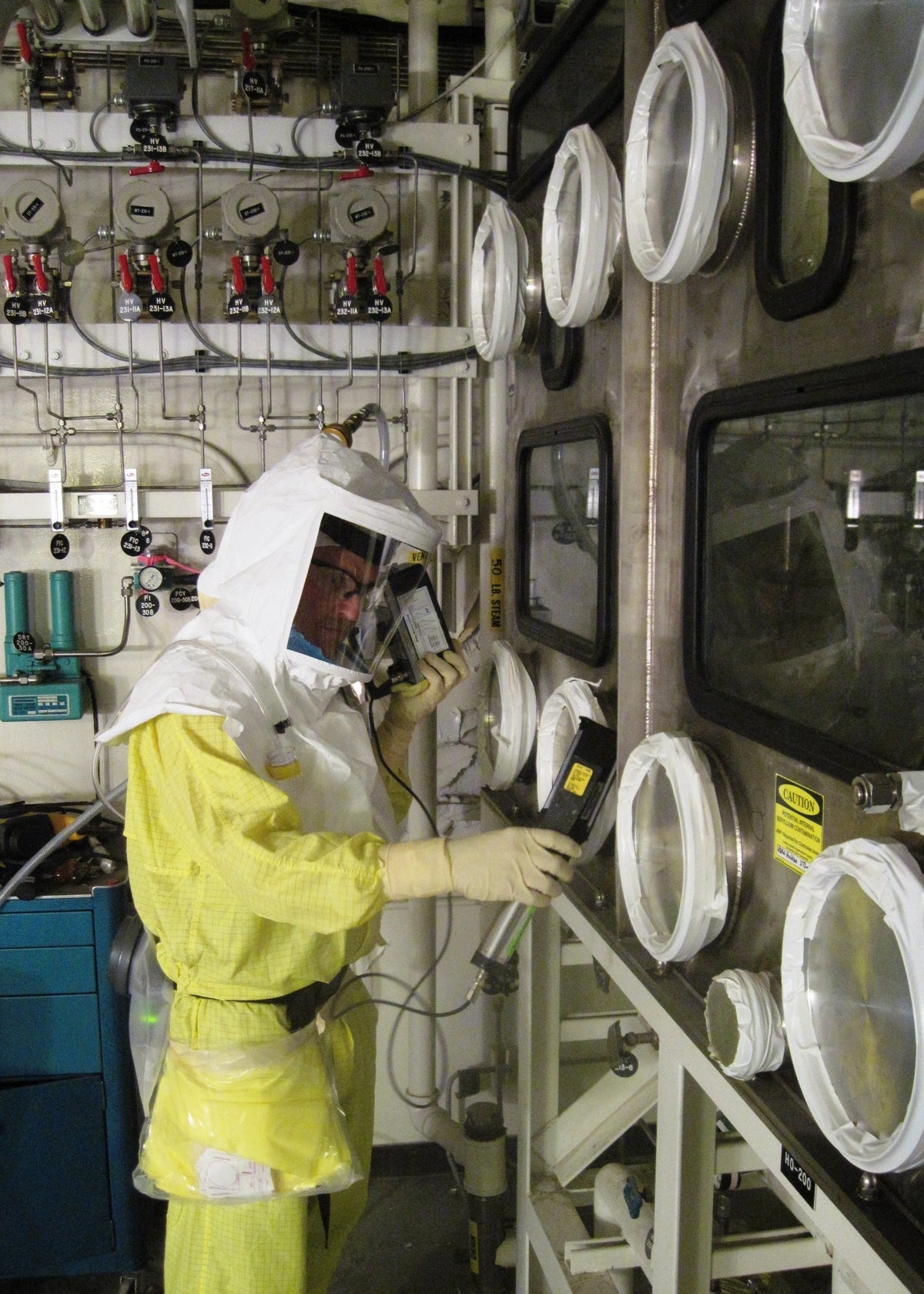
PHOTO CAPTION: A worker wearing protective clothing handles equipment during cleanup operations at the Hanford nuclear site in Washington state on July 29, 2010. An October 2026 investigation by ProPublica and Cascade PBS found that the Department of Energy has filed more than 500 appeals involving workers' compensation claims since 2018, including disputes involving workers who have died. The archival photograph does not identify a compensation claimant. (U.S. Department of Energy photo)
The U.S. Department of Energy has filed more than 500 appeals challenging workers' compensation claims involving people who became ill after working at Washington's Hanford nuclear site, including cases involving workers who have since died, according to a new investigation.
The department has also spent nearly $12 million on outside attorneys and medical experts to contest claims since 2018, according to records examined by ProPublica and Cascade PBS in reporting published October 22 and distributed with KUOW.
Approximately 152 claims approved by Washington state remain under appeal by the federal government. About half involve workers who have died, leaving surviving family members facing additional legal proceedings over benefits.
The findings raise questions about a compensation system that state lawmakers specifically redesigned to make it easier for nuclear workers suffering from certain illnesses to receive assistance.
More Than 500 Appeals Despite State Compensation Law
Hanford, located in southeastern Washington, produced plutonium for America's nuclear weapons program during World War II and the Cold War.
After weapons production ended, thousands of workers remained involved in cleaning up radioactive and chemically contaminated buildings, equipment, soil and underground waste tanks.
Some later developed cancer, neurological disorders, respiratory conditions and other serious illnesses they attributed to hazardous workplace exposure.
In 2018, Washington lawmakers approved legislation recognizing that certain conditions among Hanford workers should be presumed work-related for state workers' compensation purposes.
Previously, workers often faced the difficult task of establishing precisely how decades of exposure contributed to their illnesses.
Under the new law, qualifying workers with specified medical conditions receive a legal presumption that their illnesses resulted from their employment. That presumption can be challenged if sufficient contrary evidence exists.
The legislation was expanded in 2022 to cover qualifying workers at other radiological hazardous waste facilities in Washington, excluding specified military installations.
However, the recent investigation found that federal challenges continued despite the change.
DOE Recommended Denying Every Claim in Recent Review
Records examined by ProPublica and Cascade PBS show that 102 new claims were filed during the approximately three-and-a-half-year period beginning in 2023.
The Department of Energy did not recommend approving any of them.
Washington state ultimately approved approximately 75% of those claims. DOE then appealed all but seven of the approvals, according to the investigation.
The investigation also found that when the department challenged state-approved claims, the state appeals system ruled in workers' favor nearly nine times out of ten.
An individual claim can generate multiple appeals, sometimes concerning different aspects of compensation, medical findings or eligibility.
The federal government has the legal right to contest claims, and an appeal does not automatically prevent all benefits from being paid.
Nevertheless, workers and their attorneys argue that the volume and length of the disputes have created financial uncertainty for people already dealing with serious medical conditions.
Former Worker Faced More Than 20 Appeals
One of the workers profiled in the investigation is Lonnie Rouse, who spent nearly two decades handling plutonium and monitoring radioactive waste tanks at Hanford.
He developed a neurological illness that medical specialists associated with chemical exposure.
In 2010, the U.S. Department of Labor approved benefits under the federal Energy Employees Occupational Illness Compensation Program after determining that his work at Hanford had likely contributed to his condition.
But his separate Washington state workers' compensation case became a prolonged legal dispute.
State officials approved his claim in 2018. The Department of Energy challenged that decision and numerous related matters, filing more than 20 appeals over the course of the dispute.
DOE relied on experts who questioned his diagnosis and examined whether other factors could explain his illness.
Rouse now requires around-the-clock care.
According to his attorney, the department paid much of the back compensation owed to him in 2024. However, he remains concerned about the unresolved litigation and the possibility of having to repay benefits.
His case illustrates how receiving compensation through one federal program does not necessarily end a separate dispute over state workers' compensation.
Some Workers Died Before Their Cases Were Resolved
The investigation also documented the experience of Isidoro Mata Jr., who spent nearly 30 years demolishing buildings at Hanford.
Mata was diagnosed with thyroid cancer in 2015. Washington approved his compensation claim in 2019, but DOE appealed, questioning whether his illness was related to his work.
According to the reporting, Mata missed several legal proceedings because he was undergoing chemotherapy.
The department eventually withdrew its appeal in December 2020.
Mata died less than three months later.
His case is distinct from those still under appeal after a worker's death. Nevertheless, it illustrates how seriously ill employees can spend significant portions of their remaining lives navigating compensation disputes.
In other cases, surviving spouses and children continue legal proceedings to obtain benefits after their relatives have died.
Approximately half of the 152 state-approved claims still under appeal involve deceased workers, according to the news organizations.
Nearly $12 Million Spent on Attorneys and Experts
The investigation also examined how much the federal government has spent contesting workers' claims.
Records obtained through public information requests show that DOE paid nearly $10 million between 2018 and 2025 to the law firm Wallace, Mann, Capener, Bishop & Debney.
The department also paid more than $1.7 million to a group of physicians and an industrial hygienist who provided expert testimony in disputed cases.
Medical experts retained by DOE have examined alternative explanations for claimants' illnesses, including smoking, alcohol consumption, genetics and other health conditions.
The department maintains the legal right to introduce evidence rebutting the presumption that an illness is occupational.
Critics question whether the scale of litigation is consistent with the purpose of Washington's compensation legislation, particularly when independent state reviewers repeatedly uphold workers' claims.
Energy Department Defends Its Legal Compliance
The Department of Energy did not answer the news organizations' detailed questions about its appeals practices.
In a statement, the agency said it was following applicable laws and defended its record of protecting people and the environment.
The federal government has also previously challenged the legal framework governing Hanford compensation.
In 2022, the U.S. Supreme Court ruled that Washington's original compensation law improperly discriminated against the federal government by singling out Hanford-related employment.
Washington had already enacted a broader version of the law covering other radiological hazardous waste facilities.
Under the revised law, the presumption of occupational illness remains rebuttable. Evidence of alternative causes can be considered, but state law establishes a demanding standard for overturning the presumption.
That distinction is central to the current dispute. The question is not whether DOE has an absolute obligation to approve every claim, but how it exercises its legal right to challenge claims that state authorities have already accepted.
Washington Regulators Consider Further Action
Following questions from ProPublica and Cascade PBS, the Washington State Department of Labor and Industries met twice with DOE officials to discuss the pattern of appeals.
State officials said they were examining the seriousness of the findings.
Potential responses include additional monitoring, a corrective improvement plan or changes to DOE's authority to administer claims directly.
Washington Attorney General Nick Brown has also expressed concern over the department's persistent challenges to state-approved benefits.
No new statewide enforcement order resolving the dispute was announced in the October 22 investigation.
For now, workers and surviving families remain caught between a state compensation system that has approved their claims and a federal agency continuing to challenge some of those decisions.
The investigation highlights an unresolved question about accountability: whether a compensation system created to recognize occupational illness can provide timely relief when legal disputes continue for years, sometimes beyond the worker's lifetime.
(Source: OAF Nation)