Court Upholds Felon Gun Ban
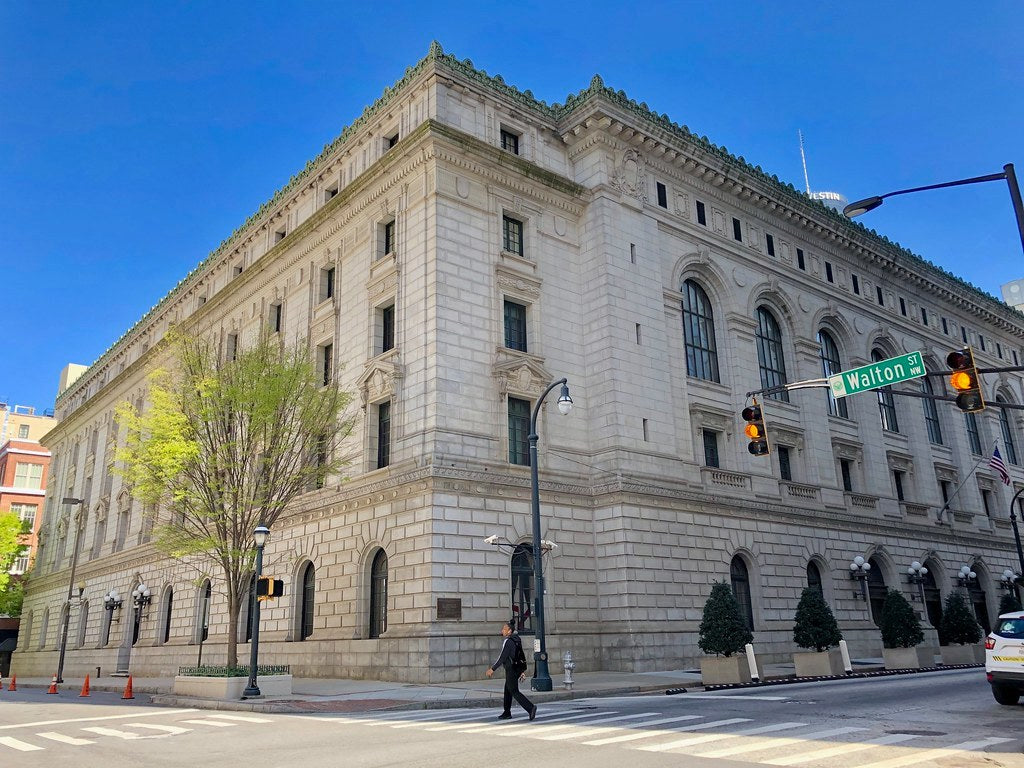
PHOTO CAPTION: Illustrative photo: The Elbert P. Tuttle U.S. Court of Appeals Building in Atlanta is home to the Eleventh Circuit, which on Sept. 23 affirmed Donald Patrick Parr's conviction after rejecting his Second Amendment challenge. Library of Congress photo by Carol M. Highsmith.
A man who was 69 when he was sentenced to 235 months in federal prison for possessing a .22 caliber revolver has lost his attempt to overturn the conviction on Second Amendment grounds.
The U.S. Court of Appeals for the Eleventh Circuit rejected Donald Patrick Parr's challenge Wednesday and affirmed his conviction for possession of a firearm by a convicted felon.
Parr argued that the federal law permanently prohibiting him from possessing a firearm was unconstitutional as applied to him.
His sentence amounts to 19 years and seven months in federal prison.
But Parr was not sentenced as an ordinary first time offender.
The district court sentenced him under the federal Armed Career Criminal Act after a jury found that he had committed three previous felony offenses on separate occasions.
The 235 month federal sentence was also ordered to run consecutively to a Florida sentence Parr was already serving.
The underlying case began when law enforcement officers arrested Parr on an outstanding warrant and searched his vehicle.
Authorities found a .22 caliber revolver inside.
According to the Justice Department, officers also found a little more than one gram of methamphetamine and a bag of marijuana.
Parr had previously been convicted of multiple felonies.
The Justice Department said his criminal history included convictions for possession of controlled substances with intent to distribute, making terroristic threats, aggravated fleeing and previously possessing a firearm as a convicted felon.
A federal jury found Parr guilty of the new firearm charge in May 2025.
Senior U.S. District Judge W. Louis Sands sentenced him on Sept. 25, 2025, to 235 months in prison followed by two years of supervised release.
There is no parole in the federal prison system.
Parr challenged the federal felon gun ban before trial, arguing that permanently disarming him violated the Second Amendment.
The district court rejected that argument.
He raised the issue again on appeal.
Parr relied on recent Supreme Court decisions that require firearm restrictions to be consistent with the nation's historical tradition of firearm regulation.
He argued that the government should not be able to permanently disarm an entire class of people unless they present a clear threat of physical violence.
Parr also argued that his own criminal history consisted primarily of drug offenses and did not demonstrate that he posed the type of threat necessary to permanently strip him of Second Amendment rights.
The Eleventh Circuit did not accept that argument.
In its Sept. 23 decision, the three judge panel said existing precedent within the circuit already foreclosed Parr's constitutional challenge.
The court pointed to previous decisions holding that the federal prohibition on firearm possession by convicted felons does not violate the Second Amendment.
The judges also noted that the Supreme Court has repeatedly described longstanding prohibitions on firearm possession by felons as presumptively lawful.
Parr argued that more recent Supreme Court decisions had changed the legal framework governing Second Amendment cases.
But the Eleventh Circuit said it had already considered that question in another case and concluded that those decisions did not overturn its earlier precedent involving convicted felons.
Because that precedent remains binding, the panel granted the government's request for summary affirmance.
The decision leaves Parr's conviction and 235 month federal sentence in place.
The case presents a much broader debate than the single .22 caliber revolver found in Parr's vehicle.
Parr's argument asked whether a person with felony convictions can permanently lose Second Amendment protections even after serving the sentences imposed for those earlier crimes.
For now, the Eleventh Circuit's answer remains that the federal prohibition is constitutional under the precedent binding the court.
Parr's nearly 20 year sentence also reflects more than the firearm found in his vehicle.
His prior criminal record qualified him for enhanced punishment under the Armed Career Criminal Act, and the federal sentence will not begin until after the Florida sentence the judge ordered it to follow.
(Source: OAF Nation)