Army Faces Scrutiny Over Kuwait Attack
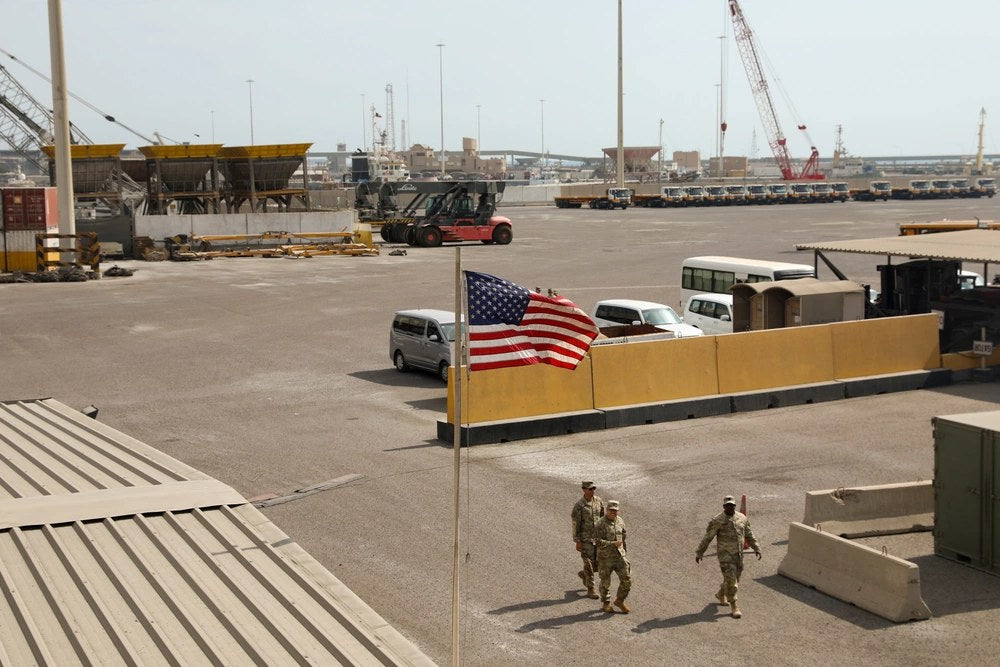
PHOTO CAPTION: Illustrative file photo: U.S. Army soldiers walk near an American flag at the Port of Shuaiba in Kuwait on Nov. 4, 2022. An Iranian drone strike at the port on March 1, 2026, killed six U.S. Army Reserve soldiers assigned to the 103rd Sustainment Command. U.S. Army National Guard photo by Spc. Ryan Scribner.
Army leaders had at least two plans to move a logistics unit farther from Iran before a drone strike killed six U.S. soldiers in Kuwait, but the unit's commanding general instead chose the location that was later attacked, according to new reporting from CBS News.
Multiple sources told CBS that Army planners had scouted and prepared relocation options in Saudi Arabia before the United States launched Operation Epic Fury.
The alternatives were presented to leadership of the 103rd Sustainment Command, an Army Reserve unit responsible for logistics operations supporting U.S. Central Command.
One option was Logistical Support Area Jenkins near Yanbu in western Saudi Arabia.
Another was Prince Sultan Air Base near Riyadh.
CBS reported that Brig. Gen. Clint Barnes instead supported moving the unit to the Port of Shuaiba in Kuwait.
On March 1, an Iranian drone struck the location.
Six U.S. Army Reserve soldiers were killed and more than 20 service members were wounded.
The six soldiers killed were Maj. Jeffrey O'Brien, Capt. Cody Khork, Chief Warrant Officer 3 Robert Marzan, Master Sgt. Nicole Amor, Sgt. 1st Class Noah Tietjens and Sgt. Declan Coady.
All six were assigned to the 103rd Sustainment Command.
The new reporting raises questions about why Port Shuaiba was selected.
Sources told CBS that Army intelligence had begun briefing Barnes in January that Port Shuaiba could be an Iranian target if the United States became more directly involved in military operations against Iran.
About a week before the war began, most U.S. Army and Air Force personnel stationed in Kuwait were moved to locations in Jordan and Saudi Arabia that were farther from Iran, according to CBS.
The sources said the two Saudi relocation options for the 103rd had also been planned before combat began.
Barnes instead chose Port Shuaiba.
The location had been used by the unit that preceded the 103rd during an earlier period of tensions with Iran in 2025.
One service member told CBS the circumstances were different at that time because Iran was not directly targeting U.S. positions.
The Army declined to comment on CBS's new reporting Thursday.
CBS said it also reached out to Barnes but had not received a response.
The new allegations have not been established as findings in a publicly released Army investigation.
U.S. Army Central and Third Army ordered an investigation into the March 1 attack to determine the facts and circumstances surrounding it.
The Army confirmed this month that the investigation was completed in early July, but the findings have not been made public.
The Army said it would not comment on individual accounts or leaked portions of the investigation while the review remains unreleased.
Previous CBS investigations have reported complaints from survivors and family members about force protection and medical resources at Port Shuaiba.
Jim and Stacey Khork, the parents of Capt. Cody Khork, told CBS that their son had raised concerns about the vulnerability of the location before he was killed.
CBS reported that Khork served as one of the unit's force protection officers.
Another officer who survived the attack, Maj. Stephen Ramsbottom, previously told CBS that he believed Master Sgt. Nicole Amor might have survived her injuries if the location had greater medical capability.
Ramsbottom said the site lacked a doctor and fixed aid station and had only one ambulance.
Witnesses previously told CBS that soldiers used improvised bandages, braces and tourniquets after the attack and used civilian vehicles to transport wounded personnel to Kuwaiti hospitals.
The Pentagon has pushed back against claims that adequate precautions were not taken.
Pentagon spokesman Sean Parnell said in March that every possible measure had been taken to protect U.S. troops and said the facility was protected by six foot walls.
There is also an important complication involving one of the relocation alternatives.
Prince Sultan Air Base, one of the Saudi locations that sources said had been considered, was also attacked by Iranian forces during the war.
CBS reported that the base suffered damage, including damage to a large Air Force aircraft, but no deaths were reported there.
That means the existence of another relocation option does not establish that moving the soldiers would necessarily have prevented casualties.
The new CBS reporting also does not establish that Barnes caused the deaths at Port Shuaiba.
What it adds is a previously unreported account of the decision making before the strike.
Sources say Army planners had identified alternatives farther from Iran, intelligence had warned that Port Shuaiba was a potential target, and Barnes nevertheless selected the Kuwaiti port.
The Army's completed investigation could provide a fuller account of why that decision was made and whether investigators found failures in planning, force protection or command decisions.
For now, those findings remain out of public view.
(Source: OAF Nation)