Court Says Gun Sales Protected
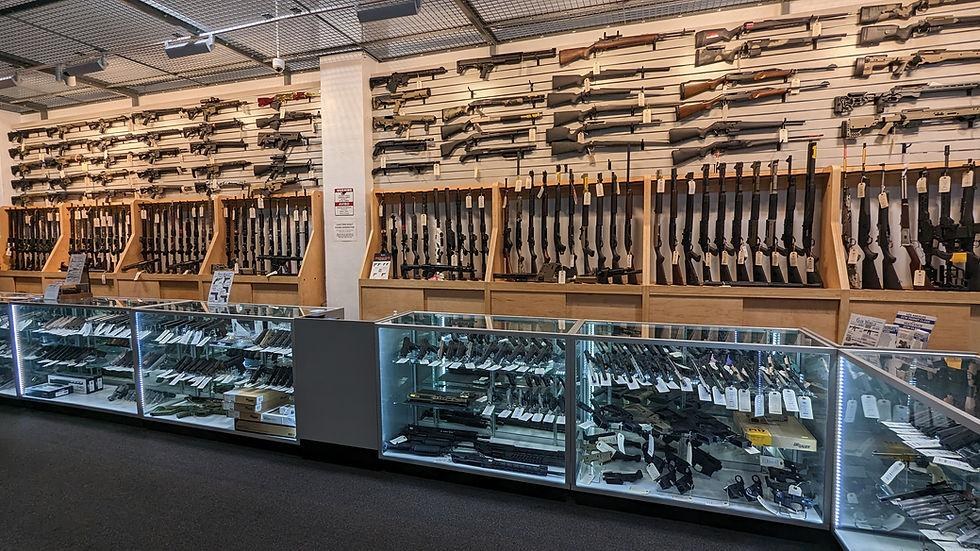
PHOTO CAPTION: Rifles displayed for sale at a firearms retailer in this April 2022 file photograph. A federal appeals court ruled November 19, 2026, that the Second Amendment protects commercial firearm sales. (Photo: Nenad Stojković / CC BY 2.0. Illustrative image.)
A federal appeals court has ruled that the Second Amendment protects more than the right to own and purchase firearms. It also covers their sale.
In a decision issued November 19, the U.S. Court of Appeals for the Fifth Circuit ruled that commercial firearm sales fall within the Second Amendment's protection, rejecting a lower court's conclusion that federal dealer licensing requirements do not implicate the constitutional right to keep and bear arms.
The decision in United States v. Deare sends a challenge to federal firearms licensing requirements back to a district court for further proceedings.
It does not eliminate those requirements or give individuals permission to operate unlicensed firearms businesses. But it establishes an important constitutional principle for future challenges involving firearm sales.
A Gun-Dealer Conviction Led to the Ruling
The case involves Jeremiah Micah Deare, who was prosecuted in Louisiana for conspiracy to engage in the business of dealing firearms without a federal firearms license and for making false statements involving licensed dealers' records.
Deare challenged the federal licensing and recordkeeping requirements under 18 U.S.C. § 922(a)(1), arguing that they violated the Second Amendment.
The district court rejected his constitutional challenge.
The judge reasoned that requirements governing firearm dealers did not interfere with an individual's right to keep or bear arms. The court also concluded that the restrictions were consistent with the nation's historical tradition of firearm regulation.
Deare was subsequently convicted by a jury and sentenced to 97 months in prison.
He appealed, bringing the constitutional question before the Fifth Circuit.
The Second Amendment Covers Sales, Court Says
The appeals court disagreed with the lower court's conclusion that firearm sales fall outside the Second Amendment.
The panel relied partly on its earlier decision in Reese v. Bureau of Alcohol, Tobacco, Firearms and Explosives, which recognized that the right to possess firearms necessarily involves the ability to acquire them.
The judges also noted that federal government attorneys conceded during oral arguments that the Second Amendment applies to commercial firearm sales.
The court concluded that selling firearms falls within the constitutional amendment's text.
That finding matters because it changes how courts must approach challenges to laws restricting firearm sales.
Rather than dismissing a challenge on the grounds that selling firearms receives no Second Amendment protection, courts must consider whether a particular restriction can be justified under the applicable constitutional framework.
Under the Supreme Court's 2022 decision in New York State Rifle & Pistol Association v. Bruen, the government generally must demonstrate that a firearm restriction affecting protected conduct is consistent with the nation's historical tradition of firearm regulation.
Judges Disagreed Over How Far That Protection Goes
The Fifth Circuit's judges did not agree on every aspect of the case.
Judge James Ho, writing separately in support of the judgment, compared the ability to sell firearms with the ability to sell books.
His reasoning was that constitutional protections would be weakened if the government could prohibit the transactions necessary for people to exercise their rights.
Judge Andrew Oldham, joined by Ho, went further in a separate opinion. He argued that restricting firearm sales can burden both the person selling a firearm and the person attempting to acquire one.
Oldham also questioned an earlier Fifth Circuit decision addressing firearms regulation and urged the lower court not to extend its reasoning to this licensing dispute.
Judge Catharina Haynes dissented.
Haynes argued that the Second Amendment protects keeping and bearing arms without necessarily extending the same protection to commercial sellers.
She also maintained that, even assuming firearm sellers were covered, Deare had not established that the licensing requirements were unconstitutional.
She would have affirmed the lower court's decision.
Does This Mean Anyone Can Sell Guns Without a License?
No.
The Fifth Circuit did not strike down the federal firearms dealer licensing law.
It also did not determine that the specific requirements challenged by Deare violate the Constitution.
Instead, the appeals court vacated the district court's order denying his motion to dismiss the indictment and returned the case for additional proceedings.
The distinction is important.
Federal law continues to require individuals who are engaged in the business of dealing firearms to obtain the appropriate federal license, subject to the law's applicable definitions and exceptions.
The court's ruling establishes that firearm sales receive Second Amendment protection. Whether the particular federal licensing restrictions are constitutionally permissible remains a separate question.
What Happens Next?
The case returns to the federal district court in Louisiana, where the constitutional challenge must be reconsidered in light of the appeals court's decision.
The Fifth Circuit covers Texas, Louisiana, and Mississippi. Its published decisions are binding precedent for federal district courts within that circuit unless superseded by higher authority or subsequent controlling precedent.
The ruling could also influence future disputes over firearms transactions and licensing elsewhere, although it does not establish a nationwide rule invalidating dealer regulations.
For gun owners, dealers, and Second Amendment advocates, the decision adds another piece to a developing body of law concerning not just possession of firearms, but access to them.
The Fifth Circuit has now recognized that the constitutional right to keep and bear arms extends to their sale.
How far that protection limits the government's authority to regulate firearm dealers is the question that remains.
(Source: OAF Nation)