Court Rules Trump's Guard Deployment Unlawful
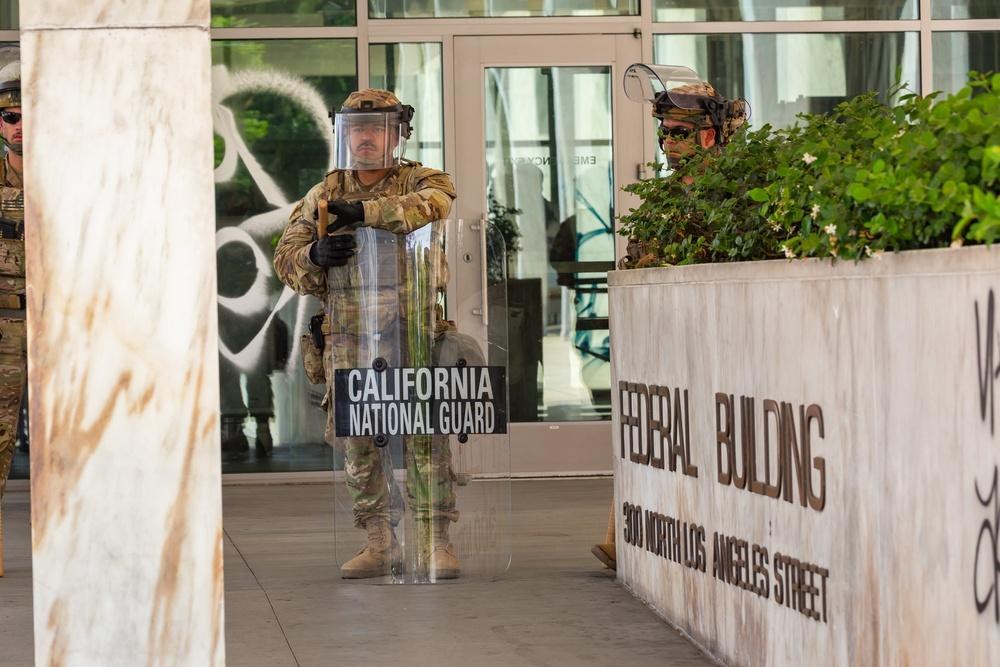
PHOTO CAPTION: California Army National Guard soldiers assigned to the 1st Battalion, 185th Infantry Regiment, protect federal personnel and property in Los Angeles on June 9, 2025, while serving under federal orders. On October 23, 2026, the Ninth U.S. Circuit Court of Appeals ruled that President Donald Trump exceeded his legal authority when he federalized approximately 4,000 California Guard troops during immigration enforcement protests. (U.S. Army photo by Capt. Alexander Werden)
A federal appeals court has ruled that President Donald Trump exceeded his legal authority when he took control of approximately 4,000 California National Guard troops and ordered them into Los Angeles during immigration enforcement protests in June 2025.
In a 2-1 decision issued Friday, October 23, the Ninth U.S. Circuit Court of Appeals upheld an injunction against the deployment, finding that the administration failed to establish the conditions required under federal law to place California's National Guard under federal control.
The majority included a judge appointed by Trump himself, while another Trump-appointed judge dissented.
The ruling addresses a central constitutional question: when can a president take control of a state's National Guard without the governor's consent?
Trump Federalized 4,000 Guard Troops During Immigration Protests
The dispute began in June 2025 after federal immigration enforcement operations triggered demonstrations across Los Angeles.
Some protesters clashed with federal officers, damaged property and attempted to interfere with immigration enforcement operations.
On June 7, Trump invoked 10 U.S.C. § 12406, a federal law permitting the president to call National Guard units into federal service under specified emergency conditions.
The administration initially activated approximately 2,000 California National Guard members before expanding the authorization to 4,000.
The troops were assigned to protect federal personnel and property, including facilities involved in immigration enforcement.
The administration argued that escalating violence and interference with federal operations justified the deployment.
California Gov. Gavin Newsom disagreed and challenged the federal takeover in court, arguing that the unrest did not meet the legal requirements for federalizing state troops.
Appeals Court Rejects Rebellion Justification
In the October 23 opinion, Judge Jennifer Sung wrote that the administration had not demonstrated that the conditions in Los Angeles amounted to a rebellion or danger of rebellion under the federal statute.
The court acknowledged incidents of violence against federal personnel and property.
However, the majority concluded that those incidents did not establish the type of organized resistance to federal authority required to justify federalizing the Guard under the rebellion provision.
The court relied partly on findings that local law enforcement agencies were responding to the disturbances and that much of the unrest involved sporadic violence rather than an organized uprising.
The majority also rejected the administration's separate argument that the federal government could not execute its laws using regular forces.
Under the relevant statutory provision, the court explained, the president must establish both a legal basis for using regular military forces to execute federal law and an inability to carry out that function using those forces.
The administration had not made the required showings, the judges concluded.
Because neither statutory justification applied, the majority found that Trump's original federalization order exceeded the authority Congress had granted the president.
The court concluded that the order also violated the constitutional separation of powers by encroaching on Congress's authority over calling state militia forces into federal service.
Trump-Appointed Judge Joins Majority
The ruling was written by Judge Jennifer Sung, who was appointed by President Joe Biden.
Judge Eric Miller, appointed by Trump, joined Sung's opinion and wrote a separate concurrence supporting the majority's legal analysis.
Judge Mark Bennett, another Trump appointee, dissented.
Bennett argued that the appeals court should not have decided the merits of the dispute after the administration sought to dismiss its appeal.
He also disagreed with the majority's treatment of the legal standards governing challenges to presidential authority and its conclusions involving constitutional protections for state governments.
His dissent emphasized that the case involved significant questions about executive authority that should not have been resolved through the procedural posture before the court.
The three judges' differing conclusions underscore the complexity of the legal dispute, which centers on statutory requirements and constitutional authority rather than an assessment of whether individual Guard members performed their duties appropriately.
Earlier Court Orders Produced a Complicated Legal Fight
The legal dispute has involved several separate rulings since the original deployment.
In June 2025, U.S. District Judge Charles Breyer issued an order blocking the federal takeover and directing the administration to return control of the Guard to California.
The Ninth Circuit initially stayed that order while the administration appealed, allowing the deployment to continue.
In September 2025, the district court separately restricted the use of deployed troops to execute civilian laws in violation of the Posse Comitatus Act. That issue became the subject of separate appellate proceedings.
The administration also issued additional orders extending the Guard's federalization beyond the original 60-day period.
In December 2025, Breyer issued another injunction against the continued federalization of California Guard troops.
The administration eventually sought to dismiss its appeals.
In its October 23 decisions, the Ninth Circuit allowed dismissal of the appeal involving the later extensions but refused to dismiss the appeal concerning the initial deployment.
That allowed the court to issue its published decision on the legality of Trump's original order.
The latest ruling does not represent a new deployment or the immediate withdrawal of 4,000 soldiers. It concerns the legal authority for the deployment ordered in 2025.
California Officials Welcome Decision
Newsom and California Attorney General Rob Bonta welcomed the ruling, describing it as an important limit on presidential authority over state military forces.
Newsom said the decision protected the constitutional system of checks and balances.
Bonta said the ruling confirmed that the president cannot federalize state Guard forces without satisfying the requirements established by Congress.
The administration had maintained during the litigation that federal troops were necessary to protect federal officers, facilities and immigration enforcement operations.
The dissenting opinion also raised concerns about the legal approach used to resolve the case.
The appellate ruling does not eliminate presidential authority to federalize National Guard troops during emergencies. Rather, it limits the use of that authority to circumstances authorized by federal law.
What the Decision Means for the National Guard
Under ordinary circumstances, National Guard forces operate under state authority, with governors serving as commanders in chief of their respective state forces.
Federal law also permits Guard units to be called into federal military service.
That distinction is central to the Guard's dual state and federal mission.
The October 23 decision clarifies that invoking emergency authority requires more than citing public disorder or interference with federal officers.
The federal government must satisfy the statutory conditions established by Congress.
Because the Ninth Circuit issued a published opinion, its interpretation may influence future legal disputes involving National Guard federalization within the circuit.
The administration can seek additional judicial review, potentially including review by the full Ninth Circuit or the U.S. Supreme Court.
For now, the October 23 ruling stands as a significant appellate rejection of the legal justification used for the 2025 California National Guard deployment.
(Source: OAF Nation)