Court Rules on Interstate Handgun Sales
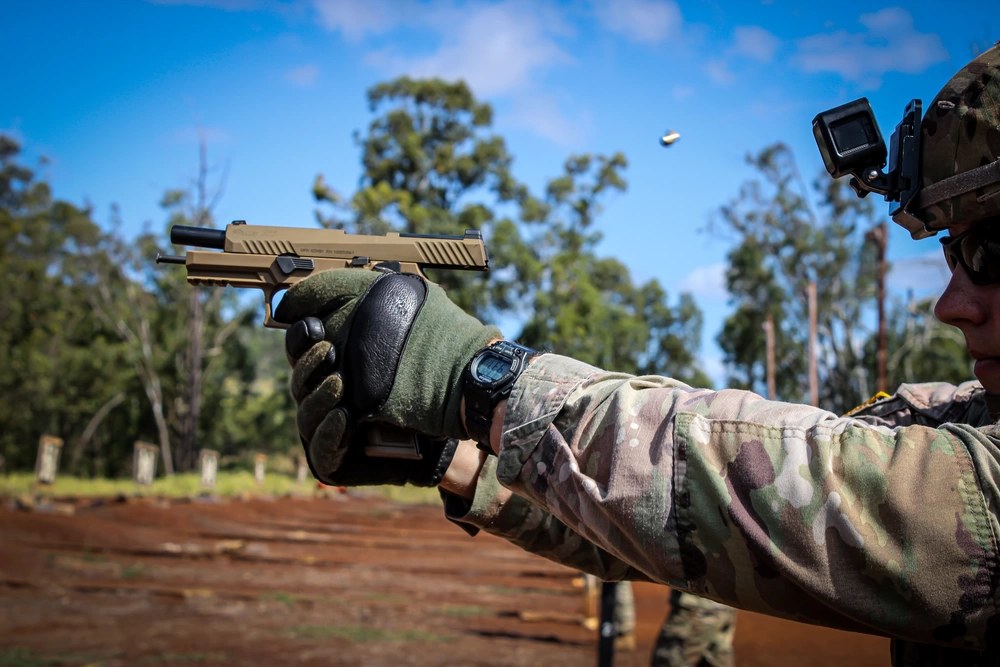
PHOTO CAPTION: Illustrative file photo — A U.S. Army soldier fires a Sig Sauer M17 handgun during weapons qualification in Hawaii in August 2020. The Fifth Circuit ruled Sept. 18, 2026, that federal restrictions on direct interstate handgun purchases violate the Second Amendment. (U.S. Army photo by 1st Sgt. Lekendrick Stallworth)
A federal appeals court has ruled that longstanding restrictions preventing Americans from directly purchasing handguns from licensed dealers outside their home state violate the Second Amendment.
The U.S. Court of Appeals for the Fifth Circuit issued the 2–1 decision Friday in Elite Precision Customs LLC v. ATF, reversing a lower court that had upheld the federal restrictions.
The case involved several provisions of 18 U.S.C. § 922 that, when applied together, generally prevent a federally licensed firearms dealer from directly delivering a handgun to someone who lives in another state.
Under the existing federal system, a person may purchase a handgun from an out-of-state dealer, but the handgun generally must first be shipped to a licensed dealer in the purchaser's home state. The buyer then takes possession through that dealer.
Rifles and shotguns have long had a broader exception. A licensed dealer may make an over-the-counter sale of a rifle or shotgun to an out-of-state resident when the transaction complies with applicable laws in both states.
The plaintiffs argued that forcing handgun buyers to use an additional dealer imposes extra costs and delays on otherwise lawful purchases.
One plaintiff, New Mexico resident Tim Herron, told the court that intermediary dealers typically charged him $30 to $40 to complete an out-of-state handgun purchase. Elite Precision Customs, a federally licensed dealer in Texas, said it wanted to sell handguns directly to customers from other states.
Writing for the majority, Judge Jerry E. Smith concluded that purchasing firearms falls within conduct protected by the Second Amendment and that the government had not identified a sufficiently comparable historical tradition supporting the modern restriction.
The majority held that the dealer-to-dealer transfer option did not save the law because direct interstate handgun purchases remained prohibited rather than simply regulated by a limited waiting period.
The court ultimately reversed the district court and rendered judgment for the plaintiffs.
Judge Catharina Haynes dissented. She said she agreed with the lower court that the provisions challenged in the case were not unconstitutional under the Second Amendment.
The decision also deepens an existing disagreement among federal appeals courts.
In its opinion, the Fifth Circuit expressly rejected reasoning used by the Second Circuit in a separate case that upheld substantially similar restrictions. The Supreme Court declined to review that Second Circuit case earlier this year.
The Fifth Circuit includes Texas, Louisiana and Mississippi, meaning the ruling establishes precedent for federal courts within those states.
But the decision should not be read as immediately eliminating every restriction on interstate firearm purchases nationwide.
State firearms laws still apply, other federal restrictions remain in force, and ATF's publicly available guidance as of Sept. 21 continues to say that an FFL generally cannot directly deliver a firearm to an out-of-state resident, except for qualifying rifle and shotgun transactions.
The government also retains procedural avenues to seek further review of the Fifth Circuit decision.
For now, the ruling represents a significant new Second Amendment decision concerning not whether a person may possess a handgun, but where a lawful buyer may purchase one and take possession of it.
(Source: OAF Nation)