Court Rules on Capitol Protest Access
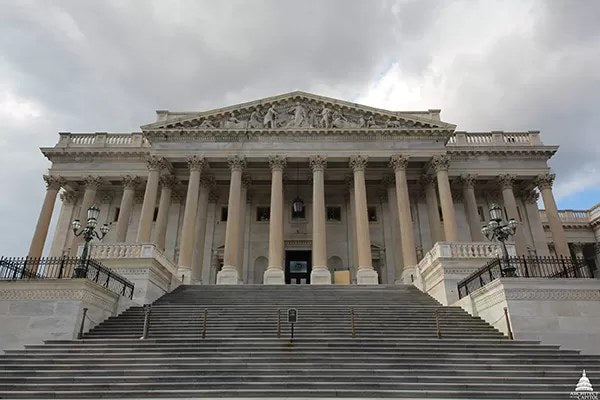
PHOTO CAPTION: Illustrative photo: The East Front steps of the U.S. Capitol in Washington. A federal appeals court ruled Sept. 22 that public demonstrations on the Eastern Steps cannot be conditioned on sponsorship from a member of Congress. Architect of the Capitol photo.
A federal appeals court has ruled that the government cannot make a person's ability to demonstrate on the eastern steps of the U.S. Capitol depend on getting a member of Congress to sponsor the event.
The U.S. Court of Appeals for the District of Columbia Circuit issued the ruling Sept. 22 in a First Amendment case brought by Reverend Patrick Mahoney, a Presbyterian minister who wanted to hold small prayer vigils and demonstrations on the Capitol steps.
Under Capitol Police Board regulations, members of the public generally could not demonstrate on the Eastern Steps.
But there was an exception.
A member of Congress could sponsor a demonstration there as long as the lawmaker acted in an official capacity and personally attended the event.
That meant a member of the public who could secure congressional sponsorship could participate in a demonstration on the steps, while someone without that political support could be prohibited from holding even a small demonstration in the same location.
Mahoney challenged that arrangement.
He had previously been arrested in August 2021 after organizing a demonstration with five other people on the steps and said he wanted to return for prayer vigils and political advocacy.
Without congressional sponsorship, however, he faced potential criminal penalties if he proceeded.
A federal district court previously sided with Mahoney and ruled that the restrictions violated the First Amendment.
The Capitol Police Board appealed.
The appeals court agreed with Mahoney that the congressional sponsorship system was unconstitutional, although the judges disagreed about exactly how the Capitol steps should be treated under First Amendment law.
Writing for the court, Judge Neomi Rao concluded that the Eastern Steps are a nonpublic forum because they serve as an entrance to the Capitol for lawmakers and staff.
That classification gives the government greater authority to regulate activity there.
But even in a nonpublic forum, the court said restrictions on speech must still be reasonable.
The sponsorship system failed that test.
The court noted that the rules could prohibit a small public demonstration while allowing a much larger demonstration at the same location if a member of Congress agreed to sponsor it.
Members of Congress were given broad discretion to decide which demonstrations they would support.
The court concluded that public access to demonstrate outside Congress could not depend on obtaining the approval of a lawmaker.
The judges emphasized that the ruling does not prevent Capitol authorities from imposing reasonable security restrictions.
The government can regulate access to the Capitol, protect entrances, maintain pedestrian traffic and provide lawmakers and staff with special access needed to perform their work.
What it cannot do, the court concluded, is use congressional sponsorship as the deciding factor in determining whose demonstration is allowed.
The case concerns the lower portion of the Eastern Steps, rather than every location throughout the Capitol complex.
There is also another significant limitation to the decision.
The district court had issued an injunction preventing enforcement of the challenged rules against anyone who wanted to demonstrate on the lower Eastern Steps.
The appeals court vacated that universal injunction.
The judges cited a 2025 Supreme Court decision limiting the ability of federal district courts to issue injunctions extending beyond the parties before them.
The case was sent back to the district court to determine the proper scope of relief for Mahoney.
Senior Circuit Judge Judith Rogers disagreed with the majority's conclusion that the Eastern Steps should be classified as a nonpublic forum.
She argued that their history of demonstrations and previous court rulings supported treating them as a traditional public forum with stronger First Amendment protection.
But Rogers also agreed that the special exception allowing demonstrations backed by members of Congress could not survive constitutional review.
The result leaves Capitol authorities free to adopt reasonable rules addressing security and access while rejecting a system in which a member of Congress effectively serves as the gatekeeper for public demonstrations on the Eastern Steps.
(Source: OAF Nation)