Congo Court Sentences 66 Soldiers to Death
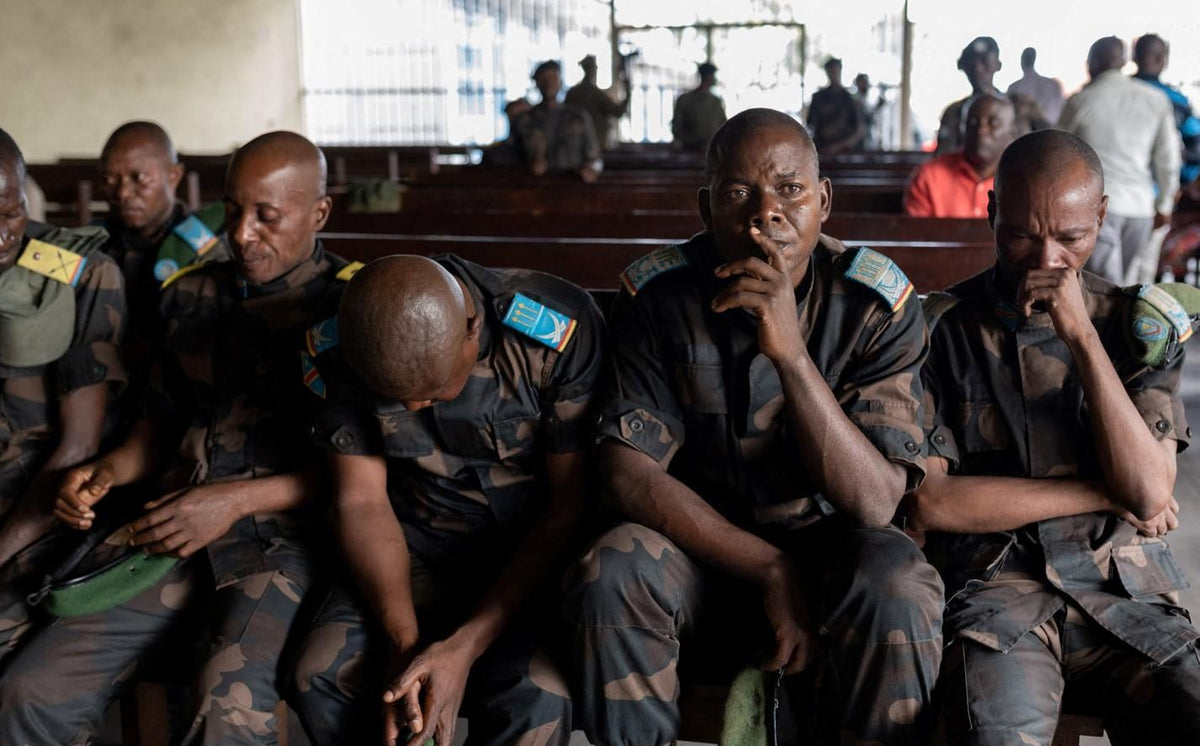
PHOTO CAPTION: Congolese soldiers from the 3415th Infantry Regiment appear before a military tribunal in Walikale, North Kivu, in October 2026. On November 6, a military court sentenced 66 members of the regiment to death for offenses including cowardice, military revolt and disobeying orders. Four others were acquitted and one received a 10-year prison sentence. (Photo via Radio Okapi, third-party rights.)
A military court in the Democratic Republic of the Congo has sentenced 66 soldiers to death following a 12-day trial involving accusations of cowardice in the face of the enemy, military revolt and refusing to obey orders.
The verdict was handed down late Friday, November 6, in Walikale, a conflict-affected territory in the eastern province of North Kivu.
All 66 condemned soldiers belonged to the Congolese army's 3415th Infantry Regiment.
Four other soldiers were acquitted, including a captain responsible for regimental intelligence, while a sergeant received a 10-year prison sentence after the court considered mitigating circumstances.
The sentences were confirmed by the Congolese military and reported by the Congolese Press Agency and Radio Okapi, a United Nations-supported broadcaster.
The ruling comes as Congolese government forces continue fighting armed groups in the country's eastern provinces, where military discipline and battlefield withdrawals have become increasingly contentious issues.
Soldiers Accused of Cowardice and Refusing Orders
According to Maj. Dieudonné Kasereka, spokesman for the Congolese military's 34th Military Region, the defendants faced several military offenses.
These included cowardice before the enemy, military revolt and refusal to obey orders.
Radio Okapi also reported allegations involving the misuse or disappearance of military ammunition.
The soldiers were arrested following incidents in October involving members of the 3415th Regiment operating in Walikale territory.
The military tribunal began hearing the case on October 26.
The proceedings were initially expected to last 10 days but continued for 12 before the court delivered its verdict.
The military said the trial was part of an effort to reinforce discipline among troops conducting operations in eastern Congo.
However, publicly available reporting does not establish the precise conduct attributed to every soldier who received a death sentence.
It also does not establish that every defendant was individually convicted of every offense initially alleged.
A Deadly Confrontation Between Soldiers and Military Police
Earlier reporting reveals that the case involved more than allegations of soldiers fleeing combat.
On October 20, a confrontation occurred in the village of Ntoto, in North Kivu's Walikale territory.
According to local reporting by Actualite.cd, soldiers arriving from the front attempted to pass through the village.
Military police reportedly tried to prevent them from continuing, leading to a confrontation between the two groups.
Gunfire followed.
Actualite.cd reported that one soldier and one civilian were killed, while another soldier and civilian were seriously wounded.
Radio Okapi separately reported that incidents connected to the investigation had resulted in two military deaths and one civilian death.
Those accounts differ on the total number of fatalities, and the publicly available evidence does not fully reconcile them.
Following the incidents, military authorities detained soldiers from the 3415th Regiment.
The first group of defendants numbered 54. Additional arrests and transfers expanded the proceedings.
During the investigation, the military also pursued allegations including murder, abandoning military positions and violating military instructions.
The available reporting does not establish which defendants, if any, were individually found responsible for the fatal shootings.
Four Acquitted, One Given 10 Years
The Goma Garrison Military Court conducted the proceedings in Walikale rather than at its usual location in Goma.
Military authorities said 66 soldiers were sentenced to death when the verdict was delivered November 6.
A sergeant received 10 years of imprisonment after the court recognized substantial mitigating circumstances.
Four defendants were acquitted, including the officer responsible for intelligence within the regiment.
Earlier reports placed the number of defendants at 71, while some subsequent accounts described 70. The reported individual outcomes account for 71 defendants.
The publicly released accounts do not fully explain that discrepancy.
The November 6 judgment was delivered by a court of first instance.
As of November 9, the reporting reviewed for this article had not established whether the condemned soldiers had filed appeals or when further proceedings might occur.
No executions resulting from the verdict have been confirmed.
Congo Has Previously Sentenced Soldiers to Death for Battlefield Conduct
The mass sentencing is not an isolated example of Congolese military courts imposing capital punishment during the country's continuing security crisis.
In October 2026, another military court sentenced 27 members of Congo's Republican Guard to death over accusations involving cowardice and violations of military orders.
Those proceedings followed allegations that troops had abandoned positions while fighting armed groups in eastern Congo.
In September, a separate case involving members of the same 3415th Regiment resulted in death sentences for two soldiers convicted in connection with the killing of a military officer.
The continued use of capital punishment has raised questions about the country's approach to military discipline during wartime.
Congo maintained a long-standing moratorium on executions before its government announced in March 2024 that it would lift restrictions on carrying out death sentences in certain cases.
Death sentences and actual executions are separate legal developments, and the existence of a capital sentence does not establish that an execution has occurred.
How Far Can Military Discipline Go?
Military organizations depend on personnel following lawful orders, maintaining positions and functioning under extreme pressure.
Abandoning a position during combat can expose fellow soldiers and civilians to danger.
Military revolt and violence within a unit can also threaten operations far beyond the individuals immediately involved.
Those concerns help explain why military authorities treat certain offenses as particularly serious in wartime.
But capital punishment for military misconduct raises difficult questions about proportionality, the reliability of evidence and whether individual circumstances have been adequately considered.
A soldier refusing a lawful order, a soldier abandoning a position under fire and a soldier refusing an unlawful order present fundamentally different legal and ethical situations.
The available reporting on the Walikale case does not establish whether any of the defendants argued that their orders were unlawful or impossible to carry out.
It also provides limited information about their defense, the evidence considered against each individual and the court's reasoning for imposing the death penalty on such a large group.
Those unanswered questions are especially important when the punishment is irreversible.
What Happens Next?
The fate of the 66 condemned soldiers remains uncertain.
The military court has issued its judgment, but no confirmed execution date or completed appellate process has been reported.
The full written judgment has not been made available in the sources reviewed, limiting independent assessment of the evidence supporting individual convictions.
Congolese military officials have presented the proceedings as a demonstration that serious breaches of discipline will face consequences during ongoing operations.
The verdict also highlights a fundamental distinction in military justice.
Armed forces require discipline, but the question of whether misconduct warrants imprisonment, discharge or execution depends on the specific acts committed, the governing law and the fairness of the proceedings.
For 66 Congolese soldiers, those questions now carry the possibility of the ultimate punishment.
(Source: OAF Nation)