Camp Lejeune Toxic Water Trial Begins
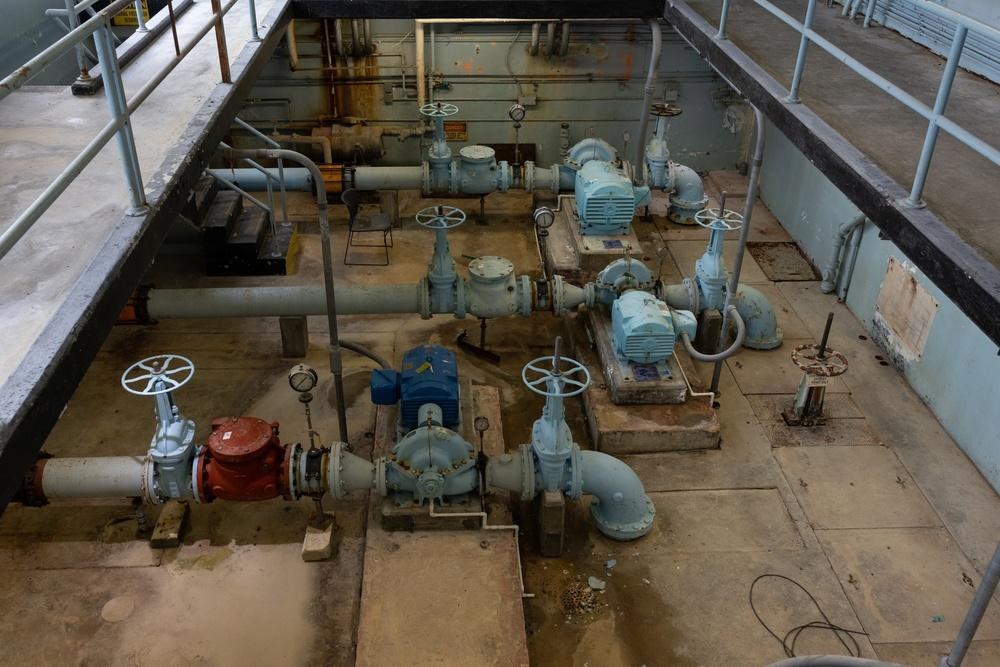
PHOTO CAPTION: Pipes and pumping equipment at the Hadnot Point Water Treatment Facility aboard Marine Corps Base Camp Lejeune, North Carolina, in April 2024. The first trial under the 2022 Camp Lejeune Justice Act was scheduled to begin October 26, 2026, as thousands of claims involving historic drinking water contamination remain unresolved. (Illustrative file photo by Cpl. Jennifer E. Douds / U.S. Marine Corps)
More than four years after Congress created a path for Camp Lejeune water contamination victims to seek compensation, the first federal trial under the landmark law was scheduled to begin Monday, marking a major step in litigation involving more than 400,000 claims.
The case centers on former Marine Frank Mousser, who developed kidney cancer after serving at the North Carolina military installation.
His case was scheduled to begin October 26 before U.S. District Judge Terrence Boyle in the Eastern District of North Carolina. Public Radio East reported Monday morning that the first trial was getting underway.
It is the first test case under the Camp Lejeune Justice Act, which Congress passed in August 2022 to allow veterans, family members and others exposed to contaminated water at the base to seek damages from the federal government.
No verdict or compensation award has been independently confirmed.
Former Marine's Kidney Cancer Case Is First to Reach Trial
Mousser's case is one of four early kidney cancer cases selected to test significant legal and scientific questions in the massive federal litigation.
Unlike a traditional civil jury trial, Mousser's case will be decided by a federal judge.
The court previously ruled that the Camp Lejeune Justice Act does not provide a right to a jury trial, meaning Judge Boyle will evaluate the evidence and determine whether the government is liable.
A central issue is whether Mousser's exposure to contaminated drinking water caused his kidney cancer.
The government's attorneys have challenged aspects of the scientific evidence, arguing that certain research does not establish a statistically significant increase in kidney cancer incidence among exposed populations.
Other federal research has identified associations between exposure to Camp Lejeune water contaminants and increased cancer risks, including kidney cancer.
The Agency for Toxic Substances and Disease Registry has concluded that historical exposure to contaminants in Camp Lejeune drinking water likely increased the risk of several cancers and other serious health problems.
The court must evaluate the evidence relevant to Mousser's individual claim rather than simply determine whether the contamination was dangerous.
More Than 400,000 Claims Have Been Filed
The first trial comes amid an enormous backlog of compensation claims.
More than 400,000 administrative claims have been filed under the Camp Lejeune Justice Act, according to reporting by Public Radio East.
The Justice Department reported that, as of September 18, it had extended more than $1.1 billion in settlement offers and paid out more than $879 million.
Those payments were made through administrative and negotiated settlement procedures rather than through verdicts in the first test trials.
Thousands of claims remain unresolved.
North Carolina Democratic Rep. Deborah Ross, who supported the original legislation, has expressed concern about the limited federal court capacity available to handle the litigation.
All lawsuits under the Camp Lejeune Justice Act must be brought in the Eastern District of North Carolina.
The first trials are expected to help establish how judges evaluate the evidence and what compensation might be available in cases that proceed beyond settlement negotiations.
However, a decision in one case would not automatically resolve every other claim.
Decades of Toxic Water Exposure
The litigation stems from decades of contaminated drinking water at Marine Corps Base Camp Lejeune.
Federal health investigators identified industrial solvents and other chemicals in water systems serving portions of the installation.
The contaminants included trichloroethylene, tetrachloroethylene, benzene and vinyl chloride.
According to the Agency for Toxic Substances and Disease Registry, contamination in the Hadnot Point system originated from several sources, including leaking underground storage tanks, industrial spills and waste disposal sites.
The Tarawa Terrace water system was primarily contaminated by chemicals associated with an off-base dry cleaning business.
The Marine Corps discovered volatile organic compounds in drinking water in 1982, and the most heavily contaminated wells were shut down by February 1985.
The Camp Lejeune Justice Act allows eligible individuals exposed during the period from August 1953 through December 1987 to pursue compensation for qualifying injuries.
For many veterans and family members, the illnesses emerged years or decades after their time at the installation.
October 30 Deadline Approaches for Broader Settlement Talks
The trial also comes as attorneys representing claimants and the federal government work toward a broader settlement framework.
The court established October 30 as a target date for progress toward a potential global resolution.
On October 23, the Plaintiffs' Leadership Group filed a motion asking the court to require a census of claimants with 25 specified diseases and medical conditions.
The proposed categories include kidney cancer, bladder cancer, Parkinson's disease, leukemia, multiple sclerosis, certain birth defects and other serious illnesses.
The group argues that identifying affected claimants could support negotiations involving large numbers of unresolved cases.
However, the proposal has not been approved as a settlement framework.
The list of 25 conditions does not create new compensation eligibility or guarantee payments.
The Justice Department has separately asked the court to require plaintiffs to provide additional evidence of their exposure, diagnosis and the connection between the two.
The government's proposed procedure, known as a Lone Pine order, is intended to help evaluate claims before they proceed further in litigation.
The competing proposals illustrate the difficulty of resolving hundreds of thousands of claims while evaluating the circumstances of individual plaintiffs.
Additional Trials Scheduled
Three other plaintiffs, David Fancher, Jacqueline Tukes and David Downs, have been identified for early kidney cancer trials.
Fancher's case is scheduled to be the next trial in November, while the remaining cases are part of the initial group selected for judicial consideration.
Their outcomes could help shape future litigation and negotiations, but individual cases may involve different histories of exposure, medical evidence and other factors.
For now, Mousser's case represents an important procedural milestone after years of legal disputes and administrative processing.
The first trial will test how the federal courts apply a law intended to provide compensation to people harmed by one of the most consequential drinking water contamination incidents in U.S. military history.
For the many claimants still awaiting decisions, the next significant developments will be the court's findings and whether the parties can make progress toward a broader settlement agreement.
(Source: OAF Nation)