Blood Markers Linked to Air Force Success
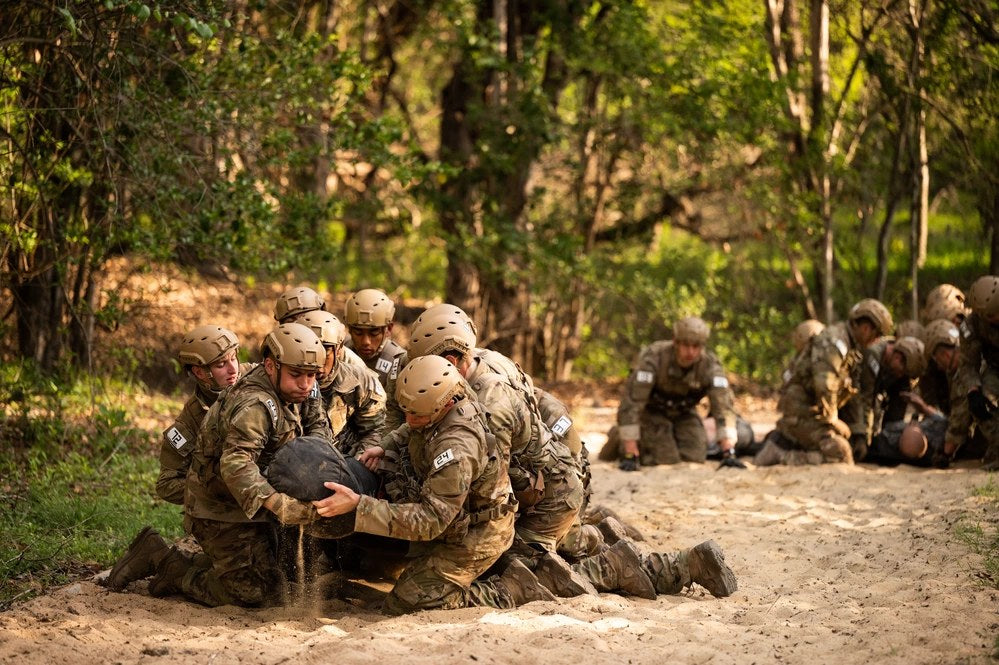
PHOTO CAPTION: Air Force Special Warfare candidates maneuver an obstacle course during Assessment & Selection at Joint Base San Antonio-Lackland, Texas, March 14, 2023. U.S. Air Force photo by Miriam Thurber.
Routine bloodwork may provide clues about which Air Force Special Warfare candidates are more likely to complete Assessment and Selection, according to new military research involving 484 trainees.
Researchers with the Air Force Special Warfare Human Performance Squadron examined blood samples, fitness measures and training outcomes among candidates undergoing Special Warfare Assessment and Selection, or SWAS. Of the 484 candidates studied, 239 graduated, 132 voluntarily left the course and 113 departed for other reasons.
The researchers were looking for biological and physical characteristics associated with completing one of the Air Force’s most demanding selection programs.
Air Force Special Warfare Assessment and Selection is an intensive four-week course used to evaluate candidates pursuing careers including pararescue, combat control and special reconnaissance. Candidates are assessed under demanding physical and psychological conditions, including obstacle courses, swimming and water-confidence events.
Researchers collected routine laboratory measurements including calcium, lymphocyte count, globulin and albumin, along with information about candidates’ training background and 1.5-mile run performance.
One statistical model combined four factors: whether a candidate entered the pipeline directly from Basic Military Training or through another pathway, along with calcium, lymphocyte and globulin measurements.
Candidates matching all four characteristics in the researchers’ favorable profile had 15.7 times the adjusted odds of graduating compared with the study’s reference group. The confidence interval around that estimate was wide, ranging from about 6.1 to 40.2, reflecting uncertainty around the exact size of the association.
Individually, entering through the lateral pathway, having higher calcium levels, higher lymphocyte counts and lower globulin levels were each independently associated with graduation in the model.
The researchers also examined physical fitness. Candidates entering laterally and those with faster 1.5-mile run times were more likely to graduate, and the combination was associated with roughly nine times the adjusted odds of graduation compared with the reference profile.
A companion analysis involving the same 484 candidates looked more closely at injury and immune and nutritional markers.
That analysis found that candidates with no prior injury, faster run times and higher albumin levels each had lower injury risk. Candidates who had all three characteristics had a 74% lower injury hazard during selection than the reference group used in the analysis.
Researchers also found that previous illness during Basic Military Training was associated with higher globulin and lower albumin levels. They said the pattern suggests that immune and nutritional status may be connected with fitness, injury risk and the ability to withstand the demands of Special Warfare training.
The findings do not mean a routine blood test can determine whether an Airman will succeed in Special Warfare.
The study found statistical associations, not proof that changing calcium, lymphocyte, globulin or albumin levels would cause a candidate to graduate. One of the strongest predictors in the 16-fold model was also the candidate’s entry pathway, meaning the result cannot be attributed to blood biomarkers alone.
Researchers said the findings could eventually help identify trainees who may benefit from interventions involving nutrition, immune health or physical conditioning before entering selection.
The results were published in the official abstract collection for the 2026 Military Health System Research Symposium, held Aug. 3-6. The work is currently reported as conference research rather than a full peer-reviewed clinical study, meaning additional publication, validation and replication would strengthen the evidence before the findings are used to guide individual training or medical decisions.
Source: 2026 Military Health System Research Symposium abstracts MHSRS-26-5336 and MHSRS-26-4243, Special Warfare Human Performance Squadron.
(Source: OAF Nation)