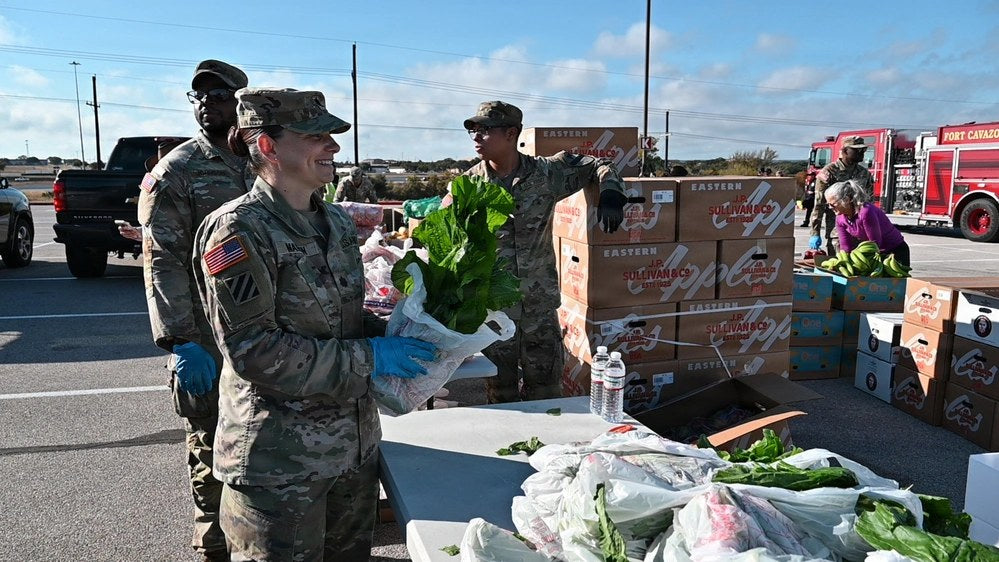
Army Families Face Food Insecurity
PHOTO CAPTION: U.S. Army soldiers prepare fresh groceries for military families during a food distribution event at Fort Hood, Texas, on November 13, 2025. A new investigation published October 20, 2026, documents active-duty soldiers relying on food assistance as military families struggle with rising living expenses. (U.S. Army photo by Janecze Wright)
Active-duty soldiers are turning to food pantries to help feed their families, according to a new investigation documenting financial hardship among troops stationed at one of the Army's largest installations.
The Guardian reported Tuesday that soldiers at Fort Hood, Texas, are regularly seeking free groceries from the Armed Services YMCA and other local organizations, even while receiving military pay and housing allowances.
The investigation comes as new survey findings reveal a substantial disparity between enlisted and officer families struggling to afford food.
A 2025 Military Family Advisory Network survey found that 57% of enlisted-family respondents experienced food insecurity, compared with 13.7% of officer-family respondents.
The findings do not mean that 57% of all enlisted families nationwide are food insecure. They reflect the experiences of families participating in the survey.
Soldiers Working Full Time Still Need Food Assistance
One Army sergeant interviewed by The Guardian described visiting a food pantry twice monthly to reduce his grocery expenses by approximately $200.
The 39-year-old combat engineer, whose name was changed in the original reporting, said his military income was insufficient to comfortably cover housing, groceries, transportation and expenses associated with raising his children.
His monthly rent exceeded his housing allowance, requiring him to make up the difference from other income.
Another soldier, 21-year-old Army supply specialist Becky Maurer, described seeking assistance despite both her and her husband serving on active duty.
The couple faced mounting childcare costs while preparing for the birth of another child.
Their experiences illustrate how military compensation, housing expenses and family responsibilities can combine to strain even households with steady employment.
Food Pantry Distributed 500,000 Pounds in One Year
The Armed Services YMCA serving the Fort Hood community distributed approximately 500,000 pounds of food to more than 19,000 families in 2025, according to figures provided to The Guardian by the organization's local leadership.
Approximately 80% of the pantry's customers are active-duty military personnel and their families.
The organization reported growing demand for food assistance, with annual increases ranging from 12% to 19% in recent years.
The pantry sometimes exhausts its available supplies before its scheduled closing time.
The demand is not limited to one installation.
Military families across the country rely on food banks, charitable assistance programs and emergency grocery distributions, particularly during moves, deployments and periods of financial disruption.
Survey Finds Major Divide Between Enlisted and Officer Families
The Military Family Advisory Network's 2025 Military Family 360 survey collected responses from 10,089 military-connected participants between October 2, 2025, and January 16, 2026.
The organization released its findings in June 2026.
Among enlisted-family respondents, 57% reported low or very low food security, compared with 13.7% of officer-family respondents.
Across currently serving military-family respondents, the rate was 47.2%.
The report also found that 59.3% of active-duty family respondents spent more on housing and utilities than their Basic Allowance for Housing covered.
More than one-third of currently serving family respondents reported having less than $500 in emergency savings or no emergency savings at all.
The survey used an established federal food-security measurement, but the percentages describe participating families rather than a census of every military household.
The survey period also overlapped with the 2025 federal government shutdown, which researchers identified as a possible influence on financial stress and participation.
Congressman Questions Use of $2.6 Billion in Housing Funds
The new reporting has also renewed attention to how the Pentagon distributed billions of dollars Congress originally approved for supplemental military housing allowances.
In July 2025, Congress appropriated $2.9 billion to supplement the Basic Allowance for Housing.
In December 2025, the Trump administration announced one-time payments of $1,776 to approximately 1.45 million eligible service members.
Those payments, called the Warrior Dividend, were financed through the housing appropriation, according to the Treasury Department and Internal Revenue Service.
The payments were tax-free and generally available to qualifying active-duty personnel through the rank of colonel or Navy captain, along with eligible reserve-component members.
Republican Rep. Don Bacon of Nebraska, a military veteran and member of the House Armed Services Committee, criticized the decision in comments published Tuesday.
Bacon argued that Congress had intended the money to provide more targeted assistance to service members facing housing-allowance shortfalls.
Instead, the administration distributed much of the funding as equal one-time payments.
Supporters of the payments emphasized that the money went directly to military personnel, providing immediate financial assistance.
The disagreement concerns whether the appropriated funds would have been more effective if targeted toward households facing higher housing costs.
The Warrior Dividend was distributed in December 2025, not as part of a new decision this week.
Army Has Launched Programs to Address Food Insecurity
The Army has acknowledged the issue and expanded food-assistance efforts at Fort Hood.
According to Army public affairs reporting, Fort Hood operated a food pantry, monthly fresh-food distributions and a $2.5 million commissary gift-card pilot program during 2025.
The gift-card initiative offered eligible junior enlisted soldiers additional assistance with grocery purchases and connected participating families with financial readiness counseling.
An Army report published in January 2026 said food security had become an installation priority because service members' ability to focus on their duties is closely connected to their families' well-being.
These assistance programs operate alongside regular military pay, housing allowances and other benefits.
Financial Pressure Raises Questions About Military Readiness
Military family advocates say the problem extends beyond grocery prices.
High housing expenses, childcare costs, military relocations and difficulty maintaining a second household income can leave families financially vulnerable even when the service member is employed full time.
Although Congress approved substantial pay increases for junior enlisted personnel in recent years, advocates argue that compensation and family-support programs have not kept pace with the financial demands facing some military households.
The new investigation does not announce a change in military pay or benefits. Instead, it documents the continuing financial pressure reported by serving troops and their families.
For some families stationed at Fort Hood, free groceries have become an important supplement to their military paycheck.
(Source: OAF Nation)