Air Force Boosts Basic Training Stress
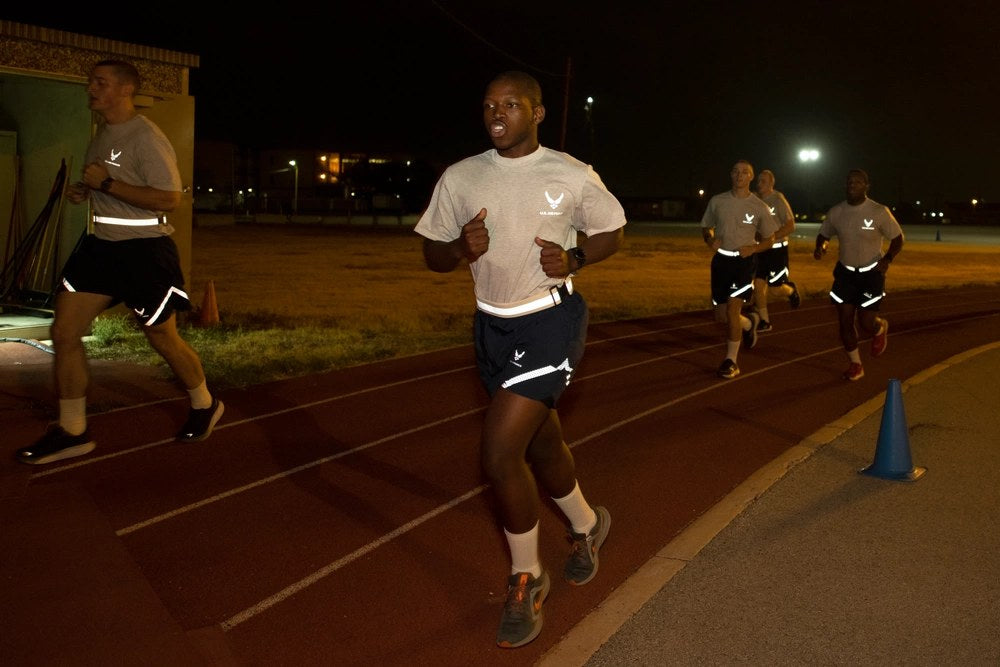
PHOTO CAPTION: U.S. Air Force basic trainee Herve Shyaka completes his third-week fitness assessment during Basic Military Training at Joint Base San Antonio-Lackland, Texas, Aug. 22, 2022. U.S. Air Force photo by Brian Boisvert.
The Air Force has begun deliberately waking more recruits during Basic Military Training and is considering additional measures designed to expose trainees to higher levels of stress before they reach operational units.
The changes began at Joint Base San Antonio-Lackland in late August and are intended to better prepare future Airmen for the fatigue and pressure they could experience during wartime operations, according to 37th Training Wing leaders interviewed by Air & Space Forces Magazine.
One of the biggest changes involves the overnight entry-control duty shared by members of each roughly 60-person training flight.
Previously, those guard shifts lasted two hours. They have now been shortened to one hour, which means significantly more recruits have to wake up during the night to cover them. Col. Kellie Courtland, commander of the 37th Training Wing, said the old system typically woke four to eight trainees during a night. The new schedule can require 21 trainees to get up.
The first week of BMT will remain largely unchanged because officials believe trainees are already dealing with substantial fatigue as they adjust to military life. The additional nighttime interruptions begin during the second week.
The Air Force then plans to progressively increase nighttime activity as recruits move through training. During the fourth week, trainees could be awakened for events such as accountability exercises, while the fifth week will include additional nighttime scenarios ahead of PACER FORGE.
PACER FORGE is BMT's culminating field exercise and has itself become considerably longer. The Air Force expanded it in 2025 from 36 hours to 57 hours — three days and two nights — to expose trainees to simulated deployment and combat conditions. Official Air Force material describes the exercise as testing teamwork, discipline, problem-solving and the ability to operate in small teams.
The new sleep changes are only one part of the effort.
Air Force leaders are also reviewing a proposed "stress inoculation" program that would intentionally increase the pressure trainees face while simultaneously teaching them techniques for functioning under that pressure.
The proposal could include methods such as controlled breathing, followed by high-stress training events where instructors evaluate whether recruits actually use the techniques they were taught. Officials said the stress component could receive approval by the end of September.
Courtland described the objective in unusually direct terms: teach trainees coping tools, "stress the hell out of them," and then determine whether they can apply those tools when things get difficult.
According to Courtland, Air Force Chief of Staff Gen. Kenneth Wilsbach directed BMT officials to make changes after recent combat operations highlighted problems with some younger Airmen performing under sustained fatigue, stressful events and an increased operational tempo.
The changes mark a notable shift from some of the Air Force's previous emphasis on human performance at BMT. In 2023, the service reorganized Zero Week in part to teach trainees about sleep hygiene, stress management, nutrition and resilience. Now officials are trying to combine those coping skills with more deliberate exposure to fatigue and pressure.
The Air Force says the purpose is not simply to make basic training harder. Leaders want recruits to experience controlled stress and sleep disruption while instructors can still identify mistakes, explain what happened and teach them how to recover before they encounter the same conditions in an operational environment.
For generations of veterans who remember their own experiences trying to function on little sleep during basic training, field exercises and deployments, however, the changes are likely to raise a much simpler question:
Wasn't basic training already doing this?
Source: Air & Space Forces Magazine; U.S. Air Force / 37th Training Wing
(Source: Air & Space Forces Magazine; U.S. Air Force / 37th Training Wing)