91% of Female Marines Pass New PFT
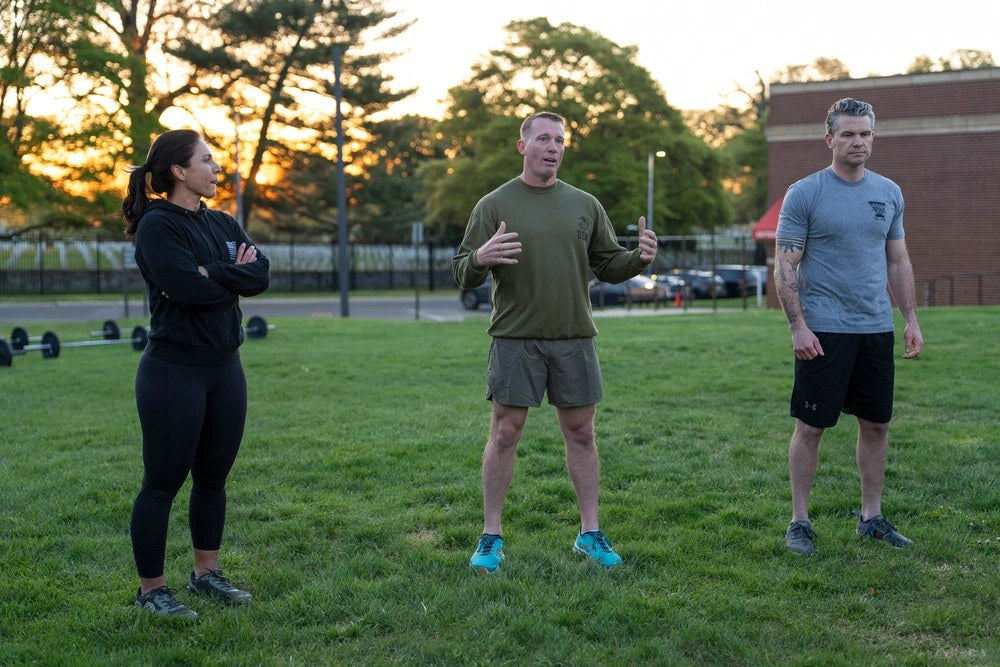
PHOTO CAPTION: Defense Secretary Pete Hegseth participates in morning physical training with U.S. Marines at Fort Myer-Henderson Hall, Virginia, April 17, 2025. Marine Corps data now provides the first results from new sex-neutral PFT scoring for Marines in combat-arms specialties. (DoD photo by U.S. Navy Petty Officer 1st Class Alexander Kubitza)
When Pete Hegseth pushed the military toward sex-neutral physical standards for troops in combat roles, one of the biggest questions was straightforward:
How many women would actually meet them?
The Marine Corps now has its first answer.
Marine Corps data obtained by The War Horse shows that 91.38% of female Marines in combat-arms specialties who took the service's Physical Fitness Test under the new scoring system met or exceeded the required standard.
Men passed at a higher rate — 96.53% — but the first set of results shows that more than nine out of 10 women tested cleared the new threshold.
The numbers provide the first real-world look at a policy that became one of the most heavily debated pieces of Hegseth's military standards overhaul.
Beginning Jan. 1, 2026, Marines serving in designated combat-arms specialties began having their PFTs scored using the male, age-normed scoring tables, regardless of sex.
Those Marines must score at least 210 points out of a possible 300, or 70% of the maximum score.
The PFT includes a three-mile run, an abdominal plank and a choice between pull-ups or push-ups.
The change applies to combat-arms occupational specialties ranging from infantry and reconnaissance to artillery, combat engineering, assault amphibian and explosive ordnance disposal positions.
According to the Marine Corps, 422 women currently serve in the affected combat specialties, and 400 have taken the PFT under the new scoring standard.
The results matter because fitness standards — particularly the standards applied to women in ground combat roles — have been at the center of a long-running argument inside and outside the military.
Hegseth made the issue a central part of his broader standards push last year, arguing that troops assigned to combat formations should face the same physical expectations regardless of sex.
But there is an important distinction.
Female Marines serving in combat specialties were already required to meet the same job-specific physical requirements as their male counterparts. The January change affected the scoring of the broader Marine Corps Physical Fitness Test, which historically used different age- and sex-based scoring tables.
Age still matters under the new system.
Combat-arms Marines are scored using the male standards for their respective age group, meaning the policy is sex-neutral but not age-neutral.
And passing the new standard does not necessarily mean the change has no career consequences for female Marines.
The War Horse reported that a female Marine whose performance would previously have produced a perfect 300 under the female scoring table could receive roughly 240 points for the same performance when it is scored under the male table.
That is comfortably above the new 210-point requirement, but the lower recorded score could matter when fitness scores are considered alongside other factors in evaluations and career advancement.
There are also consequences for Marines who fall short.
Marine Corps guidance says combat-arms Marines who fail to reach 210 by the end of the reporting period will be assigned remedial physical training and may eventually face MOS reclassification or promotion restrictions.
The original guidance also stated that adverse or punitive action would not occur until additional guidance was issued.
The Marine Corps results do not settle the larger debate over women in combat.
Women remain a small percentage of Marines serving in the affected specialties, and Marine Corps figures alone cannot predict how women will perform across the Army and other services.
The War Horse reported that it has requested comparable Army data but has not yet received it.
But for the Marine Corps, the first numbers are now available.
After months of debate over what would happen when female combat-arms Marines were scored against the male PFT tables, 91.38% met the new standard.
The argument over what that number means is unlikely to end anytime soon.
(Source: OAF Nation)