Ukraine Expands Drone Strikes on Russian Ships
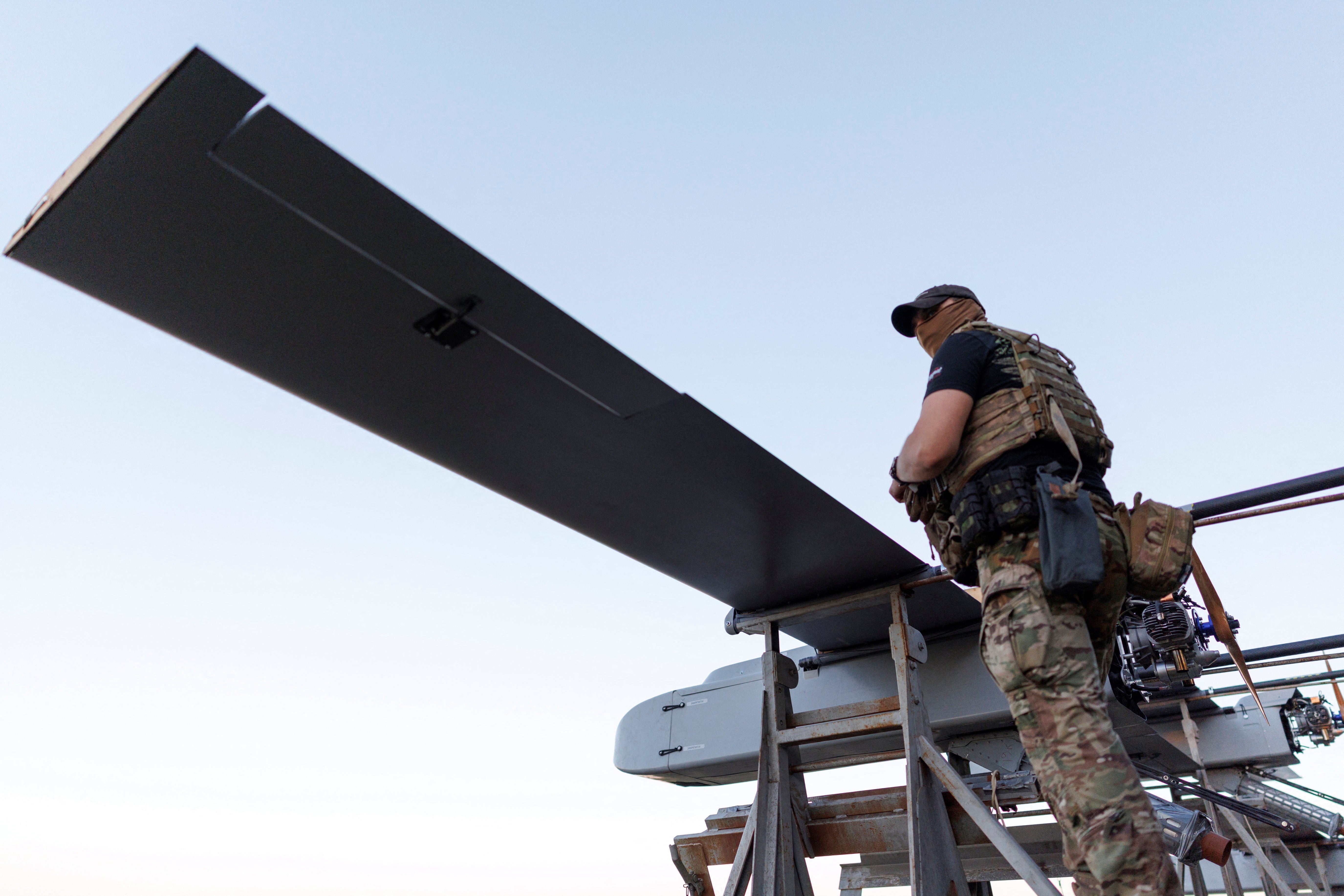
PHOTO CAPTION: A service member of the 414th Separate Unmanned Strike Aviation System Brigade 'Magyar's Birds' of the Ukrainian Armed Forces stands next to FP-1 deep-strike drones before their launch for a combat mission, amid Russia's attack on Ukraine, in an undisclosed location in Ukraine, in 2026. REUTERS/Valentyn Ogirenko
Ukrainian drone forces are expanding their campaign against Russian shipping around Crimea, targeting vessels in the Black Sea after weeks of strikes in the Sea of Azov.
Operating from fields far behind the front line in southern Ukraine, the units have reported hitting more than 180 vessels and other maritime targets around the Russian-occupied peninsula over the past three weeks.
The reported attacks are intended to raise the cost of Russia’s occupation of Crimea, disrupt military logistics and shift momentum toward Kyiv in the fifth year of Russia’s full-scale war in Ukraine.
During a recent Reuters visit, soldiers from the 414th Separate Unmanned Strike Aviation System Brigade, known as Magyar’s Birds, prepared sleek gray attack drones for missions over the Black Sea. The team launched drones every few minutes.
“We work day and night, every day, without time off,” said a battalion commander who identified himself only by his call sign, Ray, in keeping with Ukrainian military practice.
Ray’s unit said it recently struck a cargo vessel and a floating crane in the Black Sea, as well as a power substation in southern Crimea. Reuters could not independently verify those claims.
The campaign is part of an intensifying battle in strategically important waters. As Ukraine has expanded its attacks on Russian maritime logistics, Russia has increased strikes on Ukrainian ports and international cargo vessels.
Ukraine’s agriculture minister said Thursday that shipowners had temporarily suspended vessel arrivals at the country’s Black Sea ports for agricultural exports following the increase in attacks.
Crimea serves as a military and transit hub for Russian forces. Russia seized and annexed the peninsula in 2014, eight years before launching its full-scale invasion of Ukraine.
In recent months, Ukrainian drone forces have struck road and rail links across Russian-occupied southern Ukraine that connect Crimea with Russia.
The attacks have contributed to fuel shortages and a state of emergency in Crimea, where power and natural-gas facilities have also been repeatedly targeted.
Ukraine is now widening that campaign to include oil tankers, dry-cargo ships and other vessels in an effort to restrict the flow of supplies to Russian forces.
Since the latest phase of the campaign began in July, drone units commanded by Robert “Magyar” Brovdi have reported striking an average of about six vessels per day. Brovdi has publicized the attacks in mocking reports filled with emojis.
Ukrainian forces say the strikes have sharply reduced Russian shipping through the Sea of Azov. That sea receives vessels traveling from Russia’s main southern grain-producing region through the Don River.
Brovdi’s forces also said the Kerch ferry crossing between eastern Crimea and Russia’s Krasnodar region had lost about 75% of its capacity. Reuters could not independently verify that claim.
Brovdi told Reuters the campaign was intended to destroy what he called the myth of Russian dominance and establish full Ukrainian control over the country’s territorial waters.
The operation has been named “Molochko,” a portmanteau that sounds like the word for “milk” but represents a phrase meaning “Moscow will collapse because of Crimea.”
Sidharth Kaushal, a senior fellow at the Royal United Services Institute think tank in London, said Ukraine’s previous attacks on Russian overland logistics had increased Moscow’s reliance on shipping through the Sea of Azov. That shift created more maritime targets for Ukrainian forces.
Kaushal described the latest attacks as “a logical continuation” of Ukraine’s broader campaign against Russian operations in Crimea.
Russia, meanwhile, has intensified its attacks on southern Ukraine, particularly Odesa and the ports used to send Ukrainian grain to international markets through a maritime corridor.
Ten sailors were killed Sunday when Russian forces struck a Guinea-Bissau-flagged vessel carrying corn from the port of Odesa, according to Ukrainian officials.
At least three other people were killed last week in attacks on Odesa and Mykolaiv, another Ukrainian port city.
During the first two weeks of July, Russia struck Ukrainian ports 23 times and civilian vessels 17 times, Ukraine’s seaports authority said last Thursday. The attacks have created mounting logistical problems for agricultural traders.
Grain, vegetable oil and other agricultural exports remain Ukraine’s largest source of foreign-currency earnings. More than 90% of those exports are shipped from ports in the Odesa region through the maritime corridor.
Russia has said its strikes are directed at infrastructure used to store military cargo and fuel.
The Ukrainian-made FP-1 and FP-2 drones used by Ray’s unit have become an important part of Kyiv’s expanding long-range arsenal.
The drones fly automatically toward their operational area. Pilots, who may be positioned far from the launch site, then take control to guide them during the final stage of the attack.
During the Reuters visit, the launch team used a small jet booster to catapult a propeller-driven drone into the air. Minutes after launching its final aircraft, the team packed its equipment and prepared to relocate.
The unit does not reuse launch sites, and its teams may receive orders to move to a new location with only a few hours’ notice.
Advances in drone technology allow the teams to launch from more than 100 kilometers, or 62 miles, behind the front line. Even at that distance, the crews remain valuable targets for Russian drone units.
“This is a constant war — a continuous struggle of measures and countermeasures,” said Ray, who commands the brigade’s ninth battalion, known as Kairos.
A squadron commander who uses the call sign Panama said the visible results of the missions motivated members of the unit. In addition to disrupting Russian logistics, he said, the campaign was strengthening Ukrainian morale.
“It’s great that our tempo is so high,” Panama said, “but we still need to sustain it.”
(Source: Reuters)