U.S. Sinks 5 Iranian Tankers
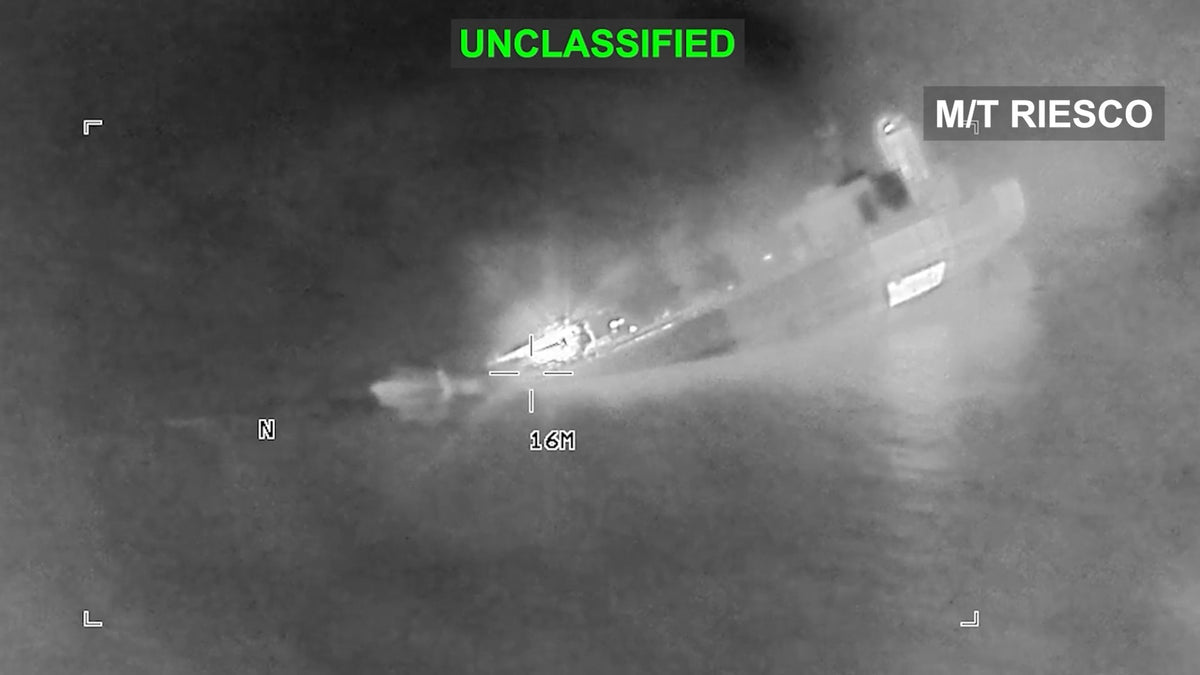
PHOTO CAPTION: Iranian crude oil carrier M/T Riesco is shown after being struck in the Gulf of Oman on Sept. 8, 2026. CENTCOM said U.S. forces targeted the vessel after attempted IRGC missile attacks on a U.S. Navy warship. (U.S. Central Command)
U.S. Central Command says American forces destroyed five Iranian crude oil carriers on Sept. 8 after the Islamic Revolutionary Guard Corps targeted a U.S. Navy warship with ballistic missiles twice over the past two days.
According to CENTCOM, the U.S. warship evaded the attacks and continued operating in regional waters. CENTCOM said no American personnel were harmed.
The command identified the struck vessels as M/T Kaviz, M/T Charminar, M/T Horizon 1, M/T Riesco, and M/T Derya. Four were hit in the Gulf of Oman, while the fifth was struck near Kharg Island.
CENTCOM said American forces ordered the crews to abandon ship before the vessels were hit and rendered inoperable. It also said Iran uses such tankers as part of a multibillion-dollar network that helps fund the IRGC and its regional proxies.
Iran then claimed it retaliated on Sept. 9 by attacking 10 ships near the Strait of Hormuz and firing ballistic missiles at a U.S. base in Jordan. Reuters reported that Jordan's military said it intercepted 18 of 20 missiles and that no casualties were immediately reported there.
That means the fight is no longer just about isolated ship harassment or warnings in the Gulf. It has now moved into direct tit-for-tat strikes involving U.S. naval forces, Iranian oil vessels, merchant shipping in one of the world's most important waterways, and a U.S. military position in Jordan.
For OAF readers, the clearest takeaway is simple: Iran keeps taking shots at U.S. forces, the U.S. is now sinking Iranian tankers in response, and the Strait of Hormuz is becoming even more dangerous for military and commercial traffic.
The biggest unanswered piece is Iran's claim that it attacked 10 ships. Iranian officials made that claim publicly, but full independent confirmation of the total number and scope of those strikes was still incomplete as the story developed.
Shipping traffic through the Strait of Hormuz has already been running below normal levels, and the latest exchange adds even more pressure to one of the most important maritime choke points on the planet.
(Source: OAF Nation)