U.S. Plans Ban on Chinese Robots
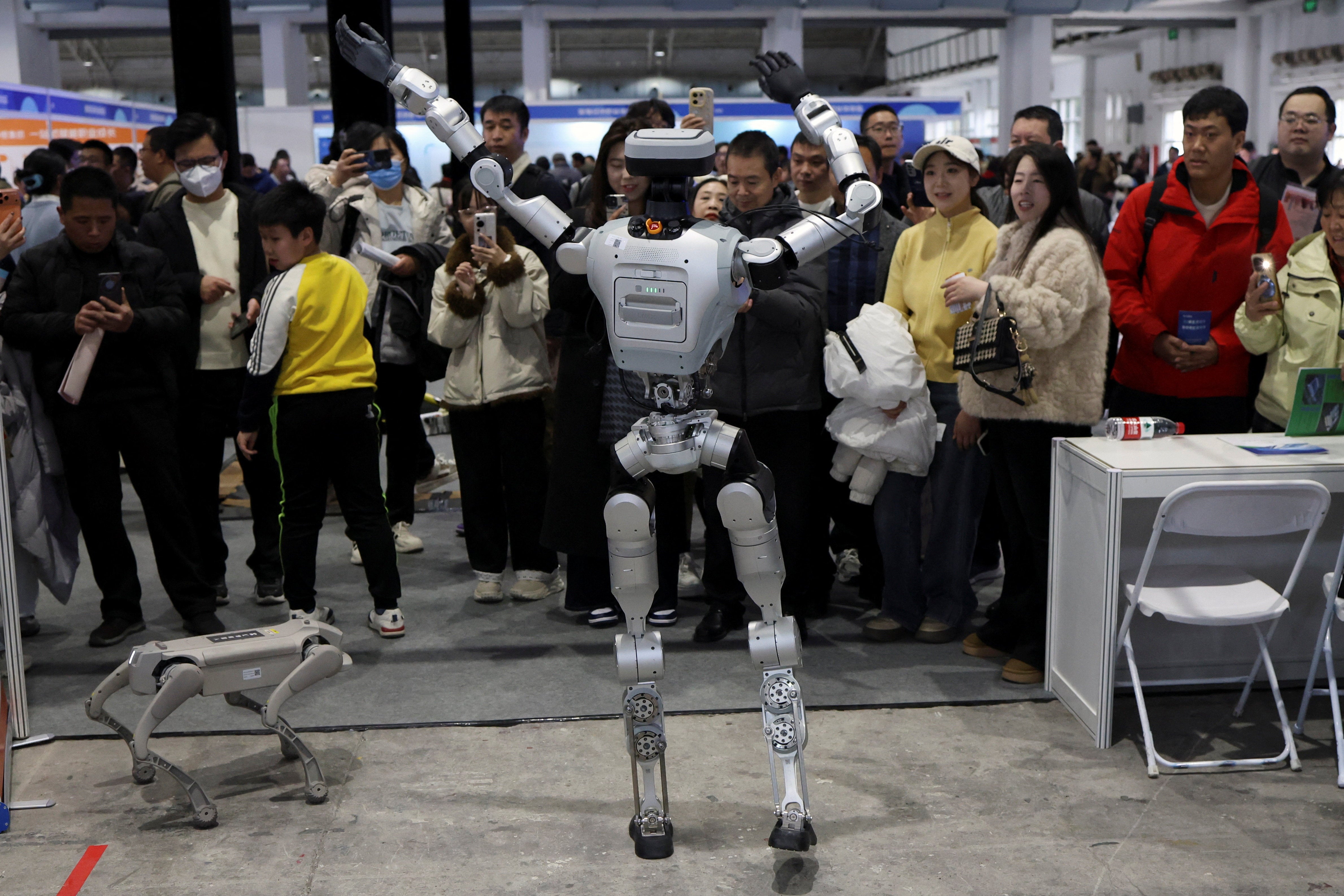
PHOTO CAPTION: A humanoid robot dances in front of visitors at a job fair in Beijing, China March 14, 2026. REUTERS/Florence Lo
WASHINGTON, July 28 — The Trump administration plans to announce restrictions Tuesday targeting imports of new Chinese humanoid and quadruped robots and connected power inverters, U.S. officials said.
The administration says the measures are intended to protect the U.S. artificial intelligence supply chain from disruption, data theft and cyberattacks while encouraging companies to move manufacturing to the United States.
The Federal Communications Commission was expected to announce the restrictions Tuesday afternoon, according to people familiar with the plans.
Connected power inverters allow renewable energy sources and batteries to connect with electrical grids and data center equipment.
“The President has made clear that the United States must have independent and secure supply chains for critical and emerging technologies like robotic devices and power inverters,” said an administration official who requested anonymity because the measures had not yet been made public.
“Economic security is national security, and the Trump administration continues to implement a nuanced and multi-faceted policy agenda to reindustrialize America,” the official said.
The Chinese Embassy in Washington did not immediately respond to a request for comment.
Some analysts expect humanoid robots equipped with artificial intelligence systems to eventually be widely used in consumer and industrial settings. Rapid growth in U.S. data center construction will also depend on reliable supplies of power inverters.
Treasury Secretary Scott Bessent has warned that Chinese artificial intelligence companies could face U.S. sanctions for stealing American intellectual property.
U.S. officials also want to avoid repeating the country’s dependence on Chinese rare earth minerals, which are critical to technology manufacturing. China has used its dominant position in that market as leverage in international negotiations.
Under the planned FCC measures, imports of new foreign-made models in the targeted technology categories would initially be prohibited. The agency is then expected to exempt many non-Chinese suppliers, four additional sources said.
The FCC used a similar approach when restricting foreign drones and routers.
The restrictions would take effect when published and apply only to robot and inverter models that have not yet been released, another U.S. official said.
The FCC could still revoke authorization for models that have already been approved for sale in the United States.
Trump drew international attention to concerns about Chinese technology during his first term, including intellectual property theft and alleged state-sponsored surveillance involving telecommunications companies such as Huawei.
During his second term, however, Trump has taken a less confrontational approach toward Beijing as China has used export controls on rare earth minerals.
The planned robot restrictions are expected to affect Unitree, which holds just under one-fifth of the global humanoid robot market, according to Counterpoint Research.
Unitree is one of three Chinese companies that dominate the emerging industry. The Pentagon recently added it to a list of companies alleged to have ties to the Chinese military, a designation that can precede additional U.S. restrictions.
Unitree recently partnered with Nvidia to use the U.S. chipmaker’s Blackwell chip in the artificial intelligence system powering one of its robots.
Nvidia has said data collected by the robots will remain in the United States and that Unitree’s largest customers are American academic and research institutions.
Critics of China’s technology sector fear the robots could collect information from key U.S. industries, transfer data to Beijing or disrupt important operations.
China is also the world’s largest manufacturer of power inverters. Major producers include Sungrow Power Supply and Huawei, which is already subject to extensive U.S. sanctions.
Chinese manufacturers have expanded their share of the Western inverter market by lowering prices.
Reuters previously reported that the FCC was developing restrictions on Chinese inverters following similar action in Europe and concerns that the equipment could be disrupted or used to install malware.
U.S. authorities want to prevent another state-linked hacking campaign similar to Volt Typhoon, which was disclosed in 2023.
In that campaign, hackers took control of privately owned routers to conceal later attacks targeting U.S. critical infrastructure.
The Defense Department is already prohibited from purchasing solar photovoltaic cells, modules or inverters made by foreign entities of concern, including Chinese companies.
Unitree, Sungrow and Huawei did not immediately respond to requests for comment.
(Source: Reuters)