U.S. Approves Patriot Missile Sales
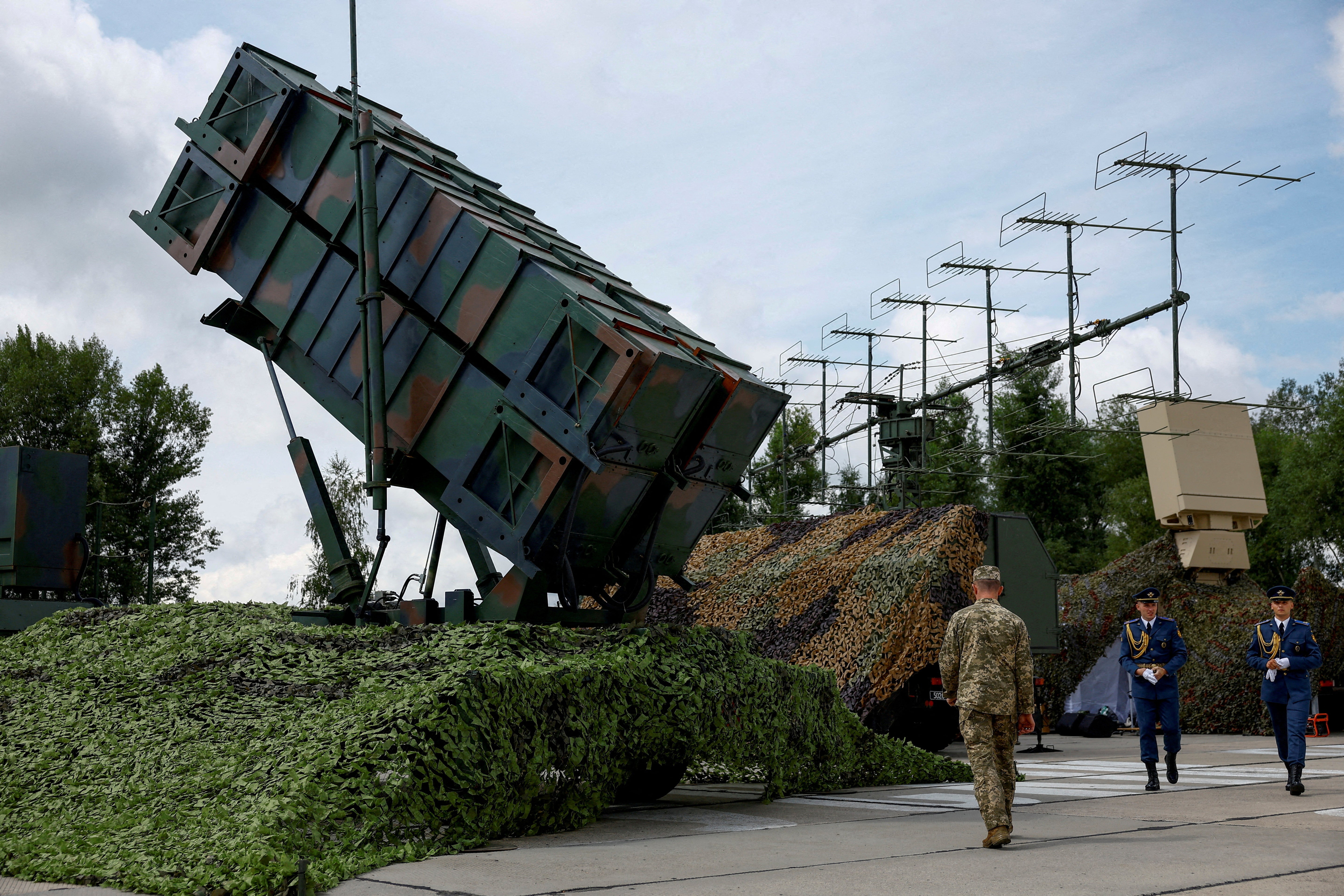
PHOTO CAPTION: FILE PHOTO: FILE PHOTO: Ukrainian service members walk next to a launcher of a Patriot air defence system, amid Russia's attack on Ukraine, in an undisclosed location, Ukraine August 4, 2024. REUTERS/Valentyn Ogirenko/File Photo
WASHINGTON, Aug. 7 — First used in the 1991 Gulf War, the U.S. Patriot air defense system has seen demand surge this year as Ukraine’s war against Russia and the widening conflict in the Middle East have depleted supplies of interceptor missiles.
Ukraine is urgently seeking additional Patriot interceptors to defend against nightly Russian ballistic missile attacks. But the Iran war has drained U.S. and Gulf arsenals, while some European countries are holding onto missiles they may need for their own defense.
What is the Patriot system?
Patriot, short for Phased Array Tracking Radar for Intercept on Target, is a mobile surface-to-air missile defense system made by U.S. weapons manufacturer Raytheon Technologies. Developed in the 1980s, it can operate in all weather and at long range and has been repeatedly modernized, with the system expected to remain in service through 2048.
A typical Patriot battery includes radar and control systems, a power unit, launchers and support vehicles. Depending on the interceptor being used, Patriot can engage aircraft, tactical ballistic missiles and cruise missiles.
What can Patriot intercept?
The system’s capabilities vary by interceptor. The older PAC-2 missile uses a blast-fragmentation warhead that explodes near its target, while the PAC-3 family uses more precise “hit-to-kill” technology designed to physically collide with an incoming threat.
Raytheon makes the PAC-2 GEM-T interceptor, which can engage smaller short-range ballistic missiles, cruise missiles and aircraft. Lockheed Martin builds the more advanced PAC-3 Missile Segment Enhancement, or MSE, designed to counter longer-range ballistic missiles, cruise missiles, aircraft and hypersonic weapons.
In July, Lockheed introduced another interceptor, the PAC-3 Adapted Capability Effector, or ACE, which the company says will cost half as much while retaining the ability to target short-range ballistic missiles, aircraft and cruise missiles.
NATO said in 2015 that the Patriot radar has a range of more than 150 km, or 93 miles, and can track up to 100 potential targets at the same time. Although Patriot was not originally designed to intercept hypersonic weapons, the United States confirmed in May 2023 that Ukraine had used the system to shoot down a Russian Kinzhal missile, which Moscow describes as hypersonic.
Countries generally keep Patriot interception data closely guarded. Ukraine said in January that its systems had destroyed 250 targets, including 140 ballistic missiles, while Patriot systems have also destroyed dozens of Iranian ballistic missiles in the Gulf, though further details have not been released.
How widely is Patriot used?
Raytheon says it has built and delivered more than 240 Patriot fire units, while Raytheon and Lockheed together have produced thousands of interceptor missiles.
Nineteen countries operate Patriot systems, according to Raytheon, including the United States, Germany, Poland, Ukraine, Japan, Qatar, Saudi Arabia and Egypt. Sixteen operate the newest PAC-3 MSE missiles, and six to eight countries have requested more interceptors to replenish depleted inventories.
How much does it cost?
A newly produced Patriot battery costs more than $1 billion, according to the Center for Strategic and International Studies. That includes about $400 million for the system and $690 million for the missiles associated with a battery.
Individual PAC-3 interceptors are estimated to cost about $4 million to $5 million each.
Why are supplies dwindling?
Exact inventory levels are classified, but CSIS estimates that about 65% of U.S. Patriot interceptors were used between February and July. It estimates fewer than 850 remained, down from 2,330 before the Iran war began.
Gulf inventories are also severely depleted, while several European countries have transferred some of their supplies to Ukraine, experts say. Saudi Arabia used about 86% of its 2,800 PAC-3 interceptors during the first 38 days of combat, leaving roughly 400 missiles in April, according to CSIS, which said other Gulf countries used similarly large portions of their inventories.
Are countries buying more?
The United States has approved the sale of 5,250 interceptors to Bahrain, Kuwait, Qatar and the United Arab Emirates to replenish their stocks.
Washington is also continuing talks that could allow Ukraine to manufacture Patriot interceptor missiles, despite President Donald Trump casting doubt on such an arrangement, according to sources familiar with the discussions. One option under consideration would allow Ukraine to produce some components for final assembly elsewhere in Europe.
Last month, the U.S. Army awarded Lockheed Martin a contract worth up to $58.6 billion to produce Patriot interceptor missiles.
(Source: Reuters)