U.S. and China Develop 'Hunter' Satellites
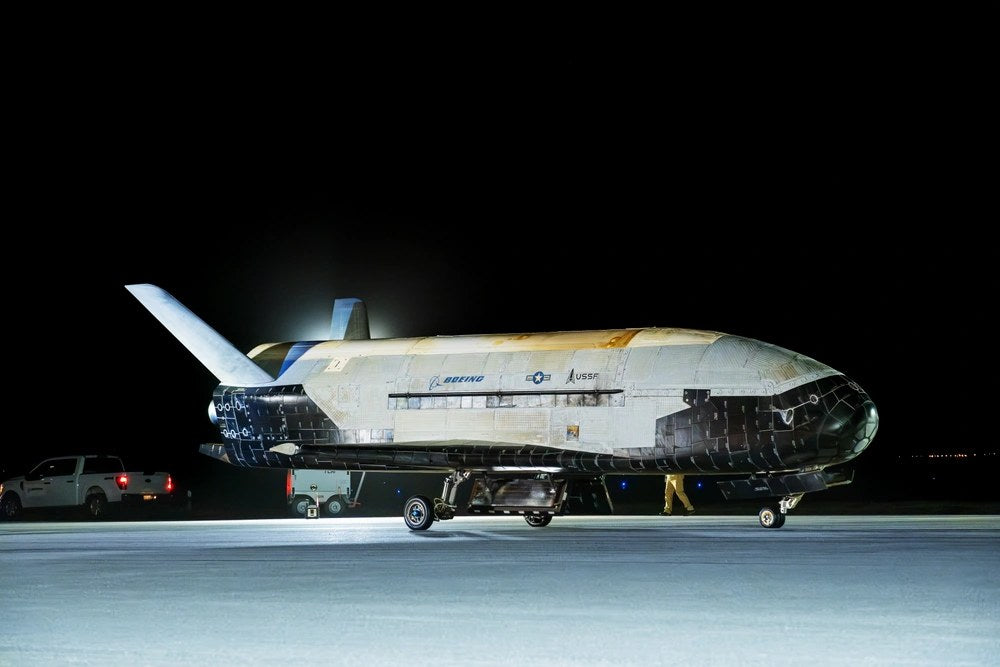
PHOTO CAPTION: The U.S. Space Force's X-37B Orbital Test Vehicle sits at Vandenberg Space Force Base, California, after completing its seventh mission March 7, 2025. The unmanned spaceplane spent more than 434 days in orbit and demonstrated advanced orbital maneuvering capabilities. (U.S. Space Force courtesy photo)
The United States and China are developing increasingly sophisticated spacecraft capable of maneuvering around other satellites as both militaries prepare for the possibility that a future conflict could extend into orbit.
The emerging competition includes secretive spaceplanes, maneuverable “hunter” satellites, electronic jammers, lasers and spacecraft capable of approaching, inspecting or potentially interfering with other objects in space, according to a Reuters review of military statements, tracking data and Chinese research documents.
One of the clearest recent examples came in June, when a secretive Chinese unmanned spaceplane released a small satellite hundreds of miles above Earth. Commercial tracking data showed the object maneuvering around another Chinese satellite before returning toward the spaceplane, though the purpose of the mission has not been publicly disclosed.
The United States operates its own unmanned spaceplane, the X-37B Orbital Test Vehicle. The reusable spacecraft has flown increasingly complex missions for the Space Force, including experiments involving orbital maneuvering and space-domain awareness technology.
During its seventh mission, the X-37B demonstrated a maneuver known as aerobraking, using atmospheric drag to change its orbit while conserving fuel. The Space Force said the mission demonstrated the spacecraft's ability to operate flexibly across different orbital regimes; the X-37B launched on its eighth mission last summer.
Satellites have long supported troops on Earth through GPS navigation, communications, missile warning and intelligence. The shift now underway is toward spacecraft that can maneuver more aggressively and potentially take a direct role in defending friendly satellites or threatening an adversary's systems.
China has already demonstrated what U.S. officials have described as orbital “dogfighting,” with multiple satellites maneuvering near one another in coordinated patterns. Chinese spacecraft have also demonstrated the ability to capture a defunct satellite and move it to a different orbit, while U.S. officials believe China attempted an on-orbit satellite refueling operation last year.
Refueling could be particularly significant. Satellites normally launch with a finite amount of propellant, meaning every major maneuver reduces their remaining operational life; the ability to refuel in orbit could allow highly maneuverable military satellites to pursue or evade other spacecraft for much longer.
Chinese military-linked researchers are also studying autonomous pursuit systems that could calculate efficient ways to chase other satellites. Other concepts identified by Reuters include multiple spacecraft working together to capture a target with nets, although technologies capable of rendezvous, servicing or moving satellites can also have peaceful uses.
The United States is developing its own increasingly active approach to operations in orbit. Last year, U.S. and British forces conducted their first publicly acknowledged joint military orbital operation, maneuvering a U.S. satellite near a British spacecraft while a suspected Chinese intelligence satellite passed below them.
Commercial tracking specialists told Reuters the maneuver appeared to send a strategic message by demonstrating that allied spacecraft could coordinate their movements. U.S. Space Command said the mission demonstrated the ability of allied forces to operate together in space but did not characterize it as a confrontation with China.
Other weapons do not have to be placed in orbit to threaten satellites. Militaries are developing or fielding ground-based electronic jammers, lasers, cyber capabilities and anti-satellite missiles designed to disrupt or destroy systems overhead.
The Space Force disclosed in June that it had introduced a ground-based electromagnetic system designed to disrupt adversary satellites. U.S. military leaders have increasingly argued that protecting American forces on Earth will require being capable of defending U.S. spacecraft—and, if deterrence fails, threatening hostile systems in space.
China says it opposes the weaponization of space and has described its spaceplane as an experimental spacecraft intended to support peaceful uses of space. Beijing has in turn accused Washington of fueling an arms race through programs such as Golden Dome and potential space-based weapons.
What is no longer disputed is how important orbit has become to warfare on Earth. Taking away satellites that provide communications, navigation, surveillance and missile warning could rapidly degrade a modern military's ability to fight—making control of space an increasingly important part of planning for a future conflict.
Source: Reuters; U.S. Space Force