Trump Faces Tough Iran War Choices
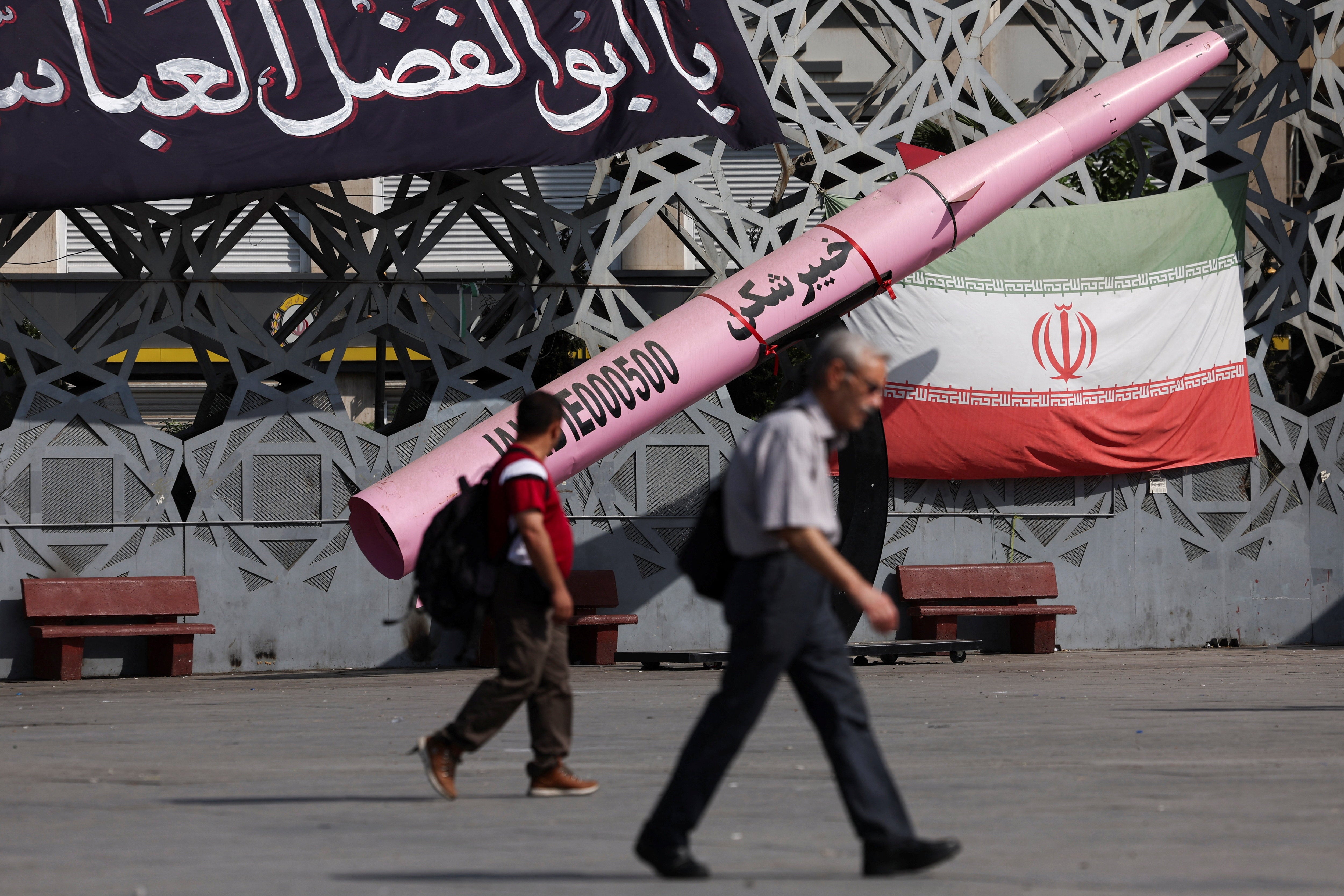
PHOTO CAPTION: FILE PHOTO: People walk next to a symbolic mockup of an Iranian missile and an Iranian flag at Imam Hussein Square in Tehran, Iran, July 12, 2026. Majid Asgaripour/WANA (West Asia News Agency) via REUTERS/ File Photo
WASHINGTON, Aug. 6 — With President Donald Trump’s war against Iran now in its sixth month, a flurry of threats and diplomacy this week has highlighted the increasingly difficult choices he faces as he tries to pull the United States out of an unpopular conflict he initially said would last only weeks.
Trump is caught between an emerging interim agreement being negotiated by Iran and Oman that could give Tehran control over the Strait of Hormuz that it did not have before the war, or following through on his threats of a sharp military escalation.
Analysts said accepting the proposed arrangement would grant Iran its most significant concession since the United States and Israel attacked it on Feb. 28. It could formalize, at least temporarily, Iranian supervision of the vital oil-shipping route that the Trump administration had vowed to keep outside Tehran’s control.
The alternative, likely involving another wave of airstrikes, could carry serious political risks ahead of November’s U.S. midterm elections. Analysts said it also appears no more likely to succeed than earlier bombing that failed to force Tehran to surrender.
Trump could instead maintain the uneasy status quo by continuing the blockade of Iranian ports and periodically retaliating for attacks on shipping. That approach, however, would not provide him with a face-saving exit from a war he predicted would end by mid-April.
“It’s a menu of bad options, but Trump may have come to the realization that he can’t let this war go on endlessly,” said Aaron David Miller, a former Middle East negotiator under Democratic and Republican administrations. “Something has to give, and that may be recognition of a new Iranian reality in the strait.”
Responding to Reuters’ questions, a U.S. official said on condition of anonymity that any “temporary” shipping routes would operate “without any impediments,” with no party overseeing transit.
Dispute over control of the strait
U.S. Secretary of State Marco Rubio has insisted the Strait of Hormuz must remain an open international waterway free of Iranian control, tolls or fees. Iran has maintained a near-chokehold on one-fifth of global oil and liquefied natural gas shipments through the strait since the war began.
Trump has previously contradicted some of Rubio’s statements about the conflict, and analysts said he could do so again. With U.S. gasoline prices high, Trump’s approval ratings low and the war deeply unpopular among Americans, they said his room to maneuver is narrowing.
Analysts said Trump’s threats have done little to force Iran to make concessions and that the president increasingly appears likely to make the largest compromises. Reopening the strait is viewed as a prerequisite for renewed U.S.-Iran negotiations, which the administration wants to focus on Iran’s nuclear program, the primary stated target of Trump’s military campaign.
It remains unclear whether Washington would accept an arrangement negotiated by Iran and Oman, which sit on opposite sides of the strait. A senior Iranian source and two regional officials told Reuters that the proposed terms would give Tehran some control over ships entering the Gulf.
Trump has said an agreement to reopen the waterway is imminent, while Iranian officials have said important details remain unresolved. Even if an Iran-Oman agreement is completed and U.S.-Iran talks resume, experts remain skeptical that the two countries can reach a permanent peace settlement.
A memorandum of understanding signed by the United States and Iran in June quickly unraveled. That preliminary agreement provided Iran with some sanctions relief from the outset, drawing criticism from some of Trump’s fellow Republicans.
Trump administration officials increasingly expect the conflict to continue in some form through the midterm elections, a White House official said on condition of anonymity. Early voting begins in some states as soon as September.
That could create further political risk for Trump, who campaigned for a second term promising to avoid foreign interventions and focus on Americans’ economic concerns as Republicans seek to retain control of Congress. The U.S. official said Trump’s decisions on Iran are not guided by “fluid opinion polls.”
Major war aims remain unmet
Trump has regularly claimed victory after U.S. strikes killed many Iranian leaders and weakened Iran’s military capabilities. Most analysts, however, agree that he has been blocked from achieving several of his principal war objectives.
Trump said Saturday that he canceled plans for new large-scale attacks after Middle Eastern partners asked him to give diplomacy another chance. At the same time, he threatened to strike Iran hard if those efforts failed.
Some analysts suggested concerns about declining U.S. missile stockpiles may also have influenced Trump’s decision. Trump has denied that the United States is running low on munitions.
He delivered another conflicting message Wednesday during a rally in Las Vegas.
“I’d rather make a deal because I don’t want to kill people,” Trump said. “But at some point we’re gonna.”
Iran has warned Washington’s Gulf allies that renewed U.S. strikes would trigger retaliation against their energy infrastructure, according to five sources familiar with the discussions.
Jonathan Panikoff, a former deputy U.S. intelligence officer for the Middle East, said China, Russia and North Korea are closely watching the conflict.
“They are learning what U.S. limitations are going to be for years to come,” he said.
Even some Iran hawks who have largely supported Trump’s war are urging caution. Behnam Ben Taleblu of the Foundation for Defense of Democracies, a hardline anti-Iran think tank in Washington, said Tehran was trying to force Trump into a “lose-lose proposition” before November.
He said the administration should avoid “rushing into anything” and recognize “where the U.S. does and doesn’t have leverage.”
(Source: Reuters)