Article: Supreme Court Hears Veteran's VA Pay Case
Supreme Court Hears Veteran's VA Pay Case
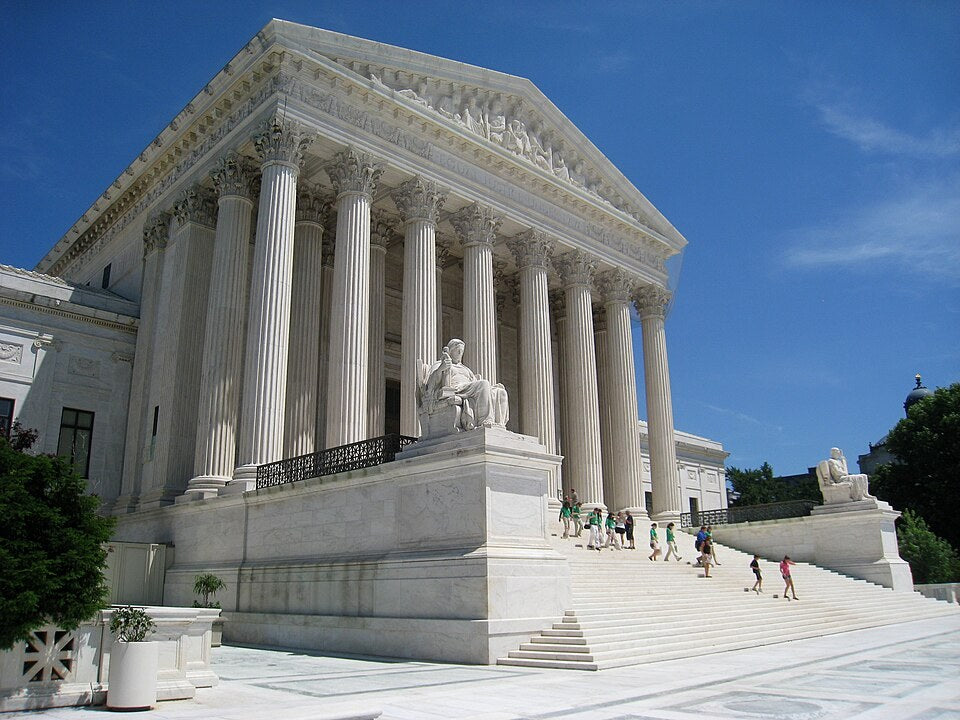
PHOTO CAPTION: The U.S. Supreme Court in Washington, D.C. heard arguments Oct. 5, 2026, in the case of Army veteran Floyd D. Johnson, whose VA disability compensation was reduced to the amount payable at the 10% rate after his incarceration for felony convictions. The justices are considering where veterans may bring constitutional challenges to federal benefits laws. Public-domain photo by Daderot via Wikimedia Commons.
The Supreme Court heard arguments Monday in a case involving an Army veteran whose service-connected disability compensation was reduced to the amount paid at the 10% rate after he was imprisoned for felony convictions.
Floyd D. Johnson served as an Army infantryman from 1983 to 1985.
In 2013, Johnson was convicted of several Florida felonies and sentenced to 40 years in prison.
While incarcerated, Johnson applied for Department of Veterans Affairs disability compensation for post-traumatic stress disorder connected to his military service.
The VA initially awarded him a 70% disability rating. After an administrative appeal, that rating increased to 80%.
But federal law limits how much disability compensation can be paid to veterans who have been incarcerated for more than 60 days following a felony conviction.
Under that law, Johnson’s payable compensation was reduced to the amount provided at the 10% disability rate. Legal Information Institute
Johnson challenged the law itself.
Representing himself at first, he filed a lawsuit in federal district court arguing that the statutory reduction violated the Constitution, including the Fifth Amendment and the Constitution’s prohibition against bills of attainder.
That dispute eventually reached the Supreme Court.
But the question the justices heard Monday was narrower than whether incarcerated veterans should receive full disability compensation.
The Court is deciding whether a veteran may bring a constitutional challenge to a federal veterans-benefits law directly in an ordinary federal district court, or whether that challenge must first travel through the specialized VA review system. Supreme Court
That specialized route generally begins inside the VA and can eventually proceed to the Board of Veterans’ Appeals, the U.S. Court of Appeals for Veterans Claims and the U.S. Court of Appeals for the Federal Circuit.
Johnson argues that constitutional challenges to acts of Congress fall outside the provision that channels ordinary veterans-benefits disputes through that system.
His attorney, Jeffrey Chen, told the justices Monday that the VA did not need to decide whether the incarceration statute was constitutional when it reduced Johnson’s compensation. He argued that challenges to the validity of a federal statute belong in federal district court. Supreme Court
The federal government disagrees.
Assistant to the Solicitor General Kevin Barber told the Court that Johnson is entitled to judicial review, “just not in district court.”
The government argues that the Veterans’ Judicial Review Act requires claims like Johnson’s to move through the congressionally created veterans-benefits review process before reaching the federal courts authorized to decide those issues. Supreme Court
The justices pressed both sides during Monday’s argument.
Justice Samuel Alito questioned how Johnson’s proposed distinction fit the text of the federal statute.
Justice Ketanji Brown Jackson questioned why some constitutional claims would go through the VA system while challenges to statutes themselves would go directly to district court.
Justice Sonia Sotomayor pressed the government about an older Supreme Court precedent that allowed a constitutional challenge to a veterans-benefits statute to proceed in district court.
And Justice Brett Kavanaugh asked the government why the Court should disturb what he described as longstanding practice if the statutory question is close.
The government responded that allowing constitutional challenges to proceed in district courts around the country could create inconsistent decisions and impose additional litigation burdens on the VA. Supreme Court
The case turns in part on a 1974 Supreme Court decision, Johnson v. Robison.
In that case, the Court allowed a constitutional challenge to a veterans-benefits law to proceed outside the traditional benefits-review process.
Congress later enacted the Veterans’ Judicial Review Act in 1988.
The dispute before the Court now is whether that later law eliminated the district-court route recognized in Robison for constitutional challenges to acts of Congress affecting veterans benefits. Supreme Court
The consequences extend beyond Johnson’s individual compensation.
A ruling for Johnson could preserve a direct route into federal district court for veterans challenging the constitutionality of federal benefits statutes.
A ruling for the government could require those veterans to begin within the VA’s specialized review structure instead.
What the Court is not deciding at this stage is whether Johnson’s underlying constitutional challenge to the incarceration benefit reduction is ultimately correct.
And no decision was issued Monday.
The Supreme Court heard approximately an hour of argument in the case, Johnson v. United States Congress, on the opening day of its October 2026 term.
(Source: OAF Nation)