Soldiers Struggle for Medical Care
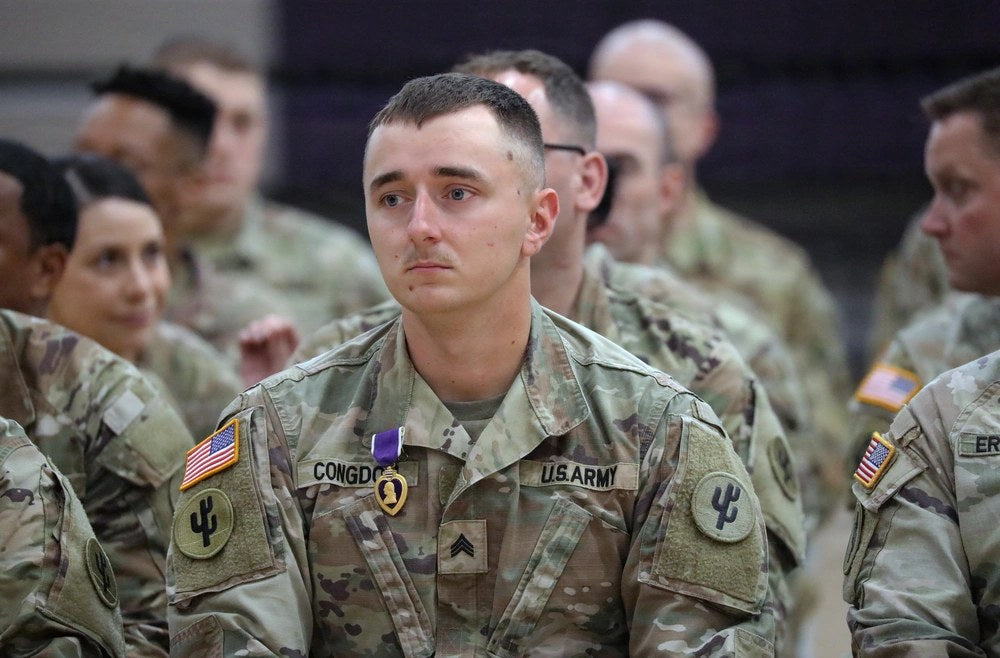
PHOTO CAPTION: U.S. Army Reserve Sgt. Tanner Congdon receives a Purple Heart during a 103rd Sustainment Command return-home awards ceremony in Norwalk, Iowa. U.S. Army photo by Sgt. 1st Class Rodney Roldan.
Army Reserve soldiers wounded in a deadly Iranian drone attack say they are still fighting for medical treatment nearly six months after being injured in combat, despite receiving Purple Hearts for their wounds.
Four soldiers from the 103rd Sustainment Command described months of delayed testing, specialty appointments and inconsistent treatment in a new investigation by The War Horse. All four spoke anonymously because they remain on active-duty orders and said they feared retaliation that could hurt their careers.
The soldiers were wounded March 1 when an Iranian drone struck Port Shuaiba, Kuwait, killing six U.S. service members and injuring dozens more. Some of the wounded suffered traumatic brain injuries, shrapnel wounds, perforated eardrums and other serious injuries.
One soldier recovering at the Soldier Recovery Unit at Walter Reed National Military Medical Center told The War Horse he still has a piece of shrapnel lodged in his back and continues to experience symptoms from a traumatic brain injury.
Four months after the attack, he said he had only recently been able to see a neurologist.
The problems reportedly began immediately after the strike. One wounded Army Reserve colonel said the unit did not have an established evacuation plan and soldiers scrambled to find vehicles to transport casualties to local hospitals.
Several of the most seriously wounded underwent emergency surgery in Kuwait. Other injured soldiers remained there for more than a week before eventually flying to Germany.
When some of the wounded reached Landstuhl Regional Medical Center, multiple soldiers told The War Horse they were informed that because they had not arrived aboard a formal medical evacuation flight, they would not be treated as wounded-in-action patients.
They said they were denied inpatient beds and told to schedule outpatient appointments that were weeks away. Landstuhl officials did not respond to The War Horse's questions about their accounts.
The problems continued after the soldiers returned to the United States.
One wounded soldier said she struggled to get prescriptions refilled after arriving at Fort Hood and repeatedly had to remind medical providers that she had survived a drone strike. Others entered the Army's Soldier Recovery Unit system, which is intended to help troops with complex medical needs recover and return to duty or transition out of the service.
Their experiences varied.
One soldier said being separated from the other wounded members of her unit left her isolated. She said there were no openings when she requested group therapy and that a request for leave to see her family was denied.
She eventually left the Soldier Recovery Unit and sought treatment through the Department of Veterans Affairs, where she said appointments were repeatedly canceled and missing military medical records prevented her from receiving some specialty-care referrals.
The VA did not dispute her specific allegations when contacted by The War Horse, but a department spokesman sharply criticized the reporting after the outlet declined to identify its anonymous source.
Another soldier at Walter Reed said his appointments appeared to receive priority, although some were still scheduled months out. An Army Reserve colonel recovering at a different Soldier Recovery Unit said staff had been supportive, but it still took roughly two months to arrange a CT scan for a persistent cough.
That scan revealed abnormal tissue growth in his lungs that doctors believed could potentially be connected to toxic fumes inhaled during the attack.
Another soldier said he had been cleared from the recovery system despite continuing to deal with a traumatic brain injury, hearing loss and post-traumatic stress. He said he was now attempting to obtain care through the civilian medical system and had still not seen a neurologist.
The War Horse said it corroborated key elements of the four soldiers' accounts through separate interviews and reviews of medical records, photographs and documents related to the attack and its aftermath.
U.S. Central Command and the Department of Defense did not respond to the outlet's requests for comment.
Concerns over the treatment of the 103rd Sustainment Command soldiers had already reached Congress. Thirteen lawmakers wrote Defense Secretary Pete Hegseth in July demanding answers about reports that wounded troops were struggling to obtain medical care.
For the soldiers themselves, the issue is more immediate.
They survived an enemy attack, received Purple Hearts for their wounds and returned home. Months later, some say their fight to recover has become a fight with the military medical system itself.
Source: The War Horse