Pentagon's Cyber Pay Shift Sparks Concerns
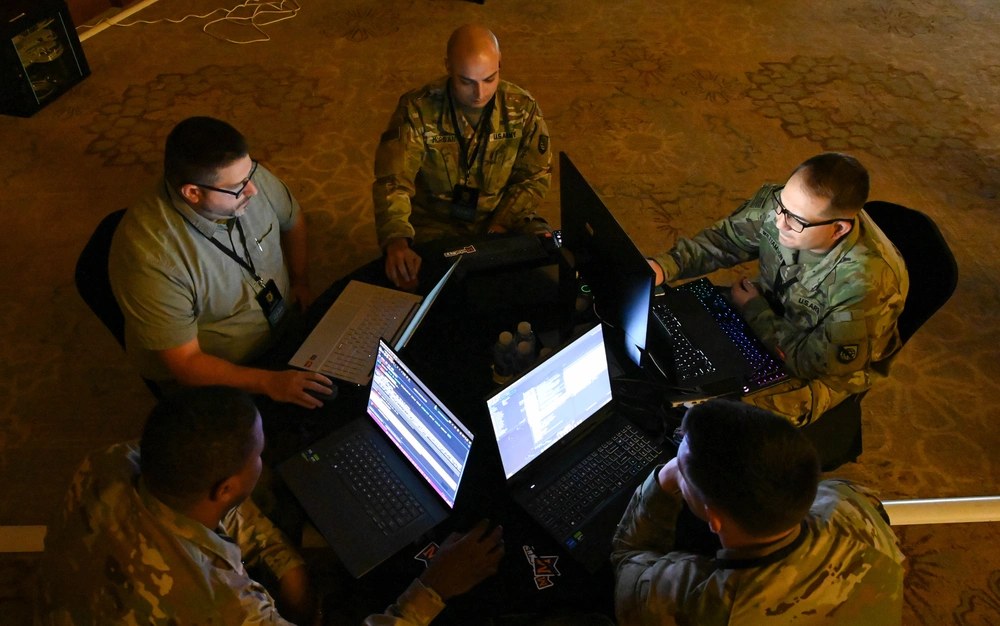
PHOTO CAPTION: U.S. Army soldiers and a Defense Department contractor assigned to the Regional Cyber Center-Southwest Asia participate in the Best Cyber Warrior Competition in Kuwait City, Oct. 29, 2024. A new Pentagon cyber incentive system that took effect Oct. 1, 2026, could eventually reduce incentive pay for some Army cyber personnel by as much as $1,000 per month. U.S. Army photo by Spc. Dean John Kd De Dios.
A new Pentagon incentive pay system for military cyber personnel took effect Oct. 1, and internal Army documents show some soldiers could eventually lose as much as $1,000 a month compared with what they received under the previous system.
The Cyber Mastery Incentive Pay program, known as C-MIP, was announced in June as a new military-wide system intended to reward cyber troops based on technical mastery and especially demanding assignments.
Pentagon officials said the program would replace legacy incentive systems with a standardized approach across the services.
But as the Oct. 1 launch arrived, documents reviewed by DefenseScoop and Bloomberg showed that the transition could mean substantial cuts for some Army cyber personnel. DefenseScoop
Under the Army's previous Cyber Assignment Incentive Pay program, qualifying soldiers could receive between $200 and $1,500 per month depending on their assignment, certification and proficiency level. Army
The new C-MIP program divides additional compensation into two categories.
Skill Incentive Pay rewards personnel based on whether they have achieved basic, senior or master proficiency in designated cyber roles.
Special Duty Assignment Pay can then be added for certain personnel performing particularly demanding duties, including instructors, certified trainers and some advanced cyber assignments. Global Security
The problem for some soldiers is what happens when their old incentive rate is compared with the new one.
An internal Army chart reviewed by DefenseScoop showed that nearly every basic and senior proficiency level across five Army cyber work roles would either receive less skill-based incentive pay than before or continue receiving no incentive pay.
Basic-level cyberspace operators and exploitation analysts faced the largest difference.
Those soldiers could go from receiving $1,000 per month under the previous system to receiving no Skill Incentive Pay at the basic level under C-MIP.
Basic enlisted capabilities developers could see an $850 monthly reduction. DefenseScoop
Bloomberg separately reviewed Army documents and reported that analysts, developers and operators at the basic proficiency level could see incentive compensation decline by as much as $1,000 per month, or $12,000 per year. Bloomberg Law
At the other end of the system, some highly qualified personnel could make substantially more.
DefenseScoop reported that when Special Duty Assignment Pay is included, changes range from a $25 monthly loss to gains as high as $3,500 per month for some personnel taking on multiple qualifying additional duties.
Not every senior or master-level cyber worker qualifies for the additional pay. DefenseScoop
Army leadership was already preparing for difficult conversations before the change took effect.
In an internal email obtained by DefenseScoop, Army Cyber Command leader Lt. Gen. Christopher Eubank provided subordinate leaders with talking points for responding to soldiers worried about losing incentive pay.
One example anticipated a soldier asking why $1,000 per month that had previously been received as a basic operator or exploitation analyst was suddenly disappearing.
The suggested response said the program was intended to encourage soldiers to advance toward higher mastery levels rather than take money away from them.
Leaders were encouraged to discuss opportunities to advance, take on additional duties and use Army financial assistance resources if the reduction created financial problems.
Among the resources specifically mentioned was Army Emergency Relief, including its loan program. DefenseScoop
The Army has also created a temporary protection policy intended to soften the immediate financial impact.
According to an Army official quoted by DefenseScoop, soldiers transitioning from the old Cyber Assignment Incentive Pay system will temporarily receive either their new C-MIP rate or half of their previous CAIP rate, whichever is higher, during the next year.
That means a soldier previously receiving $1,000 per month who would otherwise drop to zero under the new skill-pay table would not necessarily lose the entire $1,000 immediately.
The protection is temporary, however, as the Army transitions fully to the new system. DefenseScoop
The Pentagon originally promoted C-MIP as a way to strengthen a military cyber workforce competing against much higher private-sector salaries.
When the program was announced in June, officials described cyber capabilities as high-demand skills critical to military operations and said the new system would reward service members who developed deeper technical expertise.
The Pentagon said C-MIP would officially take effect Oct. 1. Global Security
The rollout has not been identical across the services.
DefenseScoop reported that the Air Force was still finalizing parts of its implementation shortly before the launch.
The Navy, which had a more limited legacy cyber incentive structure, said eligible sailors would generally see an increase.
The Marine Corps and U.S. Cyber Command did not provide detailed responses about their implementation before publication. DefenseScoop
The Pentagon has also not publicly said exactly how many service members will lose money or how many will receive increases.
For Army cyber soldiers who were already collecting substantial monthly incentive pay, however, the new system creates a clear divide.
Personnel who reach the highest mastery levels or perform additional qualifying duties can potentially earn more.
Others could ultimately see hundreds of dollars, and in some cases as much as $1,000, disappear from their monthly incentive pay.
(Source: OAF Nation)