Pentagon Plans New Officer Evaluations
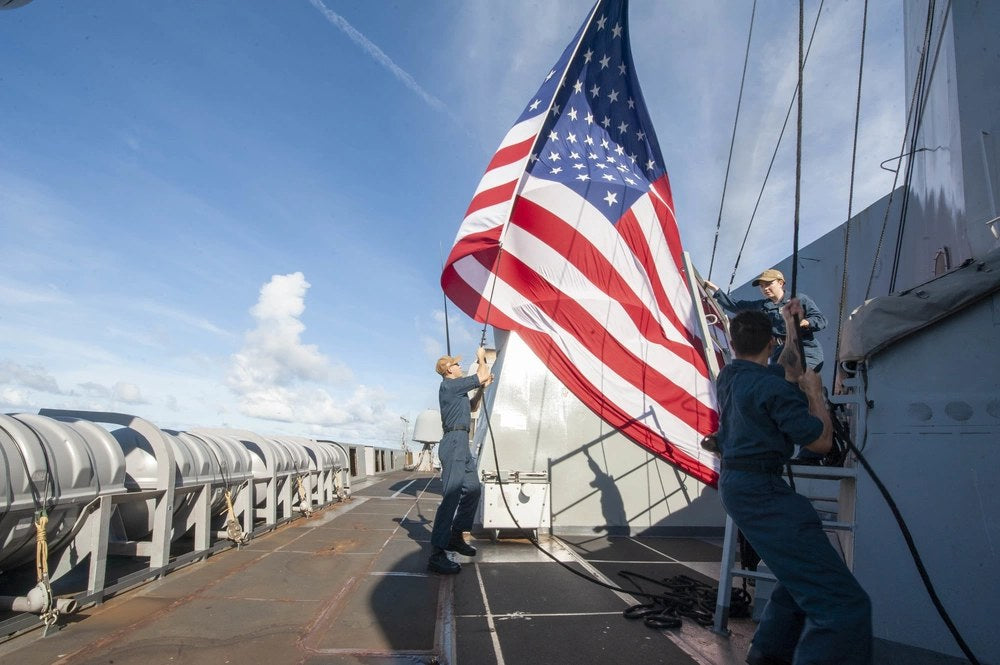
PHOTO CAPTION: Illustrative file photo. Members of the U.S. Naval War College Wargaming Department conduct a wargame at Naval Station Newport in January 2025. Under a new Pentagon promotion policy announced Sept. 22, officers competing for their first star will undergo evaluations that can include written military problems, interactive simulations and wargames. The Navy plans to conduct its evaluation at the Naval War College. (U.S. Navy photo by Petty Officer 2nd Class Connor Burns)
Senior military officers competing for promotion to general or admiral will soon face a new type of evaluation designed to test how they make decisions during simulated military crises.
The Pentagon announced Tuesday that eligible Army, Air Force and Marine Corps colonels, along with Navy captains and qualifying Space Force officers, will undergo a new Joint Warfighter Evaluation before promotion boards consider them for their first star.
The new assessment is intended to measure operational planning, decision making and leadership when officers are presented with military problems that change as the scenario develops.
The evaluation does not replace the existing promotion system.
Performance reports, previous command assignments, education, operational experience and the rest of an officer’s career record will continue to play the central role in promotion decisions.
Instead, the Pentagon wants promotion boards to have another piece of information: how an officer actually responds when confronted with a simulated battlefield problem.
The idea grew out of a broader effort to change how the military identifies officers for its most senior leadership positions.
Stuart Scheller, the senior Pentagon adviser leading the project, told Fox News that the military already has extensive systems for documenting an officer’s career performance, but no separate function specifically designed to compare how potential future generals perform as commanders in a simulated fight.
Scheller said the existing personnel system can identify officers who become very good at navigating their careers, while the new evaluation is intended to provide information about who may perform best when faced with battlefield decisions.
The evaluations will look very different depending on the service.
According to internal service plans reviewed by Fox News and subsequently detailed by Military Times, the Army expects roughly 900 colonels to complete a remote written assessment followed by a digital wargame.
The Air Force expects approximately 1,330 colonels to complete a two hour online analysis followed by a one hour interactive simulation.
About 125 Space Force officers are expected to use a similar format.
The Navy plans a considerably longer process.
Approximately 308 captains from unrestricted line and information warfare communities are expected to travel to the U.S. Naval War College.
There, candidates would complete a three hour written assessment followed by a wargame lasting another two to three hours.
The Marine Corps plans what may be the longest single evaluation.
As many as 175 Marine colonels are expected to complete an eight hour remote assessment using an AI enabled platform combining written exercises with tests of situational judgment.
Military Times noted that the detailed service plans came from internal documents reviewed by Fox and had not all been independently confirmed by the Pentagon as of Tuesday evening.
Some versions of the evaluation will use artificial intelligence to create an adversary that reacts to the officer’s choices.
The candidate makes a decision.
The simulated enemy responds.
The officer then has to interpret the new situation and decide what to do next.
That process is designed to test whether candidates can adapt when the situation does not unfold according to their original plan.
Other versions will rely on traditional wargaming, with evaluators watching how officers respond as an opposing force changes tactics.
The Pentagon says the goal is not to pretend that a computer exercise can perfectly reproduce combat.
Scheller acknowledged that no simulation can fully recreate the pressure and uncertainty of an actual war.
The department instead plans to study the first round of results and modify the evaluations based on what officials learn.
The Pentagon has also not decided exactly how much the scores will matter.
Scheller said performance reports will remain the foundation of promotion decisions.
The Joint Warfighter Evaluation will provide another data point for the board, but officials plan to wait until after the first evaluation cycle before deciding how much weight it should receive in future years.
That distinction means an officer will not simply sit down for a standardized exam, receive a passing score and automatically remain eligible for promotion.
Nor does a poor result automatically mean an officer cannot become a general or admiral.
For now, promotion boards will receive the evaluation alongside the rest of the candidate’s record.
The first real test of the system begins next year.
Eligible officers are expected to complete the new evaluations between roughly February and June 2027.
Promotion boards considering officers for pay grade O7 are then scheduled between July and September.
For the Army, Air Force and Marine Corps, promotion to O7 means becoming a brigadier general.
For the Navy, it means selection for rear admiral lower half.
The broader change is that officers reaching that point in their careers will now be evaluated on something the traditional promotion record could not directly show.
They will be given a military problem, forced to make decisions and, in some cases, confronted with an adversary that changes its actions because of what they decide.
(Source: OAF Nation)