Article: Pentagon Creates Religious Affairs Office
Pentagon Creates Religious Affairs Office
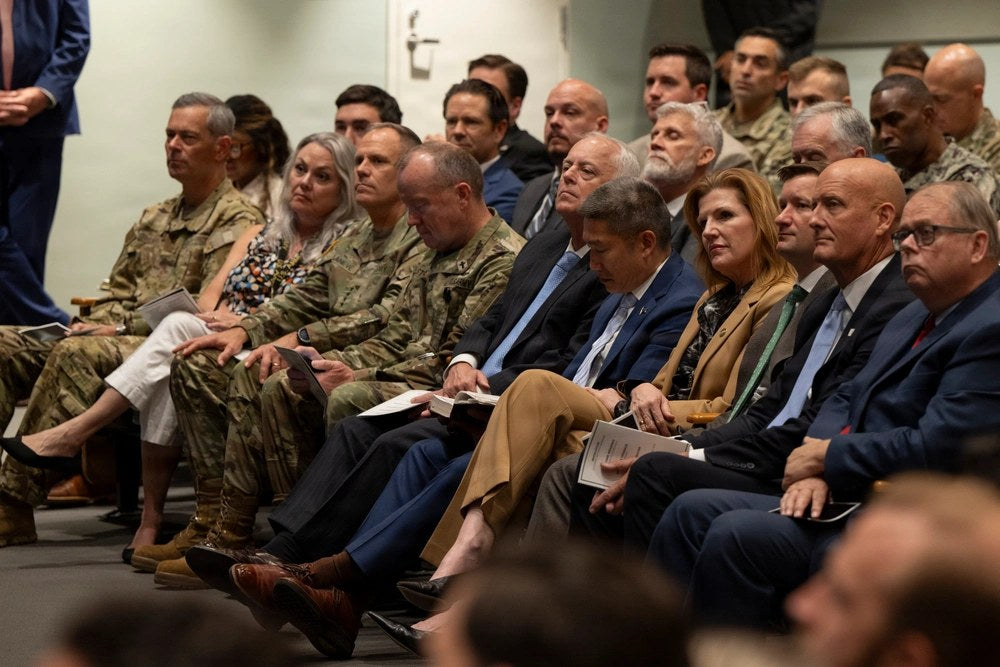
PHOTO CAPTION: Defense Secretary Pete Hegseth hosts a prayer service at the Pentagon in Washington on Aug. 19, 2026. Hegseth has created a new Office of Religious Affairs that will report directly to the defense secretary and coordinate religious support across the military. Department of Defense file photo.
The Pentagon is creating a new Office of Religious Affairs that will report directly to Defense Secretary Pete Hegseth and coordinate religious support across the military.
Hegseth announced the office during his State of the Force address at Marine Corps Base Quantico on Sept. 30.
The office became effective immediately under a Pentagon memorandum and will serve as the department’s central organization for religious-affairs policy, resources and support.
Its director, who has not yet been named, will serve as the principal adviser to the secretary and deputy secretary on religious affairs across the Defense Department.
Military chaplains will remain the primary providers of religious support to service members.
The new office is intended to serve as their advocate at the Pentagon’s highest level, including pushing for funding, infrastructure and other resources needed by the service chaplaincies.
Hegseth said the office will have direct access to senior leadership rather than leaving chaplains to work through layers of bureaucracy.
“This is not going to be a paper-pushing shop,” Hegseth said during his Quantico address.
The office will also coordinate religious-affairs policy across the military services and represent the defense secretary in religious-affairs matters involving Congress, religious endorsing organizations and other government agencies.
The Pentagon’s Armed Forces Chaplains Board and its executive director will be realigned under the new office.
Another part of the mission will involve research and tools intended to measure what the Pentagon describes as spiritual fitness, readiness and resilience among service members.
The office will also coordinate faith-based support programs for military families.
The Pentagon memo specifically mentions faith-based homeschool support and religious initiatives connected to suicide prevention.
Within 60 days, the office is expected to provide Hegseth with an initial fiscal 2027 budget proposal and identify its permanent staffing requirements.
Within 90 days, the military departments are expected to identify religious-affairs programs and requirements that are underfunded or unfunded.
The Pentagon says the office will not require anyone to participate in religious activities.
It also says the office cannot favor one religion over another or reduce the rights of service members who follow another faith or have no religious affiliation.
The creation of the office comes amid a broader series of changes involving religion and the military under Hegseth.
The Pentagon has recently consolidated the number of religious-affiliation categories used in military personnel records.
The department has also changed policies involving military chaplains, including how religious identity is displayed on some chaplain uniforms.
Hegseth has hosted Christian prayer services at the Pentagon and has repeatedly spoken about the role he believes faith should play in military life.
During Wednesday’s address, he argued that spiritual health should receive attention alongside physical readiness and said military chaplains had previously been limited by bureaucracy.
Critics say the new office raises questions about whether Christianity could gain greater influence over Pentagon policy.
Americans United for Separation of Church and State, which has previously challenged Pentagon religious practices, said the department has a responsibility to protect the religious freedom of troops of every belief and argued that the new structure risks elevating Christianity.
The Pentagon disputes that concern.
Its official description of the office says religious participation will not be compelled, no particular faith will receive preferential treatment and protections will remain in place for personnel who practice other religions or no religion.
Faith-related offices are not unprecedented elsewhere in the federal government.
Presidential administrations from both parties have maintained different versions of faith-based or religious-engagement offices, although their missions and relationships with government policy have varied.
The Pentagon’s new office is specifically focused on religious support inside the military.
Its first director has not yet been announced.
Once established, that person will report directly to the defense secretary and oversee a new Pentagon-level structure intended to coordinate religious affairs across the armed forces.
(Source: OAF Nation)