NRA Challenges PA Gun Permit Age Limit
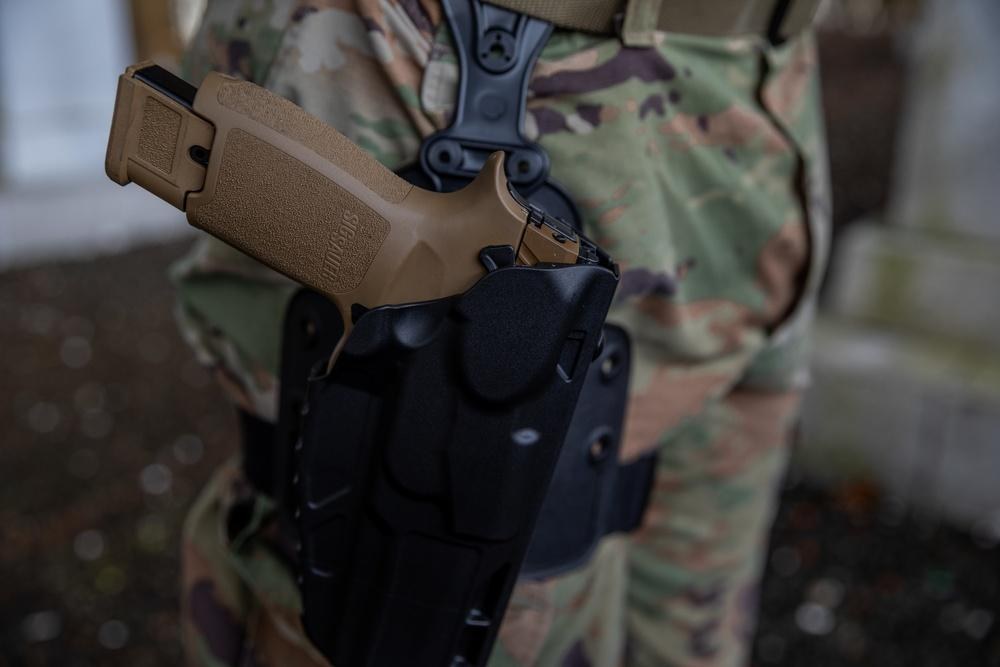
PHOTO CAPTION: An M17 service pistol is secured in a National Guard soldier's holster during training in Connecticut on April 8, 2022. A new federal lawsuit challenges Pennsylvania's minimum age of 21 for obtaining a firearm carry license, which is generally required to carry a handgun concealed or in a vehicle. No ruling has been issued in the case. (Illustrative U.S. Army National Guard photo by Sgt. Matthew Lucibello)
The National Rifle Association and Firearms Policy Coalition filed a federal lawsuit Thursday challenging Pennsylvania's refusal to issue firearm carry licenses to adults younger than 21.
The October 29 complaint argues that Pennsylvania is violating the Second Amendment by denying otherwise eligible adults ages 18 through 20 the ability to obtain licenses needed to carry concealed handguns, carry firearms in vehicles and generally carry firearms on public streets in Philadelphia.
The lawsuit, filed in the U.S. District Court for the Eastern District of Pennsylvania, names Philadelphia Police Commissioner Kevin Bethel and Pennsylvania State Police Commissioner George Bivens as defendants in their official capacities.
The plaintiffs are seeking a declaration that the age restriction is unconstitutional and a court order preventing its enforcement.
No court has ruled on the new lawsuit, and Pennsylvania's minimum-age requirement remains in effect.
Philadelphia Resident Challenges State's Age Requirement
The individual plaintiff is Daniel Maines, a Philadelphia resident between 18 and 20 years old.
According to the complaint, Maines is legally eligible to possess and acquire firearms and has no criminal convictions that would prohibit him from owning one.
He wants to carry a handgun for self-defense, including while traveling in his vehicle and on public streets in Philadelphia.
However, Pennsylvania law prohibits him from applying for a License to Carry Firearms because he is younger than 21.
The NRA and Firearms Policy Coalition joined the lawsuit on behalf of members facing similar restrictions.
The complaint argues that Maines and other adults in his age group should not be excluded from exercising public carry rights solely because of their age.
The organizations emphasize that Americans can vote, enter contracts and serve in the military at 18 while still being ineligible for Pennsylvania's ordinary firearm carry license.
Pennsylvania Law Creates Several Carry Restrictions
Pennsylvania generally permits people who may lawfully possess firearms to carry them openly without a concealed-carry license in some circumstances.
However, state law requires a License to Carry Firearms for most concealed carry and handgun carry in vehicles, subject to specific statutory exceptions.
The law also generally requires a license or applicable exemption to carry firearms on public streets and public property in Philadelphia.
Pennsylvania's licensing statute provides that applicants must be at least 21 years old.
That means otherwise eligible adults ages 18 through 20 cannot obtain the same license available to older residents.
The complaint argues that the combination of those requirements substantially restricts younger adults' ability to carry firearms for self-defense.
A person who unlawfully carries a firearm concealed or in a vehicle can face serious criminal penalties, although the classification of the offense depends on the circumstances.
Pennsylvania provides exceptions for certain activities, including specified hunting, shooting and law enforcement situations.
Those exceptions do not create a general carry-license pathway for adults under 21.
Federal School-Zone Law Adds Another Complication
The lawsuit also raises an issue involving the federal Gun-Free School Zones Act.
Federal law generally restricts firearm possession on school grounds and within 1,000 feet of qualifying elementary and secondary schools.
The statute includes several exceptions, including one for individuals holding qualifying licenses issued by the state where the school zone is located.
Because Pennsylvania does not issue its ordinary carry licenses to adults under 21, the plaintiffs argue that younger adults who are otherwise permitted to carry openly can face additional restrictions while traveling through neighborhoods surrounding schools.
The complaint contends that the combined effect of federal and state law makes lawful public carry particularly difficult for those younger adults.
The federal statute also provides other exceptions, including certain private-property situations and transportation of unloaded firearms in locked containers.
The lawsuit does not establish that every firearm possession within 1,000 feet of a school is automatically unlawful.
Earlier Federal Court Victory Did Not Resolve Permit Issue
The new case builds on an earlier Pennsylvania Second Amendment dispute.
In Lara v. Commissioner Pennsylvania State Police, the U.S. Court of Appeals for the Third Circuit held that the Second Amendment protects adults ages 18 through 20 and rejected Pennsylvania's restrictions on their ability to carry firearms openly during declared emergencies.
The Third Circuit first ruled in the challengers' favor in January 2024.
The Supreme Court subsequently returned the case for reconsideration after its decision in United States v. Rahimi.
In January 2025, the Third Circuit reaffirmed its earlier conclusion.
The Supreme Court declined further review in June 2026.
However, that litigation involved restrictions on open carry during declared emergencies.
It did not eliminate Pennsylvania's separate minimum age of 21 for ordinary firearm carry licenses.
The NRA and Firearms Policy Coalition now want federal courts to address that remaining licensing restriction.
Lawsuit Raises Broader Second Amendment Question
The new complaint relies heavily on the Supreme Court's 2022 decision in New York State Rifle & Pistol Association v. Bruen.
That ruling recognized constitutional protection for carrying handguns in public for lawful self-defense and required the government to justify covered firearm regulations through the nation's historical tradition of firearm regulation.
The plaintiffs argue that Pennsylvania cannot demonstrate a sufficient historical basis for excluding law-abiding adults ages 18 through 20 from obtaining carry licenses.
They also cite a federal appeals court decision involving Minnesota's restrictions on permits for younger adults.
The constitutional dispute centers on whether states may impose a higher minimum age for public handgun carry licenses than the age of legal adulthood.
The Pennsylvania officials named as defendants will have an opportunity to respond to the new complaint and defend the state's licensing system.
No defense filing or ruling in this new case has been established by the initial October 29 announcement.
What the Lawsuit Could Change
The plaintiffs are asking the federal court to declare Pennsylvania's minimum-age carry-license restriction unconstitutional as applied to otherwise eligible adults ages 18 through 20.
They also seek an injunction preventing state and Philadelphia authorities from enforcing the age restriction through the licensing and background-check process.
If the challengers prevail, the decision could expand access to carry-license applications for younger Pennsylvania adults.
It would not necessarily eliminate criminal background checks, other licensing requirements or separate restrictions on firearm possession.
For now, the lawsuit marks another stage in an ongoing constitutional dispute over where Second Amendment protections begin and whether states can impose different carry-license standards on younger and older adults.
Pennsylvania's existing licensing requirement remains in effect while the case proceeds.
(Source: OAF Nation)