Navy Plans Extended Carrier Deployments
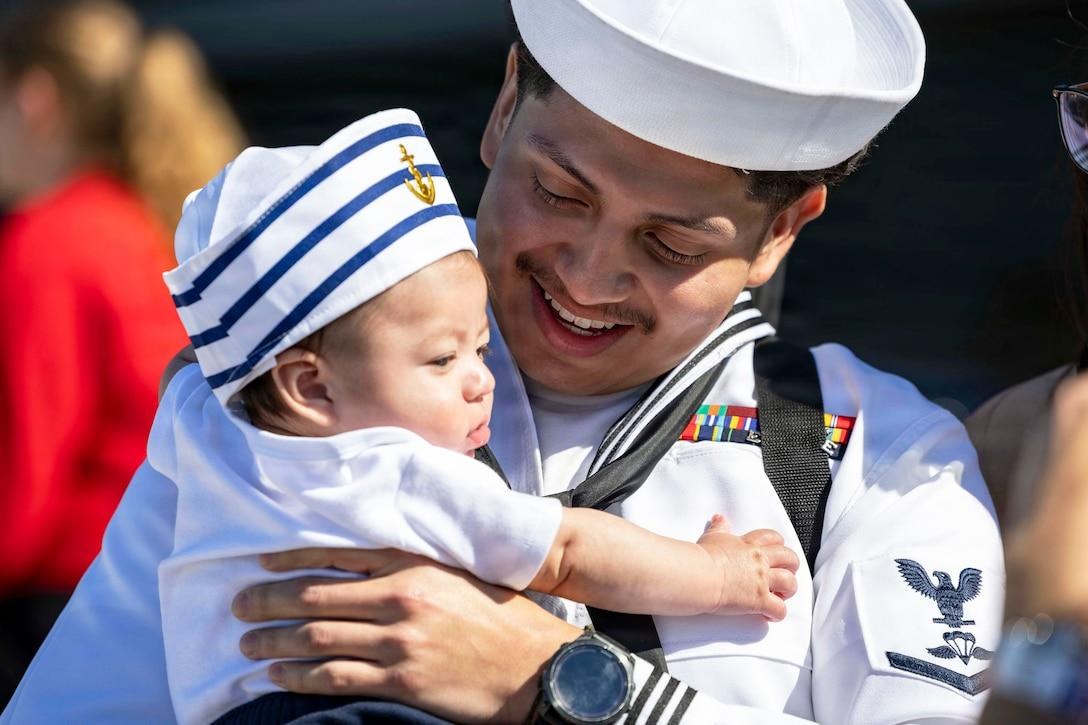
PHOTO CAPTION: Navy Petty Officer 3rd Class Omar Mora meets his newborn child for the first time at Naval Station Norfolk, Virginia, on May 16, 2026, following an 11-month deployment aboard USS Gerald R. Ford. Navy leaders now say sailors assigned to deploying carrier strike groups should expect 10 to 11 month deployments, with a return to traditional seven-month schedules potentially years away. (Archival U.S. Navy photo by Petty Officer 1st Class Sophie Pinkham)
Sailors assigned to deploying Navy carrier strike groups are being told to prepare for deployments lasting 10 to 11 months, with the service's top leaders warning that a return to the traditional seven-month schedule could still be years away.
Master Chief Petty Officer of the Navy John Perryman said Wednesday that the fleet's operational demands have made extended deployments increasingly difficult to avoid.
Chief of Naval Operations Adm. Daryl Caudle reinforced that assessment during a separate appearance at the Navy Memorial this week, acknowledging that the Navy does not currently have enough capacity to maintain its commitments while returning ships to shorter deployment schedules.
The comments, reported October 29 by USNI News, represent a significant acknowledgment that unusually long deployments may continue affecting sailors and their families for the foreseeable future.
The statements are planning expectations for carrier strike groups, not a new order requiring every Navy sailor to spend 11 months deployed.
Sailors Being Told to Expect 10 to 11 Months
Perryman said Navy leadership has begun giving sailors preparing for carrier strike group deployments more realistic estimates of how long they will be away from home.
Rather than initially planning for seven months and repeatedly extending the deployment, leaders are telling some crews to prepare for 10 to 11 months from the beginning.
According to Perryman, the uncertainty surrounding return dates has become one of the most frustrating aspects of prolonged deployments.
Sailors and their families often make plans based on the original schedule, only to have those arrangements disrupted by repeated extensions.
Perryman said the problem is not simply the number of months at sea.
"It's the uncertainty. They can't plan for it."
He acknowledged that the Navy would prefer shorter deployments but said its current operational commitments make that difficult.
Perryman expects it could take another couple of years before deployment lengths return to the traditional seven-month schedule.
Navy Chief Says Fleet Lacks Capacity
Caudle offered a similar assessment, explaining that the Navy's available ships cannot meet current operational demands while maintaining shorter deployment rotations.
He said sailors should anticipate deployments lasting at least 10 months under present conditions.
The admiral argued that reducing those commitments would require additional fleet capacity.
"I need a bigger Navy," Caudle said.
Longer deployments have become increasingly common as the United States maintains naval forces in multiple regions while supporting military operations in the Middle East.
The Navy has faced sustained operational pressure since the Houthi attacks on international shipping in the Red Sea began driving extended carrier operations in 2023.
The situation intensified following the expansion of American military operations against Iran in February 2026.
Those commitments have required ships and crews to remain deployed well beyond their traditional schedules.
Caudle said he is working with Defense Secretary Pete Hegseth and Chairman of the Joint Chiefs of Staff Gen. Dan Caine to establish more predictable deployment timelines.
Two Aircraft Carriers Recently Spent Nearly 11 Months Deployed
Two of the Navy's largest carrier strike groups illustrate the operational demands facing the fleet.
USS Gerald R. Ford returned to Naval Station Norfolk, Virginia, on May 16 following a 326-day deployment.
The carrier operated across multiple fleet areas, including the Middle East, and supported military operations during the conflict with Iran.
Its crew sailed more than 57,000 nautical miles and completed 23 replenishments at sea during the deployment, according to the Navy.
USS Abraham Lincoln returned to San Diego on October 8 after a 321-day deployment, most of which involved operations in the Middle East.
The carrier spent 265 consecutive days without making a port visit, setting a Navy record for that measure.
The unusually long stretch without access to shore facilities drew attention to the strain on sailors who had spent much of the year aboard the ship.
Both deployments were among the longest recorded for American aircraft carriers in recent decades.
Navy Leaders Acknowledge Family Strain
Perryman said the service is trying to improve communication with sailors about deployment expectations, particularly when operational requirements make extensions likely.
A sailor who expects to return after seven months may make arrangements for childcare, housing, family celebrations or other commitments based on that schedule.
Repeated extensions can force families to change those plans with little warning.
The issue becomes especially difficult when a deployment stretches toward an entire year.
Caudle also emphasized the importance of providing port visits during extended operations.
He said sailors need opportunities to leave the ship, contact their families and recover from the demands of sustained operations.
Those visits do not eliminate the burden of being separated from loved ones, but Navy leadership considers them important for maintaining morale and readiness.
The Navy has also adjusted programs intended to help sailors transition back to life at home after prolonged deployments.
Perryman said the service is conducting additional assessments and follow-up contacts with returning sailors based on their individual risk levels.
The efforts recognize that returning from an extended deployment can present challenges even after the ship reaches its homeport.
Pentagon Makes Final Decisions on Extensions
Perryman also addressed who ultimately decides whether ships remain deployed beyond their scheduled return dates.
He said Navy officials submit objections explaining why additional extensions could negatively affect crews and fleet readiness.
However, decisions to keep ships deployed are made at higher levels of the Defense Department and national security leadership.
Once those decisions are issued, the Navy is responsible for executing them.
That creates a difficult balance between meeting current military requirements and preserving the long-term health of crews and ships.
Extended deployments can also complicate maintenance schedules.
Ships returning after unusually demanding operations may require additional repairs and inspections, potentially affecting when they can return to service.
The longer those maintenance periods become, the harder it can be for the Navy to provide enough ships for future deployments without extending the tours of other crews.
Retention Remains Strong on Some Deployed Ships
Despite the extended deployments, Navy leaders pointed to continued reenlistment among sailors serving aboard several of the fleet's busiest ships.
Perryman said approximately 74 percent of eligible sailors aboard USS Abraham Lincoln chose to reenlist during its deployment.
The Navy did not specify how many sailors were eligible for reenlistment, making the percentage difficult to evaluate without additional context.
Caudle also identified USS Gerald R. Ford and USS George Washington among carriers reporting strong retention.
The figures suggest that lengthy deployments have not uniformly discouraged sailors from continuing their naval careers.
However, they do not eliminate concerns about family separation, fatigue, maintenance demands or the long-term sustainability of repeated extended deployments.
No Immediate Return to Seven-Month Deployments
For now, Navy leadership is preparing carrier strike group sailors for extended tours rather than promising a return to traditional deployment lengths.
Perryman believes the fleet could need several more years before seven-month deployments become the norm again.
Caudle has not established a specific date for when the Navy will have enough capacity to shorten its schedules.
Future deployments will still depend on operational requirements, available ships and decisions made by senior defense leaders.
The practical message for sailors and their families is that 10 to 11 months away from home may remain an expectation for deploying carrier strike groups, rather than an exceptional extension.
And according to the Navy's own leadership, that reality is unlikely to change quickly.
(Source: OAF Nation)