MATE-3MDR Shows PTSD Symptom Drop
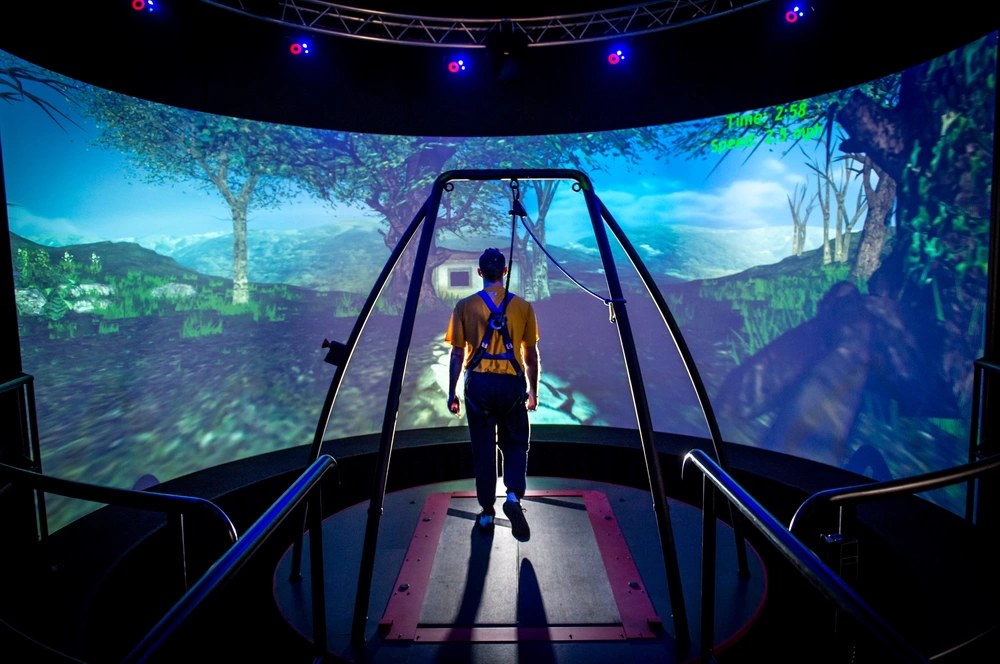
PHOTO CAPTION: Illustrative file photo — A patient uses the Computer Assisted Rehabilitation Environment at Walter Reed National Military Medical Center in Bethesda, Maryland. U.S. Air Force photo by J.M. Eddins Jr.
An experimental therapy that combines treadmill walking, personalized music and imagery with eye-movement exercises produced a large drop in PTSD symptom scores among the first 10 patients to complete an enhanced version of the treatment, according to new military medical research.
The approach, known as MATE-3MDR, is being studied in patients who have both post-traumatic stress disorder and a history of traumatic brain injury. Among the first 10 people to complete the newer treatment, scores on the PTSD Checklist fell by an average of 26 points.
The findings were presented during the 2026 Military Health System Research Symposium by researchers affiliated with the Uniformed Services University.
The treatment builds on an approach called 3MDR, short for multi-modular memory desensitization and reconsolidation. During treatment, patients walk on a treadmill while working through personally selected material connected to their traumatic experiences.
Patients can select music associated with the traumatic period and images that evoke memories connected to the event. During the session, they move toward those images in a virtual environment while discussing the memories with a therapist and completing a dual-task eye-movement exercise.
The newer MATE-3MDR version adds music and art therapists to the process. The additional therapists help participants select music and create artwork centered on post-traumatic growth.
The 26-point average reduction was measured using the PTSD Checklist for DSM-5, or PCL-5, a 20-question self-report tool commonly used to measure PTSD symptom severity. Scores can range from zero to 80, with higher numbers reflecting greater symptom severity. The Department of Veterans Affairs says a change of about 10 points has been suggested as an indicator of treatment response, although interpretation should be made by a clinician.
The new results build on earlier research into 3MDR.
In a previous randomized pilot study involving 20 active-duty service members and veterans who had both probable PTSD and a history of mild traumatic brain injury, 16 participants completed the treatment.
Average PTSD Checklist scores in that study fell from 52 before treatment to 33.6 afterward. Nine of the 16 completers no longer met the study’s criteria for probable PTSD after treatment, while two additional participants showed significant improvement without reaching that threshold.
Researchers have been studying 3MDR partly because conventional trauma-focused treatments can be difficult for some patients to complete. The approach is designed to make patients physically move toward trauma-related memories rather than discussing them only while seated.
The therapy also uses individualized music and imagery rather than presenting every patient with the same virtual environment.
Despite the size of the symptom reduction reported in the newest group, the MATE-3MDR findings remain preliminary.
Only 10 patients were included in the reported early results, and the presentation does not establish that the therapy caused the improvement or that similar results would occur in a much larger population.
The new findings also have not yet been reported as the results of a large randomized clinical trial.
Researchers will need additional participants, comparison groups and longer follow-up to determine how durable the improvements are and how the treatment compares with established PTSD therapies.
Still, the early results add to a growing body of research examining whether movement, immersive environments and personalized trauma cues can help service members and veterans who are dealing with both PTSD and traumatic brain injury.
The findings were presented at the Military Health System Research Symposium in August 2026.
Source: Uniformed Services University; 2026 Military Health System Research Symposium; prior randomized 3MDR research published in Frontiers in Virtual Reality.
(Source: OAF Nation)