Marines Use Goats for Wildfire Control
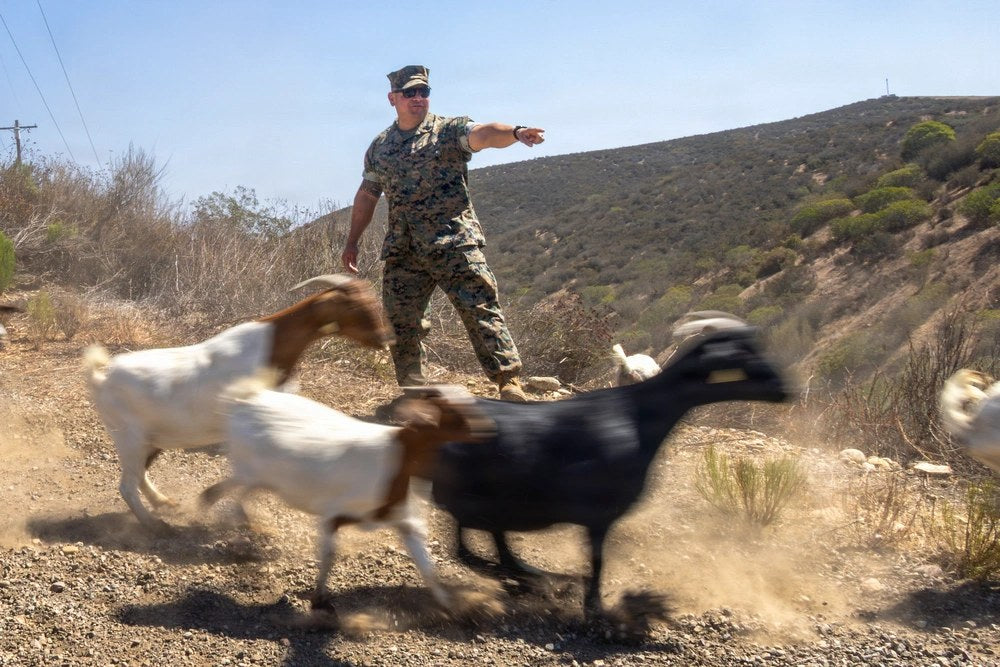
PHOTO CAPTION: U.S. Marine Corps Sgt. Maj. Alejandro Garcia Jr., sergeant major of Marine Corps Air Station Miramar, directs goats toward their grazing area during Operation Goat Rope at MCAS Miramar, California, Sept. 15, 2026. The base brought in 471 goats to clear vegetation and reduce wildfire risk. (U.S. Marine Corps photo by Cpl. Seferino Gamez)
The Marine Corps has brought in an unusual new force to fight wildfires at one of its California installations.
Four hundred seventy-one goats.
Marine Corps Air Station Miramar launched a pilot program this week using hundreds of grazing goats to clear dry brush and invasive vegetation from training land around the San Diego base.
The Marines gave the effort an appropriately military name:
Operation Goat Rope.
The goats arrived at Miramar on Sept. 15 as part of a partnership with Shepherdess Land and Livestock, a company that uses goats and sheep for targeted vegetation management.
Over the next five to six weeks, the herd is expected to work its way across an initial area of more than 600 acres in Miramar’s explosive ordnance disposal training area.
Their mission is simple.
Eat.
The goats are being sent into steep canyon terrain and other areas where clearing brush with personnel or heavy machinery can be difficult.
By consuming dry vegetation, officials hope the animals will create natural fuel breaks that can slow the spread of a wildfire before flames reach critical infrastructure or neighboring communities.
Miramar Fire Chief Joshua Allen said those breaks can give firefighters additional time when a blaze begins moving through Southern California vegetation.
“The strategic fuel breaks created by this targeted grazing program slow a fire’s advance and lower the energy released,” Allen said.
That, he said, can give firefighting crews an advantage in containing a blaze before it grows.
The Marine Corps says the program also avoids some of the drawbacks associated with traditional brush-clearing methods.
Base spokesman 1st Lt. Blake Starbuck said targeted grazing can reduce wildfire hazards while avoiding emissions, soil disruption and chemical runoff associated with some mechanical or chemical vegetation-control methods.
Southern California military installations routinely deal with wildfire danger because of extensive undeveloped training areas and the region’s long dry season.
At nearby Marine Corps Base Camp Pendleton, for example, officials say an average of roughly 101 wildfires occur each year across the installation.
Miramar officials describe the goat program as a first for the military.
According to the base, MCAS Miramar is the first U.S. military installation to use goats in this specific type of wildfire-mitigation program. The project is being treated as a pilot so officials can evaluate whether targeted grazing should become part of future wildfire-prevention efforts.
And unlike most new equipment being tested by the military, the maintenance requirements are relatively straightforward.
The goats are kept behind portable electric fencing, provided with water and moved between grazing areas as they work through the vegetation.
For the next several weeks, nearly 500 of them will effectively serve as Miramar’s newest brush-clearing crew.
(Source: OAF Nation)