Marines Train to Counter Drones
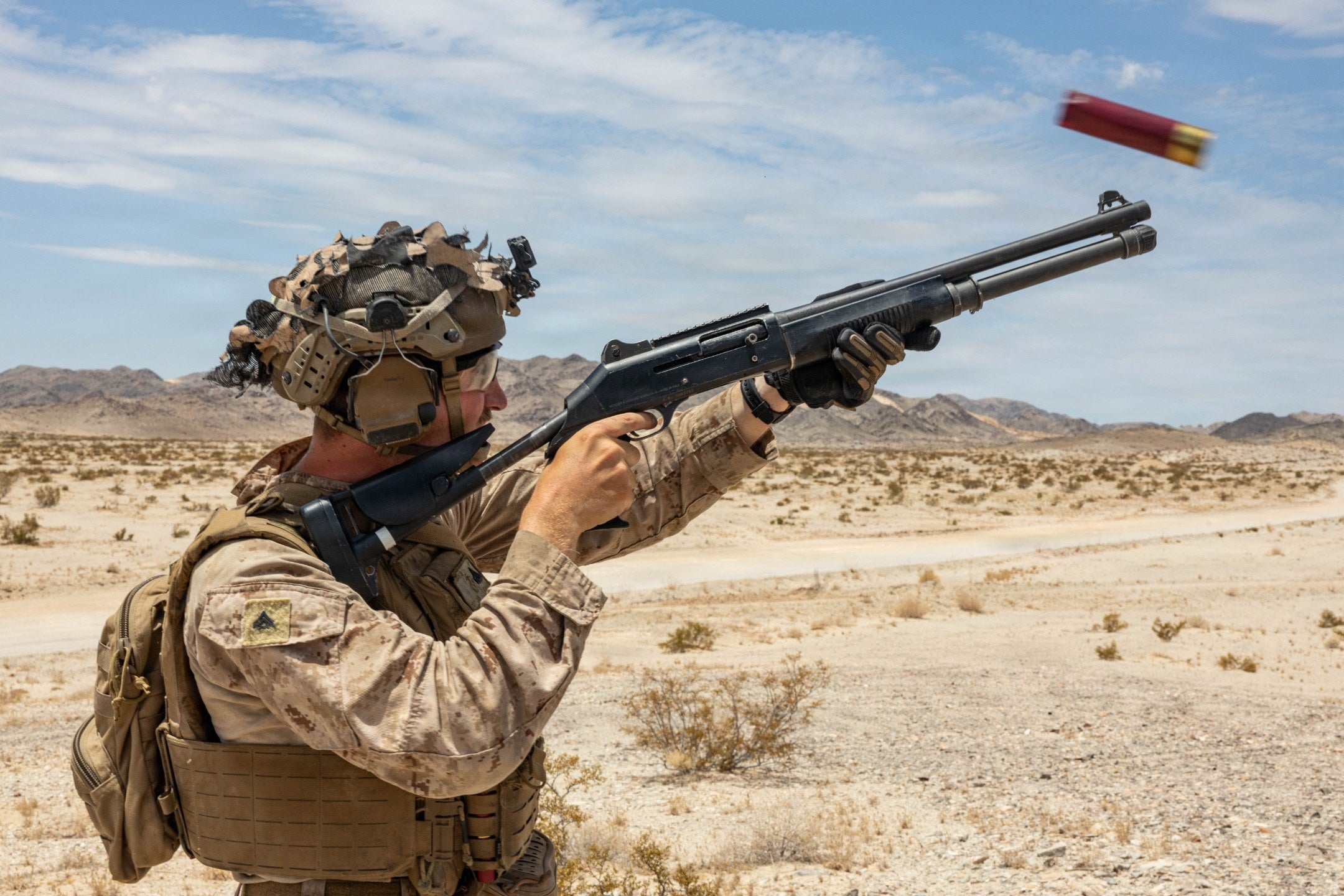
PHOTO CAPTION: U.S. Marine Corps Cpl. Ethan Camarco fires an M1014 combat shotgun during counter-small unmanned aerial system training at Marine Corps Air Ground Combat Center Twentynine Palms, California, July 17, 2026. (U.S. Marine Corps photo by Lance Cpl. Cody Fitzgerald)
The Marine Corps is training troops to shoot down small enemy drones with weapons already carried by Marine units, including rifles, shotguns and grenade launchers, as the service adapts to the growing threat of inexpensive unmanned aircraft.
The Marine Corps announced the training Aug. 11, 2026, after launching its first dedicated counter-small unmanned aerial system training lanes during Service Level Training Exercise 4-26 at Twentynine Palms, California. The new training began July 15 and involved units from the 1st and 2nd Marine Divisions.
Marines used M27 infantry automatic rifles firing 5.56 mm ammunition and M1014 combat shotguns firing 12-gauge shells against simulated enemy drones.
They also trained with M32A1 and M320 grenade launchers firing 40 mm rounds. Electronic warfare systems were used alongside the conventional weapons to give Marines both kinetic and non-kinetic ways to defeat unmanned aircraft.
The targets were not stationary.
During the live-fire training, Marines engaged simulated enemy drones flying at speeds of more than 90 mph, including targets that approached within about 20 meters of their positions.
Before entering the live-fire lanes, Marines completed three days of classroom instruction and practical training focused on detecting, tracking and defeating small drones. Counter-drone threats were then incorporated throughout the broader exercise rather than being treated as a stand-alone event.
The Marine Corps also trained dedicated drone operators to provide a more realistic enemy threat. Marines from the Tactical Training and Exercise Control Group, 7th Marine Regiment and 3rd Light Armored Reconnaissance Battalion underwent a three-week course that included first-person-view drone operations and tactical employment.
The shift reflects lessons coming from modern conflicts, where cheap commercial and military drones can locate troops, direct fire, conduct surveillance or attack individual vehicles and positions.
Marine officials said the goal is not to turn every infantry squad into a specialized air-defense unit, but to make counter-drone awareness part of how Marines operate on the battlefield and give troops confidence that they can respond with equipment already available to them.
The service has also created a new Marine Corps Counter Drone Team and Marine Corps Robotics Integration Group to help test counter-drone tactics and turn successful approaches into standardized training across the force.
Twentynine Palms plans to continue incorporating small drones and counter-drone training into future Service Level Training Exercises.
For Marines, that means a threat once handled largely by specialized air-defense and electronic-warfare systems is increasingly becoming something an infantry squad may have to deal with using the rifle, shotgun or grenade launcher already in its hands.
(Source: OAF Nation)