Marines Plan CT Scanners for Armor
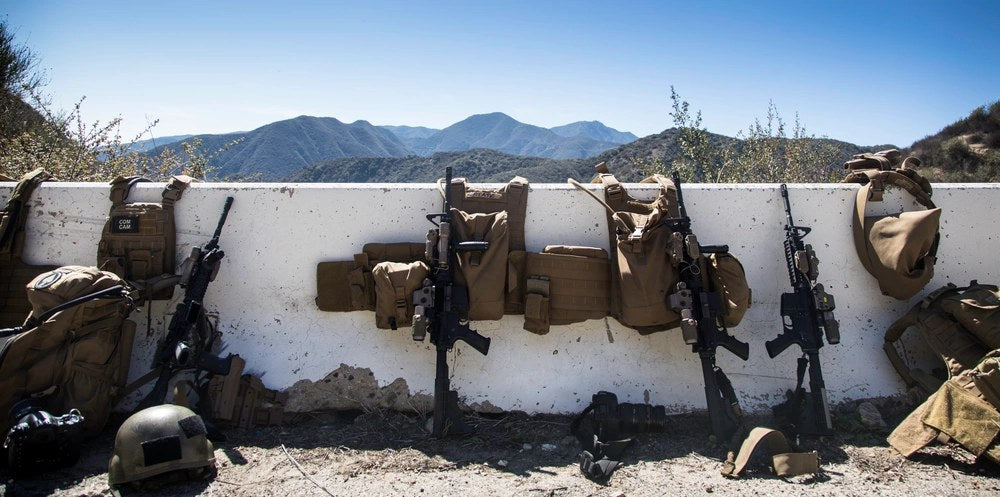
PHOTO CAPTION: Weapons and body armor used by Army, Navy and Marine Corps personnel sit staged during Fleet Combat Camera Pacific’s Winter Quick Shot exercise in California, March 8, 2014. U.S. Army photo by Spc. Philip Diab.
The Marine Corps is looking at high-resolution CT scanners to detect hidden cracks and separation inside hard body-armor plates, potentially automating inspections that still rely in part on tapping the armor and listening to the sound it makes.
A new Marine Corps request for information calls for an Enhanced Armor Inspection System capable of scanning Enhanced Small Arms Protective Inserts, commonly known as ESAPI plates, as well as Marine Corps Lightweight Plates. The service is seeking information from industry on automated systems using computed tomography and defect-recognition software.
The Marine Corps envisions 10 inspection systems: six in the continental United States, two in Japan, one in Hawaii and one in Guam.
CT scanning would allow inspectors to create detailed three-dimensional images of armor plates and identify defects including cracks and delamination that may not be visible from the outside.
The current inspection process is considerably more hands-on.
Marine Corps guidance has long instructed personnel to use a tap test to look for delamination in ESAPI plates. During that test, an inspector taps the plate and listens to the response: a normal area produces a more distinct chime, while a dull sound can indicate separation inside the plate.
The Corps also uses other methods to identify damage. Traditional X-ray inspection can detect cracks in ceramic armor, while Marines themselves are instructed to periodically perform a torque test to check their plates for possible damage.
The Marine Corps has previously acknowledged drawbacks to existing inspection technology. A 2023 research solicitation described CT scanning as a possible solution but noted that conventional CT equipment was extremely expensive and required highly trained personnel.
The new effort seeks a more automated commercial system that would move individual armor plates through the inspection process, capture CT imagery and use automated defect-recognition software to identify potential problems.
The stakes are straightforward. Hard armor plates are designed to protect Marines from rifle fire, and internal damage can reduce a plate’s ability to perform even when the exterior appears intact.
Marine Corps Systems Command has emphasized for years that ESAPI plates should be inspected before issue and periodically checked by the service member using them. The Corps even published an official instructional video demonstrating the tap-and-torque process.
Industry responses to the new CT-scanning request are due Oct. 2.
For now, the Corps has not announced a contract award or selected a specific system. The request is an effort to determine what industry can provide as the Marines look for a faster and more automated way to determine whether the armor troops depend on is actually sound.
Source: U.S. Marine Corps; Marine Corps Systems Command
(Source: OAF Nation)