Marines' Cold-Weather Boots Fail
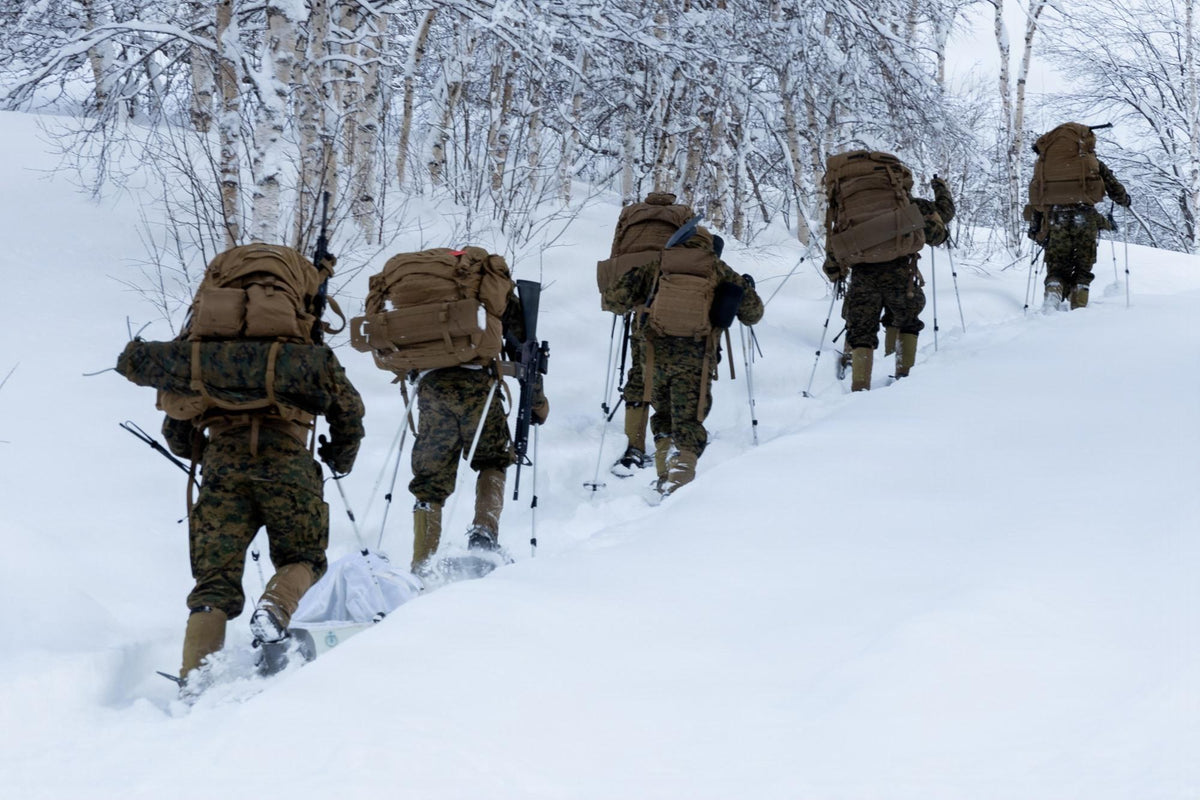
PHOTO CAPTION: U.S. Marines move through deep snow near Setermoen, Norway, during cold-weather training for Exercise Cold Response 26 on Feb. 24, 2026. Newly disclosed military records show issued cold-weather boots failed during the Arctic training, prompting inspections that later identified 538 workmanship failures. (U.S. Marine Corps photo by Cpl. Apollo Wilson)
U.S. Marines sent to Norway for one of the military’s largest Arctic exercises began running into a basic equipment problem within days:
Their issued cold-weather boots were falling apart.
Military records newly reported Thursday show Marines preparing for Cold Response 2026 experienced holes opening in their boots, soles separating and freezing water getting inside as they moved through snow and ice.
Some of the affected boots had been worn for less than 30 days.
The failures became serious enough that some Marines were pulled from training and replacement footwear had to be obtained in Norway.
The Marine Corps has confirmed that the problems involved Belleville Intense Cold Weather Boots and said Marine Corps acquisition personnel witnessed the issues firsthand during training in Norway.
According to an early-2026 military assessment reviewed by Newsweek, Marines encountered “significant defects” in the specialized footwear during cold-weather training beginning in late February. Problems included soles separating from the boots, damage to the leather and failures around the heel and eyelets.
A Pentagon official told the outlet that Marines were removed from the ice-covered training areas in some cases after soles began peeling away or plastic components near the heel created problems.
Other boots allowed cold water inside as Marines moved through the Arctic environment carrying their equipment.
The problem was not limited to the boots already being worn in Norway.
After the failures emerged, Marine Corps personnel began inspecting additional inventory at Camp Lejeune, North Carolina.
The results were substantial.
In April, inspectors examined 2,642 Belleville Intense Cold Weather Boots and identified 183 with defects, a failure rate of 6.93%.
A second inspection in July examined another 1,781 boots.
This time, 355 were found defective — a failure rate of 19.93%.
Combined, the two inspections covered 4,423 boots and identified 538 defects, producing an overall rate of 12.17%.
The Marine Corps confirmed that the inspections found 538 “out-of-the-box workmanship failures.”
For comparison, the military presentation reviewed by Newsweek cited an industry failure rate of roughly 2% to 3%.
The July inspection therefore found defects at a rate several times higher than the benchmark cited in the military briefing.
The Marine Corps said the findings resulted in a corrective-action plan requiring Belleville to replace affected Intense Cold Weather Boots on a one-for-one basis. The Defense Logistics Agency also confirmed that it had been helping the Marines inspect the footwear.
When replacements were needed in Norway, U.S. forces obtained locally available cold-weather footwear through an established host-nation support process so Marines could continue training.
The military said commanders and logisticians acted to keep Marines equipped and the exercise moving.
Belleville told Newsweek that it has been working directly with the Marine Corps to address the concerns and improve the quality of the footwear.
The company said it is committed to continuous quality improvements and said its performance consistently exceeds Defense Logistics Agency expectations.
The failures occurred as thousands of U.S. Marines deployed to Norway for Cold Response 26, a Norwegian-led winter exercise designed specifically to test whether U.S. and allied forces can deploy and operate in demanding Arctic conditions.
The Marine Corps says Cold Response involved more than 25,000 personnel from 12 countries.
For Marines training above the Arctic Circle, footwear is hardly a minor piece of equipment.
And according to the newly disclosed inspections, hundreds of boots intended specifically for extreme cold were failing before some Marines had even had them for a month.
(Source: OAF Nation)