Marine Corps Updates Swim Standards
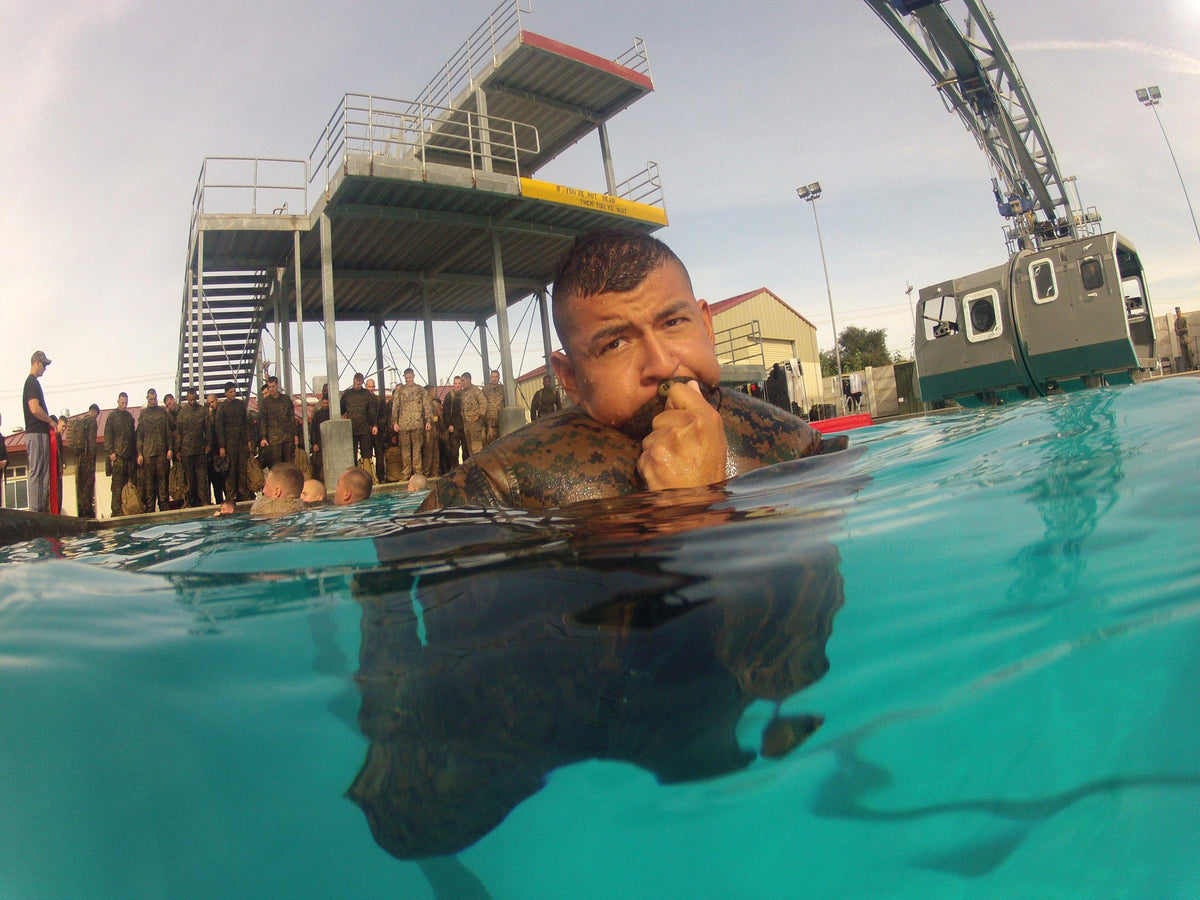
PHOTO CAPTION: A U.S. Marine with Marine Combat Instructor School practices inflating a uniform blouse during water survival qualification at Marine Corps Base Camp Pendleton, California, on October 23, 2026. The Marine Corps introduced updated water survival qualification standards effective October 1. (U.S. Marine Corps photo by Cpl. Jacqueline Akamelu)
The Marine Corps has changed its water survival qualification standards, introducing five levels of proficiency and establishing a new minimum requirement for Marines serving in the fleet.
The updated standards took effect October 1, 2026, and were detailed in Marine Corps implementation guidance highlighted in a November 20 report by Military Times.
For Marines who remember jumping into a pool wearing boots and camouflage, swimming with equipment, or trying to turn a blouse into a flotation device, much of the training will sound familiar.
What's changing is how those skills are measured, how far Marines must swim, and how long their qualifications remain valid.
The New Minimum: Water Survival Novice
Under the updated program, Water Survival Novice (WSN) becomes the minimum qualification for Marines in the fleet.
To earn it, Marines must complete a series of water survival exercises that test their ability to remain afloat, move through the water, and use their clothing and equipment to survive.
The requirements include:
A 25-meter swim assessment.
A platform entry followed by a 50-meter self-rescue swim using an approved survival stroke.
Five minutes staying at the surface, including inflating a uniform blouse during the final minute.
Shedding equipment in shallow water.
Swimming 25 meters while using flotation equipment.
The qualification remains valid for two years.
The requirements are designed around survival rather than swimming speed alone. A Marine who unexpectedly ends up in the water needs more than the ability to swim a few laps in ideal conditions.
The ability to stay calm, conserve energy, remove equipment, and create flotation can make a significant difference.
Five Qualification Levels, Different Requirements
The revised Marine Corps Water Survival Program establishes five qualification levels.
Water Survival Basic (WSB) remains the minimum requirement for graduating recruit training. It is valid for one year and is conducted during recruit training.
Water Survival Novice (WSN) is the new fleet-wide minimum, requiring a 50-meter self-rescue and five minutes staying afloat. It is valid for two years.
Water Survival Competent (WSC) raises the self-rescue distance to 150 meters and requires Marines to demonstrate two swimming strokes, remain at the surface for seven minutes, and complete additional water survival exercises. It is valid for three years.
Water Survival Proficient (WSP) replaces the previous Water Survival Intermediate qualification. Marines must complete a 250-meter self-rescue, demonstrate three swimming strokes, stay at the surface for 10 minutes, shed equipment in deep water, and perform a buddy-assistance exercise. It is valid for four years.
Water Survival Advanced (WSA) is the highest qualification. It includes a 500-meter swim completed in under 20 minutes, all four approved swimming strokes, and advanced rescue and survival skills. The qualification is valid for five years.
The different levels allow Marines to develop and maintain more demanding skills beyond the fleet's minimum requirement.
What Happens to Marines Who Already Qualified?
The transition does not automatically invalidate every Marine's previous swim qualification.
The Marine Corps established implementation rules for personnel with existing qualifications, including provisions addressing expiration dates and training requirements.
Marines who need additional preparation can also receive instruction through Preparatory Aquatic Training, including programs supported by Semper Fit and the Warrior Athlete Readiness and Resilience program.
The service is maintaining established uniform, equipment, and testing procedures even as it updates qualification levels.
Why the Marine Corps Is Changing the Program
The Marine Corps has been moving toward a more progressive approach to water survival training, emphasizing continued development rather than treating swim qualification as an isolated event.
Earlier in 2026, the service described its approach as building skills throughout a Marine's career.
That matters for a force whose operations can involve amphibious landings, shipboard assignments, small boats, and unexpected exposure to water while carrying military equipment.
Water survival training has long been part of Marine Corps life. The updated program does not eliminate familiar exercises such as blouse inflation, equipment removal, or swimming in uniform.
Instead, it establishes a new progression of standards and qualification periods intended to keep those abilities current.
For Marines who went through swim qualification under an earlier system, the new requirements provide a straightforward comparison: how far they had to swim, how long they had to remain afloat, and what equipment they had to manage along the way.
(Source: OAF Nation)