Judge Halts Trump's Monument Plan
PHOTO CAPTION: U.S. Air Force maintainers disassemble a B-52H Stratofortress wheel at Barksdale Air Force Base, Louisiana, on September 8, 2026. Air Force officials say the service faces a $14 billion spare-parts shortfall that is affecting aircraft maintenance and readiness across multiple fleets. (U.S. Air Force photo by Airman 1st Class Maxwell Cunningham. File photo.)
A federal judge has temporarily blocked construction of President Donald Trump's proposed 250-foot triumphal arch near Arlington National Cemetery, delivering a setback to the administration just after a federal planning commission approved the controversial monument.
U.S. District Judge Tanya Chutkan issued a 14-day restraining order late Thursday, November 5, preventing the government from beginning work while legal challenges continue.
The ruling came shortly after the National Capital Planning Commission voted 8-4 to approve final plans for the massive arch, which would stand at Memorial Circle near the Virginia entrance to Arlington Memorial Bridge.
Three Vietnam-era veterans are among those challenging the project, arguing that the monument would interfere with historic views connecting Arlington National Cemetery and the Lincoln Memorial.
The administration maintains that the arch would honor American veterans, commemorate the nation's 250th anniversary and enhance security.
But opponents question whether the project has received the necessary congressional authorization and whether its size and location are appropriate near one of America's most important military burial grounds.
Judge Stops Construction Just After Federal Approval
The November 5 commission vote followed a lengthy public hearing during which veterans, preservation advocates, lawmakers and local residents expressed concerns about the project.
More than 130 people were registered to speak, and reporting from Military Times indicates that over 90% of those who testified opposed the monument.
Despite the objections, commissioners approved the final plans by an 8-4 vote.
The Trump administration had indicated that construction could begin as soon as the required approvals were completed.
Shortly after the commission's decision, Judge Chutkan issued a temporary restraining order preventing work from starting for 14 days.
The court found that Washington, D.C., and Virginia had established that immediate construction could cause significant harm.
Among the concerns were disruptions to traffic, interference with emergency-response coordination and expenses that local governments might be unable to recover.
The judge also questioned the administration's reliance on a nearly century-old law as authorization for building the new monument.
The ruling does not permanently stop the project. It preserves the status quo while the legal challenges proceed.
Three Vietnam Veterans Are Challenging the Monument
The lawsuit includes three Vietnam-era veterans: Michael Lemmon, Shaun Byrnes and Jon Gundersen.
They are joined by Calder Loth, a former senior architectural historian for Virginia.
The plaintiffs argue that the proposed monument would damage a historic landscape deliberately designed to connect Arlington National Cemetery with the Lincoln Memorial across the Potomac River.
The setting has particular significance for veterans and military families.
Arlington National Cemetery contains the graves of more than 400,000 service members, veterans and eligible family members.
The Arlington Memorial Bridge provides a ceremonial connection between the cemetery and the National Mall.
During court proceedings, Lemmon described how he visits the Vietnam Veterans Memorial and Lincoln Memorial before crossing to Arlington to pay his respects to fallen comrades.
He expressed concern that a 250-foot structure with a tourist observation deck would change the character of the area.
For the plaintiffs, the dispute is not simply about architectural style. It concerns whether a large new attraction belongs along a historic route associated with military remembrance.
Trump Says the Arch Would Honor Veterans
The administration has presented the project as a tribute to American history and military service.
The arch would commemorate the nation's 250th anniversary and celebrate American achievements.
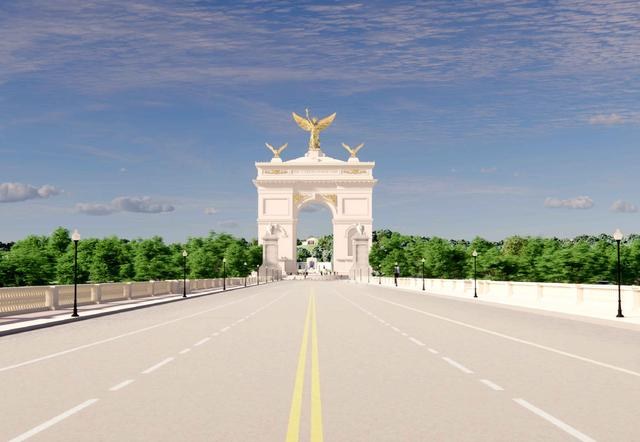
Its proposed design includes a large classical stone arch decorated with gold accents and crowned by a winged statue.
At approximately 250 feet tall, the structure would be more than twice the height of the Lincoln Memorial.
Supporters argue that a landmark of that scale would provide a fitting national monument and strengthen Washington's ceremonial landscape.
During the commission hearing, officials supporting the proposal described the arch as a tribute to veterans and a symbol of national identity.
The administration also argues that the location was contemplated for a memorial nearly a century ago.
A 1925 law provided for a different memorial proposal at the site, and administration officials contend that the earlier authorization supports the current project.
Critics dispute that interpretation, arguing that it cannot substitute for the specific approvals required for the much larger structure now proposed.
Trump Has Also Discussed Snipers and Drones
One of the more unusual aspects of the controversy is the administration's description of possible military uses for the monument.
Trump has publicly discussed using the structure as part of a security complex containing personnel and equipment such as snipers and drones.
However, those military features were not included in the final plans publicly submitted for the commission's approval.
The Washington Post reported in October that the published architectural materials contained no clear provisions for the security capabilities Trump had described.
During the November 5 hearing, officials confirmed that specific national security details had not been provided to the planning commission as part of the publicly reviewed design.
An Interior Department official said some security-related information had been submitted under seal in court proceedings.
That leaves unresolved questions about what security functions the monument would actually contain and how those functions would be incorporated into the approved design.
It would be inaccurate to describe the sniper and drone facilities as completed or publicly approved components of the arch.
The proposal currently remains a combination of submitted architectural plans and additional security concepts discussed by administration officials.
Why Arlington's Location Matters
Memorial Circle sits at the western end of Arlington Memorial Bridge, along a historic ceremonial route linking the Lincoln Memorial and Arlington National Cemetery.
The proposed monument would stand in a location that currently provides an open view across the Potomac River.
Opponents argue that adding a structure approximately 250 feet high would fundamentally change that setting.
Some veterans have also questioned whether an observation deck overlooking the cemetery would be appropriate near burial grounds where military funerals continue to take place.
Those concerns featured prominently during public testimony.
Others raised questions about traffic congestion, historical preservation, environmental impacts and the monument's potential effect on nearby airspace.
Supporters maintain that the project would enhance the ceremonial entrance to the capital and provide another destination honoring American history.
The competing arguments concern whether the monument complements the existing memorial landscape or significantly alters its intended character.
The Court Is Also Examining Congressional Authorization
A separate issue is whether the executive branch has authority to proceed without a new act of Congress.
The challengers argue that existing federal laws governing commemorative works require additional authorization and review.
Administration officials contend that legislation approved in 1925 already contemplated a monument in Memorial Circle and provides a legal basis for moving forward.
Judge Chutkan expressed serious doubts about that argument in her temporary ruling.
The court's skepticism does not amount to a final judgment resolving every legal question.
But it places the project's statutory authority among the issues the government must continue defending.
The litigation also involves the governments of Washington, D.C., and Virginia, which argue that construction would impose immediate costs and disrupt transportation and emergency services.
Their participation broadens the case beyond the objections raised by veterans and historic preservation advocates.
What Happens Next?
The temporary restraining order prevents construction for 14 days.
Judge Chutkan also ordered the government to submit a compliance report on Monday, November 9.
Additional court proceedings will determine whether construction can resume or whether a longer injunction should be issued.
The administration can continue defending the project and its claimed legal authority.
The planning commission's approval remains an important procedural step, but it does not override the court's temporary prohibition on construction.
The project could therefore face further delays, additional legal scrutiny or changes depending on the outcome of the litigation.
For veterans opposed to the monument, the immediate order prevents work from beginning while their concerns are considered.
For supporters, the arch remains a proposed national landmark intended to recognize American achievements and military service.
The larger question is whether the administration has the authority to place a 250-foot monument beside the historic approach to Arlington National Cemetery, and whether doing so is consistent with the character of a site devoted to military remembrance.
For now, construction is on hold, and that question remains unresolved.
(Source: OAF Nation)