Iran Urges U.S. to Honor Deal
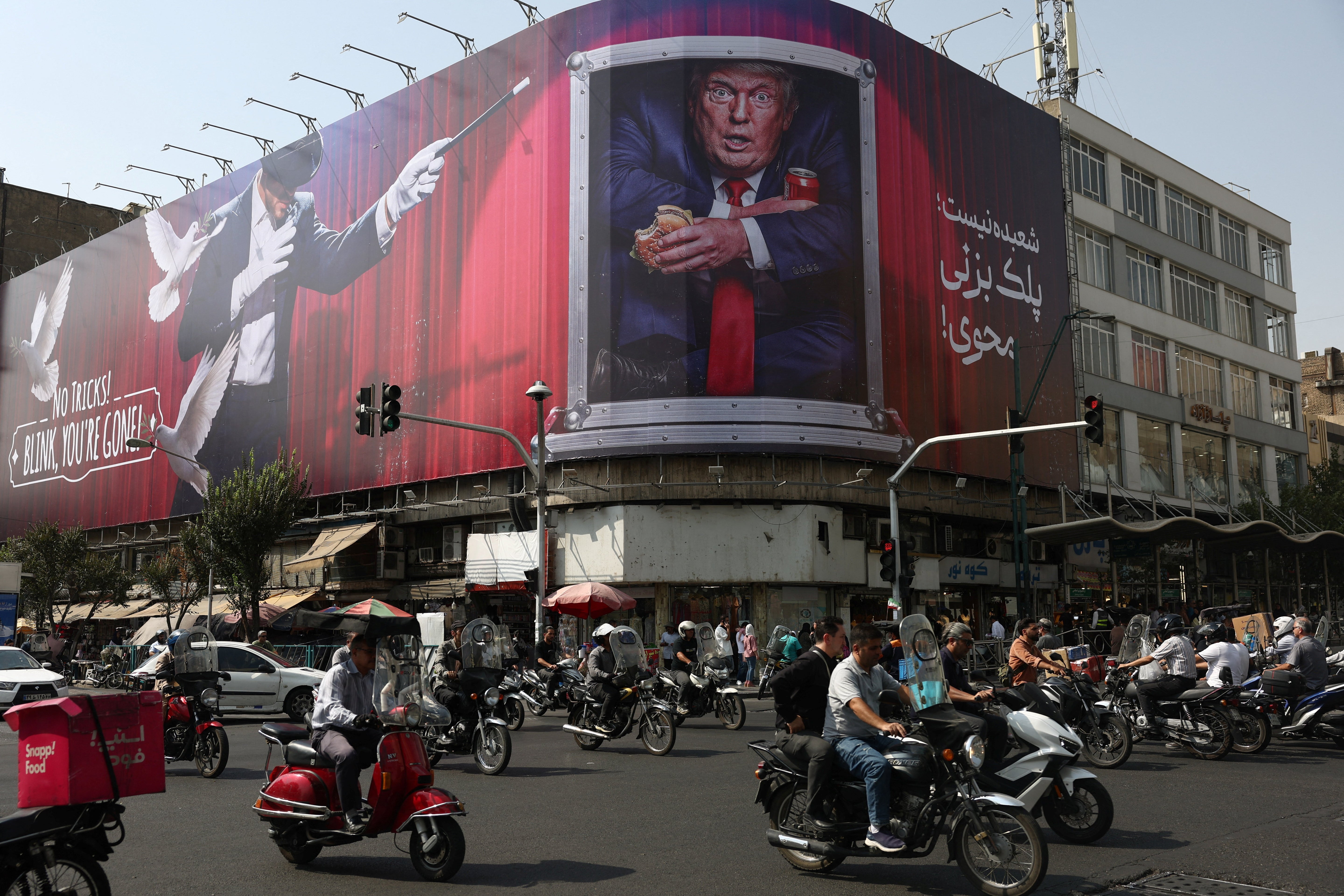
PHOTO CAPTION: People drive near a billboard depicting U.S. President Donald Trump on a building in Tehran, Iran, August 31, 2026. Majid Asgaripour/WANA (West Asia News Agency) via REUTERS
DUBAI, Sept. 1 — Iran said Tuesday it would reciprocate if the United States returned to its commitments under a June interim agreement aimed at halting their conflict, even as tensions remained high following President Donald Trump’s threat of further strikes.
Oil prices rose after the first direct exchange of attacks between the two countries since late July and after reports that two tankers were struck while leaving the Strait of Hormuz, the key global oil route that Iran has effectively closed to most shipping.
The six-month conflict had increasingly shifted toward sanctions, blockades and other forms of economic pressure before U.S. forces struck Iran’s Larak Island on Sunday. Iran responded by launching missiles at two U.S. air bases in Jordan.
“We're going to hit them hard ... There will be a response,” a Fox News reporter quoted Trump as telling the network Monday. Trump separately told reporters that the renewed strikes did not mean the conflict was returning to full-scale war.
A senior Iranian source described the exchange as a “limited and contained confrontation” but said Tehran would respond harshly if attacked again.
Neither side appears to be seeking an immediate return to all-out war, but their warnings of retaliation have highlighted how quickly a conflict increasingly fought through economic pressure could again escalate militarily.
Iran says U.S. must return to June agreement
Tehran has repeatedly said it will restore free navigation through the Strait of Hormuz only if Washington fulfills commitments under the Memorandum of Understanding signed by both sides in June.
The agreement declared an end to fighting but left many of the most difficult issues unresolved and established a broader 60-day negotiating period. That deadline passed without a further agreement.
“I am stating clearly that if the U.S. returns to its commitments under the Memorandum of Understanding, the Islamic Republic of Iran will immediately reciprocate,” Iranian President Masoud Pezeshkian said.
Pezeshkian spoke in Bishkek, Kyrgyzstan, during a Shanghai Cooperation Organisation summit whose members include Russia, China, India and Pakistan.
He had also said Monday that continued war was in no one’s interest and that Tehran remained open to a negotiated solution.
There has been no sign of a diplomatic breakthrough, however, and this week’s renewed fighting has revived concerns about disruptions to oil supplies from the world’s most important crude-producing region. Brent crude futures rose another 1.3% Tuesday.
“The tit-for-tat missile exchanges between the US and Iran bring validation to those who believe that even if not a ‘forever war’, this conflict will run and run,” PVM analyst John Evans said.
Those concerns were reinforced late Monday when two supertankers carrying Saudi oil were struck by unknown projectiles within minutes of each other while traveling out of the Strait of Hormuz, according to shipping intelligence and tracking firms Marisks and Kpler.
Washington increases economic pressure
Thousands of people have been killed in the conflict, mainly in Iran and Lebanon, since it began with U.S. and Israeli strikes on Iran on Feb. 28.
Washington has increasingly relied on economic pressure in an effort to force Tehran to stop blockading the Strait of Hormuz and bring the conflict to an end.
Treasury Secretary Scott Bessent has warned that countries doing business with Iran could face U.S. sanctions and said secondary sanctions were likely to be announced weekly, initially targeting banks.
Iranian central bank governor Abdolnaser Hemmati said Tuesday that Tehran had adequate foreign currency reserves and was prepared to inject as much as $2 billion into the foreign exchange market to limit recent volatility, according to the semi-official Tasnim news agency.
“I am telling the president of the United States: Iran has (foreign) currency and it has enough,” Hemmati said.
His remarks came as senior Iranian officials, including Pezeshkian, have acknowledged mounting economic pressure.
Iran’s currency fell to a record low in August, weakening past the psychological threshold of 2 million rials to the U.S. dollar. Annual inflation reached 66% in July.
(Source: Reuters)