Iran-Backed Plot Targets U.S. Bombers
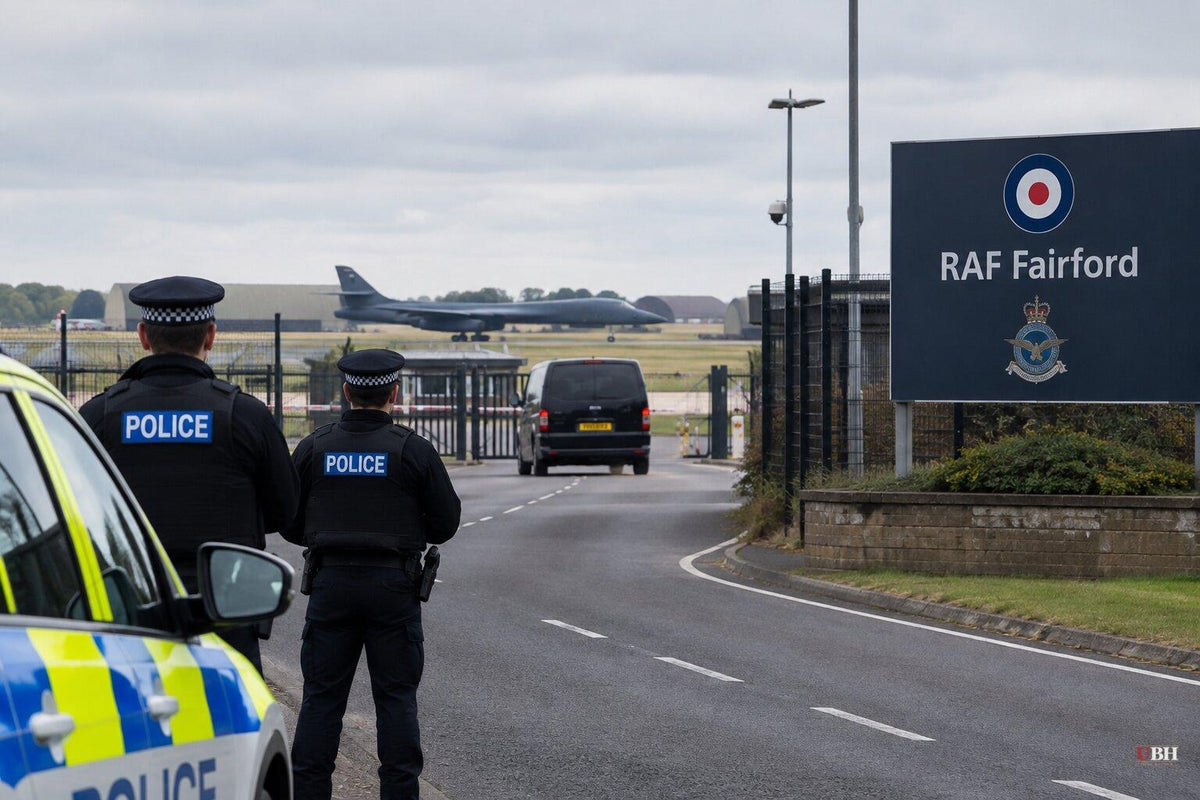
PHOTO CAPTION: A U.S. Air Force B-1 bomber prepares to take off as British police guard a checkpoint near RAF Fairford, England, on September 29, 2026. Federal prosecutors unsealed an indictment on November 10 accusing three men of coordinating an Iran-backed terrorist plot against the installation, which housed American aircraft and military personnel. The allegations have not been proven in court. (AP file photo by Alastair Grant.)
Federal prosecutors have accused three men of coordinating an Iran-backed terrorist plot targeting a British air base housing American military personnel and bombers, alleging that the network used disguised delivery vans, surveillance footage and coded communications from a New York jail to organize the attempted attack.
An eight-count federal indictment unsealed Tuesday, November 10, identifies RAF Fairford in Gloucestershire, England, as the intended target of a September operation allegedly organized on behalf of Iran's Islamic Revolutionary Guard Corps and the Iran-aligned militant group Kata'ib Hizballah.
According to prosecutors, members of the network arranged for three vans to approach the installation on September 26. Some vehicles contained barrels of fuel, while others had been prepared to resemble legitimate commercial delivery trucks.
Security roadblocks prevented at least two vans from reaching their intended routes.
British counterterrorism police subsequently arrested five men near the installation.
The indictment provides the most detailed public explanation yet of an incident that prompted heightened security around RAF Fairford and the eventual withdrawal of American bombers from the base.
The allegations have not been proven in court.
Three Men Charged in Alleged International Terror Network
The Justice Department identified the defendants as Mohammad Baqer Saad Dawood al-Saadi, a dual Iranian-Iraqi national; Mohsen Mohajeri, an Iranian national; and Mohammed Ali al-Hassani, an Iraqi national.
Federal authorities allege that the three coordinated terrorist activities benefiting Kata'ib Hizballah and the Islamic Revolutionary Guard Corps, both designated by the United States as foreign terrorist organizations.
The investigation involves nearly 20 alleged attacks and attempted attacks in Europe and the United States, including plots targeting Jewish communities.
The Fairford operation is the most recent alleged activity detailed in the superseding indictment.
Prosecutors say al-Hassani and Mohajeri were in Iran during the September operation and relied on contacts operating inside the United Kingdom.
Al-Saadi, meanwhile, was already in federal custody in New York awaiting trial on earlier terrorism charges.
Despite his incarceration, prosecutors allege he continued helping coordinate activity through coded messages passed to relatives overseas.
Of the three newly named defendants, only al-Saadi was in American custody when the indictment was announced.
Surveillance, Fake Company Logos and Vans Carrying Fuel
The alleged preparations began weeks before the suspicious vehicles appeared near RAF Fairford.
According to the indictment, al-Hassani arranged for associates in Britain to examine the installation and gather information about its surroundings.
On August 22, he allegedly paid an individual to conduct surveillance around the base's perimeter.
That person reportedly recorded videos of the surrounding area and transmitted them to al-Hassani.
In September, prosecutors say the network began gathering equipment and arranging transportation.
The alleged preparations included obtaining vans, barrels of fuel, materials potentially suitable for use as explosive accelerants and metallic objects that could be used as shrapnel.
Investigators also identified research into acquiring additional chemical materials.
The indictment alleges that associates commissioned custom decals for the vehicles to make them appear to belong to fuel-delivery and swimming-pool supply businesses.
The apparent commercial identities were intended to disguise the vans' connection to the alleged operation.
Prosecutors say al-Hassani directed and financed these preparations while communicating with individuals inside Britain.
Three Vans Approached Base Used by American Bombers
On September 26, al-Hassani allegedly directed associates to drive three vans toward RAF Fairford.
The installation had been hosting American military aircraft and personnel supporting operations during the conflict with Iran.
Prosecutors say al-Hassani remained in frequent contact with the drivers, instructing them where to travel.
At least two vans encountered security roadblocks and were unable to continue along their intended routes.
The drivers allegedly communicated with al-Hassani both before and after reaching those checkpoints.
During the early hours of September 27, British law enforcement officers located three white vans displaying the commercial decals.
Five men were arrested near the base.
The arrests followed reports of suspicious vehicles in the Whelford area.
British police established security cordons and conducted searches with support from specialist counterterrorism personnel, forensic investigators and military resources.
The situation drew national attention because RAF Fairford was hosting U.S. strategic bombers that had participated in operations involving Iran.
British Police Found Petrol, but No Completed Bombs
An important distinction emerged during the initial British investigation.
On September 29, Counter Terrorism Policing confirmed that investigators had recovered a quantity of petrol from the vehicles.
However, officers found no improvised explosive devices.
That finding does not eliminate the possibility of criminal preparations, but it means the vehicles were not publicly confirmed to contain completed bombs.
The suspects arrested near Fairford were initially questioned over explosives-related and terrorism offenses.
They were subsequently released on police bail while investigators continued gathering evidence.
British officials acknowledged that the decision raised questions but said the releases formed part of the investigative process.
The new American indictment provides additional allegations about the purpose of the vehicles, the planning behind their movements and the people suspected of directing the operation.
It does not establish that an explosive device was ready for detonation when the vans approached the installation.
Alleged Coordinator Sent Messages From a New York Jail
One of the most unusual elements of the case involves al-Saadi's alleged activities while incarcerated.
According to the Justice Department, al-Saadi had been detained in New York on separate terrorism charges before the Fairford incident.
Investigators allege that he continued communicating with associates through telephone calls involving relatives in Iraq.
During conversations in June and July, prosecutors say al-Saadi discussed Mohajeri using several aliases.
The indictment describes references to financial obligations and work that prosecutors interpret as coded discussions about terrorist operations.
In one conversation, al-Saadi allegedly asked a relative whether earlier work had been canceled or merely suspended.
His relative responded that it had not been canceled.
Prosecutors allege that messages were subsequently passed to Mohajeri and al-Hassani.
The government contends those communications formed part of the broader coordination involving terrorist activities, including the period leading up to the Fairford operation.
The precise role each communication played in the September incident will be a question for the criminal proceedings.
Why RAF Fairford Was a Significant Target
RAF Fairford is a Royal Air Force installation in southwestern England that has long supported American strategic bomber deployments.
During the 2026 conflict with Iran, U.S. B-1B Lancers and other long-range bombers operated from the installation.
The aircraft provided the United States with a forward operating location for missions connected to the conflict.
An attack against the base could have endangered American service members, British personnel and nearby communities.
It also could have damaged aircraft and facilities supporting military operations.
British authorities previously investigated the incident as a possible Iran-linked security threat, while Iranian officials denied involvement.
In early October, American bombers temporarily stationed at Fairford returned to their home bases in the United States.
The Pentagon confirmed the aircraft departures, although officials did not publicly disclose every operational consideration behind the decision.
The November 10 indictment now offers a more detailed account of the alleged preparations that preceded those movements.
Nearly 20 Alleged Attacks Across Europe and the United States
The Fairford allegations form part of a larger federal investigation into an Iran-aligned network.
According to the Justice Department, the three defendants were involved in a broader campaign encompassing nearly 20 attacks and attempted attacks.
Several allegedly targeted Jewish communities in Europe and the United States.
Federal prosecutors characterize the activities as efforts conducted in support of the Islamic Revolutionary Guard Corps and Kata'ib Hizballah.
The superseding indictment contains eight counts covering conspiracy to provide material support to designated terrorist organizations, terrorism-related offenses, bombing conspiracy and terrorism financing.
Some charges carry potential sentences of life imprisonment.
However, the charges differ among defendants, and the maximum penalties depend on the specific offenses involved.
The government will have to prove the allegations beyond a reasonable doubt to secure convictions.
What Happens Next?
The investigation is now proceeding through federal court in the Southern District of New York.
Al-Saadi remains in custody, while Mohajeri and al-Hassani were not in U.S. custody when the indictment was announced.
The Justice Department has not established when the two defendants outside American custody might be brought before a U.S. court.
British authorities are also continuing their investigation into the individuals arrested near RAF Fairford.
The newly unsealed indictment does not establish that every suspect detained in Britain has been charged in the American case.
It also does not prove that the Iranian government directly ordered the attempted attack, although prosecutors allege the network operated in support of Iranian-backed organizations.
What has changed is the level of detail now available about the September incident.
British authorities initially described suspicious vans, recovered petrol and arrests near a base housing American bombers.
Federal prosecutors now allege the vehicles were part of a coordinated terrorist operation involving surveillance, disguised commercial vehicles, potential explosive materials and instructions transmitted from abroad.
The case provides another example of how the conflict with Iran has generated security concerns far beyond the Middle East, including at installations where American military personnel serve alongside allied forces.
Whether prosecutors can prove the alleged conspiracy, and establish the responsibility of each defendant, will be determined through the courts.
(Source: OAF Nation)