Green Beret Receives Purple Heart
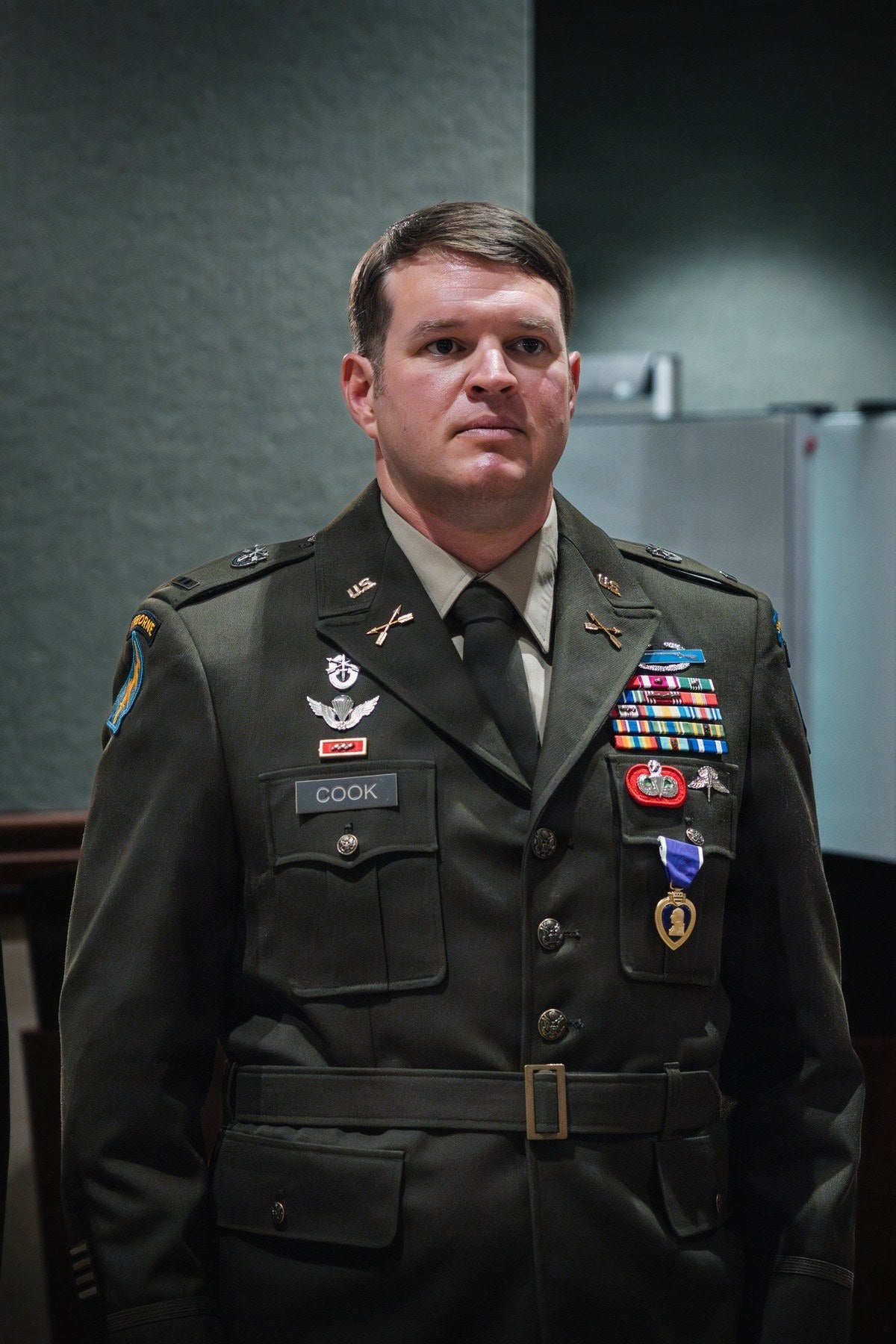
PHOTO CAPTION: U.S. Army Chief Warrant Officer 2 Corey L. Cook stands after receiving the Purple Heart at Fort Carson, Colorado, Sept. 15, 2026. Cook was wounded when a 120-pound IED detonated beneath his vehicle in Afghanistan nearly 16 years earlier. (U.S. Army photo by Staff Sgt. Luis Solorio)
Nearly 16 years after a massive roadside bomb detonated beneath his vehicle in Afghanistan, a Green Beret has finally received the Purple Heart for the wounds he suffered that day.
Chief Warrant Officer 2 Corey L. Cook, assigned to the 10th Special Forces Group (Airborne), received the medal during a ceremony at Fort Carson, Colorado, on Sept. 15.
The attack that led to the award happened on Dec. 10, 2010, while Cook was serving in Helmand Province, Afghanistan.
Cook and his teammates were conducting a tactical ground movement and resupply mission when their convoy transitioned to blackout operations. As Cook reached for the controls to activate his vehicle's thermal camera, a 120-pound improvised explosive device detonated beneath the front driver's side.
The explosion rolled the vehicle onto its side, tore off the driver's door and scattered debris across the area.
Cook later recalled only pieces of what happened immediately after the blast — realizing he was lying against the ground inside the overturned vehicle and seeing flames through the windshield.
His attention quickly turned to the other men in the vehicle.
Despite suffering facial lacerations, bleeding from his ears and significant pain from the blast, Cook freed himself and helped evacuate the others through the gunner's hatch.
The danger wasn't over.
According to the Army, Cook and his teammates came under small-arms fire after the explosion. They reestablished security, secured sensitive equipment and held their position until medical evacuation arrived.
The blast left Cook with concussion-related symptoms, vertigo and other blast trauma. He spent 10 days receiving medical care.
Then he returned to his detachment and finished the deployment.
Cook wasn't the only member of the team to survive an explosion during that tour. The Army said nine members of the detachment, including Cook, survived at least one blast during the deployment, while firefights became so frequent that the team eventually stopped keeping track of troops-in-contact incidents.
For years afterward, Cook apparently wasn't focused on receiving a medal for what happened. The Army said he even questioned whether his injuries warranted a Purple Heart.
Then, nearly 16 years after the IED attack, an email arrived notifying him that the Army had approved the award.
The Army's account does not explain why the Purple Heart was approved so many years after Cook was wounded.
On Sept. 15, with family members, former teammates and fellow Soldiers present at Fort Carson, Brig. Gen. John W. Sannes of 1st Special Forces Command pinned the Purple Heart on Cook.
Cook said the medal made him think less about himself than about others who have received it — especially those who never came home.
“I'm glad to be alive,” Cook said. “I am glad I'm able to be a father, to be a husband.”
Cook has now served more than 17 years in the Army, including more than 15 in Special Forces. He has deployed multiple times to Afghanistan and Iraq and currently commands the Special Forces Advanced Urban Combat Detachment at Fort Carson.
Nearly 16 years after the explosion that almost killed him, the Purple Heart is finally on his uniform.
(Source: OAF Nation)