Article: DOJ Opens Gun Rights Applications Nov. 4
DOJ Opens Gun Rights Applications Nov. 4
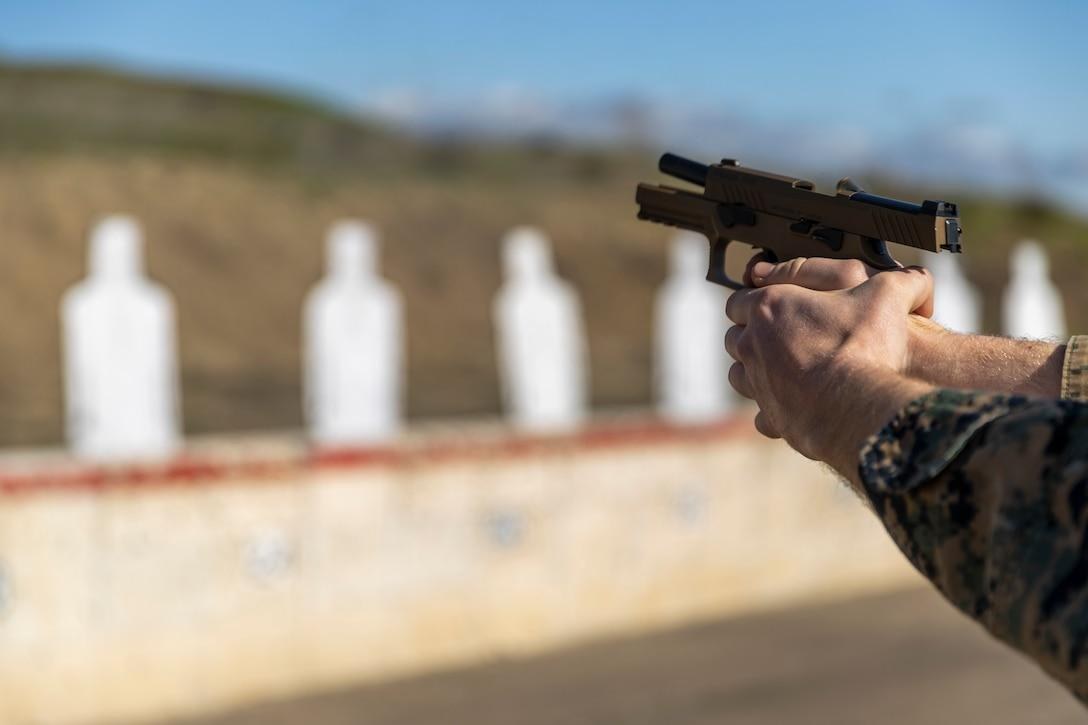
PHOTO CAPTION: U.S. Marine Corps Sgt. Mowry fires an M18 service pistol during a qualification exercise at Camp Pendleton, California, on February 13, 2023. The Justice Department is scheduled to open federal firearm-rights restoration applications on November 4, 2026, with access initially limited to 5,000 applicants. Approval is not guaranteed. (Illustrative file photo by Lance Cpl. Isaac Velasco / U.S. Marine Corps)
The Justice Department will begin accepting public applications to restore federal firearm rights on November 4, reopening a process that has been effectively unavailable to most Americans for more than three decades.
Only the first 5,000 applicants will be admitted during the initial public phase, according to updated guidance published by the department.
The applications will be accepted on a first-come, first-served basis.
The new Federal Firearm Rights Restoration program allows certain people prohibited from possessing firearms under federal law to request an individualized review of whether their rights should be restored.
Approval is not automatic. Applicants must demonstrate that restoring their rights would not endanger public safety or conflict with the public interest.
The program does not automatically remove independent state or tribal firearms restrictions.
First 5,000 Applicants Will Get Access November 4
The Justice Department's official program schedule identifies November 4, 2026, as the first opening available to the general public.
The initial phase will accept 5,000 applicants.
The department previously opened an invitation-only application phase on September 25.
Under the next stage, scheduled for January 4, 2027, another 500 people will be permitted to apply, and the department will begin collecting its $30 processing fee.
DOJ says the gradual rollout is intended to test the online application system and internal review procedures before expanding access more broadly.
The department has not announced a date for unrestricted public enrollment.
As of October 29, its official website still described the public online application as coming soon.
No specific opening hour has been announced.
Applicants are directed to the Justice Department's Federal Firearm Rights Restoration website at justice.gov/ffrr for updated instructions and access to the application when it becomes available.
The 5,000-person limit applies to the opportunity to submit an application, not to the number of people guaranteed to regain their rights.
New DOJ Guidance Sets 30-Day Deadline
The department updated its frequently asked questions on October 27, adding important details for people preparing to apply.
Once someone initiates an electronic application, that person has 30 days to complete and submit it.
An unfinished application that exceeds the deadline must be restarted.
The department also warns that the Office of the Pardon Attorney currently cannot recover a lost application link and personal identification number. Losing those credentials may require an applicant to begin again.
DOJ recommends gathering required documentation before starting the application.
Applicants generally must provide criminal-history records covering the previous 25 years or their adult lives, whichever period is shorter.
Depending on the reason their firearms rights were lost, applicants may also need conviction records, court judgments, documentation showing the completion of a sentence or other supporting records.
The process also requires three character references who have known the applicant for at least three years and are not related by blood or marriage.
Electronic fingerprints must be submitted through participating United States Postal Service locations, following instructions issued during the application process.
Additional costs may apply to obtaining fingerprints and records.
Who Can Request Restoration?
The program operates under 18 U.S.C. 925(c), a federal statute allowing the attorney general to grant relief from certain firearms disabilities.
Federal law prohibits several categories of individuals from possessing, receiving or handling firearms.
Those categories include people convicted of certain offenses, individuals subject to qualifying domestic-violence restrictions, people prohibited because of certain mental-health adjudications and other statuses identified in the Gun Control Act.
The new process allows people with federal firearms prohibitions to request consideration for relief.
The existence of an application pathway does not mean every applicant is likely to qualify.
Under the final rule, applicants must satisfy the Justice Department that their conduct, record and reputation demonstrate that restoring their firearms rights would be consistent with public safety.
The department will review each application individually.
Violent Offenders Face Strong Presumptions Against Approval
The rule creates strong presumptions against restoring rights to people with serious criminal histories or ongoing public-safety risks.
Those include certain convictions involving homicide, sexual violence, kidnapping, domestic violence, robbery, terrorism and other serious offenses.
Some presumptive disqualifications are permanent, while others involve five-year or ten-year periods.
People with certain current prohibited statuses also face presumptive disqualification.
The department can consider extraordinary circumstances when applying those presumptions, but applicants are not entitled to relief simply because they submit a completed application.
Attorney General Todd Blanche said when the rule was announced August 17 that the process was intended to provide individualized consideration while preserving safeguards against restoring firearms access to people who present a danger.
The Justice Department maintains that a person's record, reputation and conduct after the event that caused the prohibition must be considered before relief is granted.
Veterans May Also Qualify to Apply
The Justice Department's guidance specifically addresses veterans and former service members.
Individuals whose federal firearms rights were restricted because of qualifying court-martial convictions or dishonorable military discharges may submit applications under the new process.
Former service members whose firearms prohibitions involve certain mental-health adjudications may also have a pathway to seek relief.
However, the department directs people with some mental-health-related prohibitions to first pursue other available relief programs when applicable.
Veterans who have already received a qualifying restoration of rights through another lawful process may not need to apply again if they have no remaining federal prohibition.
Former service members with applicable military records may be required to provide a DD Form 214 or other discharge and court-martial documentation.
These provisions establish a possible application pathway, not an automatic exemption from the program's public-safety standards.
Why the Process Was Unavailable for Decades
Congress established a mechanism for restoring certain federal firearm rights under the Gun Control Act, but the process became largely unavailable after Congress restricted funding for the Bureau of Alcohol, Tobacco, Firearms and Explosives to review individual applications.
Those funding restrictions effectively prevented most people from using the statutory relief process for more than 30 years.
The Justice Department's new rule places responsibility for individual applications with the Office of the Pardon Attorney rather than ATF.
The regulation was finalized in August 2026 after a rulemaking process that included public comments about Second Amendment protections, rehabilitation and public safety.
Supporters argued that people who no longer present a danger should have an opportunity for individualized review.
Opponents raised concerns that restoring firearms access to previously prohibited individuals could create risks, particularly in cases involving violence or abuse.
The Justice Department says its new review procedures are intended to balance those considerations.
Federal Approval Will Not Override State Gun Laws
A federal grant of relief does not necessarily mean an applicant may immediately possess firearms in every jurisdiction.
The Justice Department specifically states that the program cannot remove independent state or tribal firearms prohibitions.
Applicants must ensure that no other applicable restriction prevents lawful firearm possession.
When federal relief is granted, the FBI will update the National Instant Criminal Background Check System to reflect the decision.
The applicant's name and the date of the restoration will also be published in the Federal Register.
The department may issue a special identifying number to assist with future background checks.
However, an approved applicant remains responsible for complying with other applicable federal, state, tribal and local requirements.
What Happens Next?
The first general-public application phase is scheduled to begin November 4.
Only the first 5,000 people admitted into that phase will be able to apply during the initial rollout.
The Justice Department has not specified an opening hour or announced how quickly the available application slots might be filled.
Another limited phase is scheduled for January 4, 2027, with 500 additional application opportunities and the start of the $30 processing fee.
For people seeking federal firearms-rights restoration, the immediate development is the first public opportunity in decades to request individualized review through the renewed federal process.
But the program remains an application and investigation system, not a blanket restoration of rights.
Applicants will still have to satisfy federal eligibility requirements and demonstrate that receiving relief would not present an unacceptable risk to public safety.
(Source: OAF Nation)