BASES STILL BAN CONCEALED CARRY
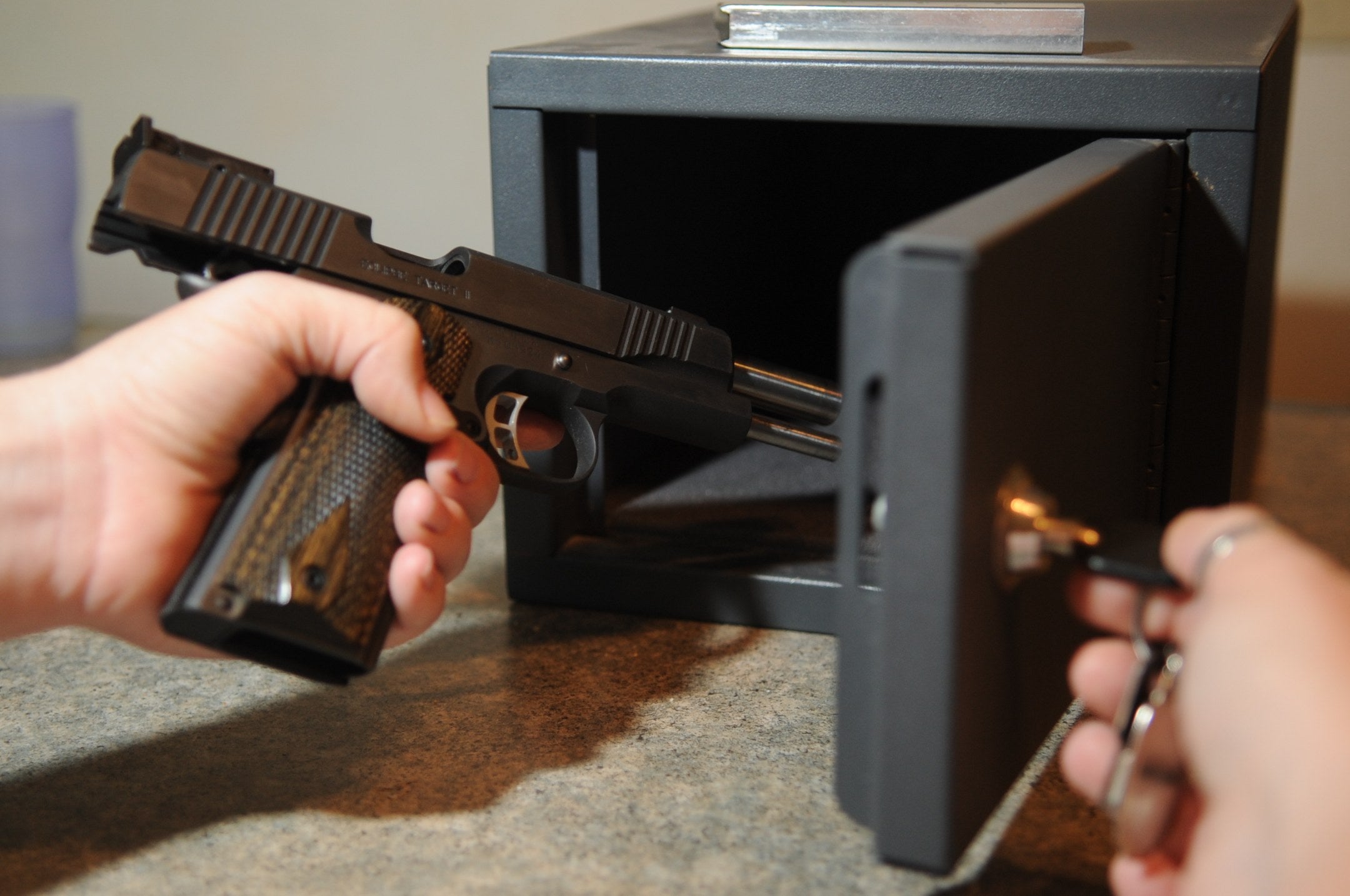
PHOTO CAPTION: A handgun is placed into a lockable safe at Minot Air Force Base. Five months after Pete Hegseth ordered a presumption of approval for off-duty personal-firearm carry requests, several major installation websites still post broad concealed-carry prohibitions. U.S. Air Force photo by Tech. Sgt. Thomas Dow.
Five months after Pete Hegseth directed military installations to give service members a presumption of approval when they request to carry personal firearms for off-duty protection, official websites for several major bases are still telling troops that concealed carry is prohibited.
An OAF Nation review of current installation guidance found blanket-ban language posted by Fort Campbell, Fort Meade and Davis-Monthan Air Force Base. The discrepancy does not necessarily mean commanders are refusing requests permitted under Hegseth's directive, but the public guidance provides little indication that the new application process exists.
Hegseth signed the memorandum on April 2, directing commanders to allow uniformed service members to request permission to carry privately owned firearms while off duty on Department of War property in the United States. Permitting officials were instructed to review those requests with a “presumption of approval.”
If a request is rejected, the memorandum requires a written explanation identifying an objective and individualized reason for the denial.
“Again, the presumption is service members will be able to have their Second Amendment right on post,” Hegseth said when announcing the change.
But a service member checking Fort Campbell's official weapons-registration page today receives a considerably different first impression.
“Carrying concealed weapons on Fort Campbell is NOT AUTHORIZED,” the page states. Farther down, the installation says carrying concealed personal firearms is “strictly prohibited” and that state concealed-weapons permits are neither recognized nor honored on the installation.
Fort Meade's current official guidance displays nearly identical language: “Carrying concealed weapons on Fort Meade is NOT AUTHORIZED.”
The installation does acknowledge that privately owned weapons may be carried when authorized by the senior commander, but its public page does not explain an application process based on Hegseth's April presumption-of-approval policy. It also says personnel who do not live on Fort Meade cannot bring their firearms onto the installation and prohibits carrying a loaded firearm in a vehicle.
The mismatch isn't limited to the Army.
Davis-Monthan Air Force Base's current firearms page says privately owned firearms may be brought onto the installation by certain military personnel, retirees, family members and DoD civilians. But under a separate section titled “Carrying Firearms,” the base states that carrying a privately owned firearm is not authorized except for specified law-enforcement personnel performing official duties.
That does not necessarily establish that any of the installations are disregarding Hegseth's order. Public-facing pages can lag behind internal policies, and installations may have separate procedures that are not described on their websites.
But another part of the Pentagon's own public record raises questions about how completely the April directive has been implemented.
Hegseth's memorandum specifically tasked the Pentagon's intelligence and security office with updating Department of War Manual 5200.08, which governs physical-security policy and was supposed to provide authority for officials reviewing personal-firearm requests.
As of Sept. 7, the Pentagon's public directives database still lists DoD 5200.08-R with its most recent change dated October 2020, while Volume 3 of DoD Manual 5200.08 shows its latest change as September 2020. No post-April 2026 revision implementing the new firearm directive is listed publicly.
There is also an important distinction between what Hegseth changed and the impression created by some of the initial headlines surrounding his announcement.
Military personnel already had a mechanism for requesting permission to carry privately owned firearms on DoD property before April. The existing DoD Directive 5210.56 explicitly states that personnel may request permission to carry a private firearm for personal protection unrelated to official duties.
Under that directive, an authorized official may grant written permission for concealed or open carry after considering eligibility, training and other requirements. Carry inside federal buildings faces additional legal restrictions.
Hegseth's significant change was therefore not automatic concealed carry on every military installation. It was an order to change how those applications are treated: requests are supposed to begin with a presumption of approval, and a denial must be individualized and explained in writing.
A state concealed-carry permit by itself also does not give a service member permission to begin carrying a handgun on a military installation.
What remains unclear five months later is how consistently that new presumption has filtered down into installation-level procedures — and why troops checking some of the military's own public websites are still seeing language that sounds much like the blanket restrictions Hegseth said he intended to change.
Until installation guidance explicitly says otherwise, service members should continue following the firearm rules issued by their individual installation and should not assume the April memorandum alone authorizes them to carry a privately owned weapon on post.
(Source: OAF Nation)