Army Trains for Mass Battlefield Burials
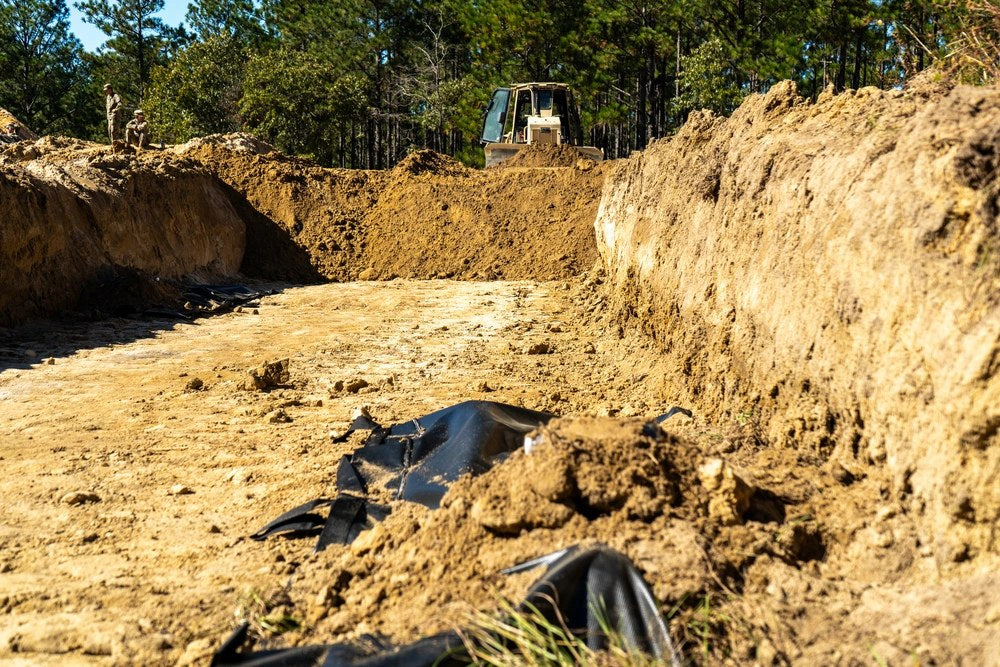
PHOTO CAPTION: A U.S. Army D6 bulldozer backfills a simulated battlefield burial trench during Operation Dragon Covenant at Fort Bragg, North Carolina, October 21, 2026. The exercise tested procedures for temporarily interring fallen service members when immediate recovery and repatriation are not possible. U.S. Army photo by Capt. Thomas McCarty, via DVIDS.
The U.S. Army has conducted an unusual training exercise preparing for a scenario most American military families hope never happens: a future war in which so many service members are killed, or battlefield conditions become so dangerous, that bringing the fallen home immediately is no longer possible.
During an October exercise at Fort Bragg, North Carolina, soldiers tested procedures for temporarily burying fallen troops on the battlefield while preserving their remains for eventual identification and return to their families.
Army planners calculated that a properly equipped engineering company could prepare and close temporary burial trenches for as many as 2,400 remains in a single day during continuous operations.
The training marks a significant return to procedures the Army says it has not used on a large scale since the Korean War.
And it raises an uncomfortable question: What kind of conditions is the military preparing to face in its next major conflict?
What the Army Actually Practiced
The exercise, known as Operation Dragon Covenant, took place October 20 and 21 near Fort Bragg's St. Mere Eglise Drop Zone.
It involved soldiers from the 3rd Corps Sustainment Command, the 20th Engineer Brigade, fatality management specialists, medical personnel and military chaplains.
Their mission was to determine how quickly engineers could prepare temporary graves without damaging remains that would eventually need to be recovered.
Using D6 bulldozers, crews excavated trenches designed to accommodate 20 remains in an average of one hour and 15 minutes.
Previous trials involving smaller backhoes had taken approximately three hours to prepare a trench for ten.
Based on the new results, Army planners estimated that an engineer company operating eight bulldozers and four High Mobility Engineer Excavators could prepare and close trenches for up to 2,400 remains over 24 hours.
That figure is a theoretical operating capacity based on the exercise results. The Army did not bury 2,400 people, and the training involved simulated remains rather than actual casualties.
But the purpose was serious: develop procedures for a war in which conventional casualty recovery operations might become impossible.
Why Is the Army Revisiting Battlefield Burials?
Throughout the wars in Iraq and Afghanistan, American forces generally had the air superiority, transportation networks and medical infrastructure necessary to evacuate fallen service members rapidly.
A future conflict involving a powerful adversary could look very different.
Airfields could be damaged. Transportation routes might become contested. Recovery teams could face continued attacks, and entire areas of the battlefield might remain inaccessible.
Under those circumstances, the military may be unable to immediately return every fallen service member to the United States.
The Army says temporary battlefield interment has not been conducted at scale since the Korean War, when severe terrain, shifting frontlines and intense fighting complicated the recovery of American troops.
The latest exercise is intended to address gaps in procedures that have received relatively little practical testing during the past two decades.
Sgt. 1st Class Delbert Ruede, a senior fatality management noncommissioned officer involved in the training, acknowledged the challenge.
"If we went to war tomorrow, we would be making this up as we went along," Ruede said in the Army's official report.
His comments reflected the Army's concern that existing procedures need to be tested before soldiers might have to rely on them under combat conditions.
The Goal Is Still to Bring Every Fallen Service Member Home
Temporary battlefield burial does not mean abandoning efforts to identify and return the fallen.
Army officials emphasized that preserving remains for future recovery was one of the exercise's most important objectives.
Soldiers used simulated skeletal models and sealed water containers inside burial bags to examine whether heavy equipment could cover temporary graves without causing structural damage.
Afterward, teams uncovered the simulated remains and evaluated whether the burial methods had preserved them.
The exercise also revealed problems with existing instructions.
For example, the prescribed spacing between trenches proved too narrow for modern bulldozers to operate without potentially disturbing the burial area.
Engineers adjusted the dimensions and tested alternative backfilling procedures.
Those findings will help the Army revise its battlefield fatality management doctrine.
The ultimate objective remains recovering the fallen, establishing their identities and returning them to their families when conditions permit.
Military Chaplains Prepare for the Same Grim Possibility
The exercise involved approximately 130 religious support personnel from units across the XVIII Airborne Corps.
For the first time in more than 20 years, Army chaplains and religious affairs specialists practiced religious support operations associated with temporary battlefield burials.
In a high-casualty conflict, individual funeral ceremonies might not be possible while recovery and interment operations continue.
Chaplains therefore examined how entire temporary burial sites could be consecrated and how religious traditions could be respected when a fallen service member's identity or faith is unknown.
The Army also considered the emotional demands placed on personnel responsible for handling large numbers of casualties.
Its planning assessment suggested that religious support teams could experience serious physical, emotional and spiritual exhaustion within four to six hours under such conditions.
Officials identified the need for personnel rotations and additional procedures to ensure that fallen troops receive respectful treatment while protecting the well-being of those carrying out the mission.
Does This Mean the Army Expects a Major War?
The exercise reflects the military's preparations for large-scale combat operations, including scenarios involving heavy casualties and disrupted transportation networks.
But the Army has not said that the exercise is connected to a specific upcoming war or that it expects 2,400 American troops to die each day.
The number represents an estimated temporary burial capacity, not an anticipated casualty rate.
Military organizations routinely prepare for difficult scenarios, including situations they hope never occur.
Still, the exercise offers a revealing look at an often overlooked part of modern military readiness.
While much of the public discussion about future wars focuses on missiles, drones, aircraft and advanced weapons, the Army is also confronting the possibility that even recovering its dead could become extraordinarily difficult.
What's Next?
The findings from Operation Dragon Covenant will be forwarded to Army organizations responsible for revising battlefield fatality management and religious support procedures.
A third phase is planned for spring 2027.
That exercise is expected to expand the training to include nighttime operations, security teams, medical facilities and a fully functioning mortuary affairs collection point.
For veterans familiar with the military's commitment to its fallen, the underlying issue is deeply personal.
Preparing for the possibility of temporary battlefield burials is not an announcement that such losses are expected.
It is an acknowledgment that future wars could present conditions the American military has not faced on this scale in generations.
And if those circumstances ever arise, the Army wants procedures in place to ensure the fallen are treated with dignity and ultimately returned home.
(Source: OAF Nation)