Army Tests Expanded Training Plan
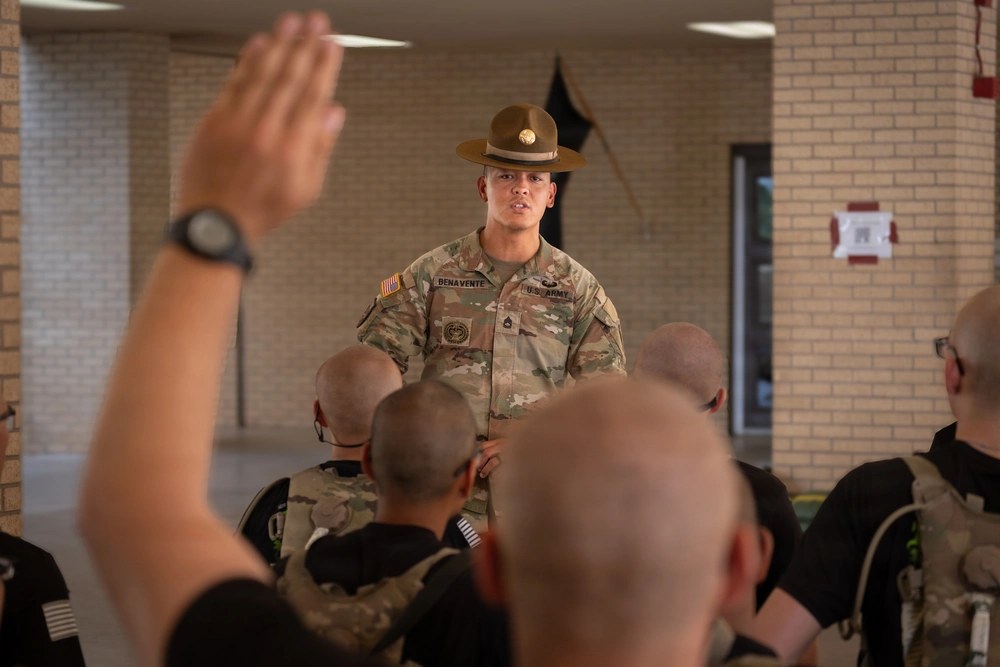
PHOTO CAPTION: U.S. Army Reserve Sgt. 1st Class Robert Benavente addresses Basic Combat Training trainees at Fort Sill, Oklahoma, on Aug. 16, 2026, during Operation Wildcat Rising, an experiment testing how Reserve drill sergeant formations could expand Army training capacity during a major conflict. U.S. Army Reserve photo by Maj. Linda Gerron.
The Army has tested a plan for expanding Basic Combat Training if a major war suddenly forces the service to produce significantly more trained soldiers.
The experiment, called Operation Wildcat Rising, paired the Army Reserve's 1st Brigade, 95th Training Division with the active-duty 434th Field Artillery Brigade at Fort Sill, Oklahoma, during an actual Basic Combat Training cycle this summer.
Instead of using individual Reserve drill sergeants simply to fill vacancies in active-duty formations, the Army kept Reserve drill sergeants and their leaders together as a formation and gave them a larger role in running the training cycle.
The idea is to determine whether Army Reserve units could provide additional training capacity if wartime demand overwhelms the Army's existing training base.
Ninety-one Army Reserve soldiers participated in Wildcat Rising, including 65 drill sergeants. By the end of the cycle, 133 trainees had graduated from Basic Combat Training.
Army leaders stressed that expanding capacity cannot mean lowering the standards required of new soldiers.
“At the end of the day, we have to train these men and women for combat,” Maj. Gen. Michael J. Dougherty, commanding general of the 80th Training Command, said. “Basic Combat Training is step one, and we have to get that right. There is one standard, and we have to train to that standard.”
The pilot also exposed problems the Army would need to solve before trying the concept on a much larger scale.
Some Reserve personnel arrived at Fort Sill without completing required certifications, while communication gaps left others unclear about requirements before the mission began. The three-week rotation schedule also provided limited time for outgoing and incoming teams to transfer knowledge.
Those lessons are part of the reason the Army conducted the experiment before an actual wartime surge made additional training capacity urgently necessary.
Col. Matthew Horning, commander of 1st Brigade, 95th Training Division, said the initial test was deliberately limited so the Army could identify problems before expanding the concept.
A larger brigade-level experiment is planned for fiscal year 2027.
The Army has not said that a specific major conflict is imminent or that Basic Combat Training is currently being expanded because of an impending war. Wildcat Rising is instead an effort to determine how the service could scale its training system if a future conflict suddenly requires substantially more soldiers.
For Army leaders, the goal is to avoid figuring that out after a crisis has already begun.
If a major war requires the Army to train soldiers at a much faster pace, the service wants a tested plan for bringing Reserve drill sergeant formations into the effort without sacrificing the standards expected of new troops.
Source: U.S. Army / 95th Training Division
(Source: OAF Nation)