Army Reservist Sues OPM Over Pay
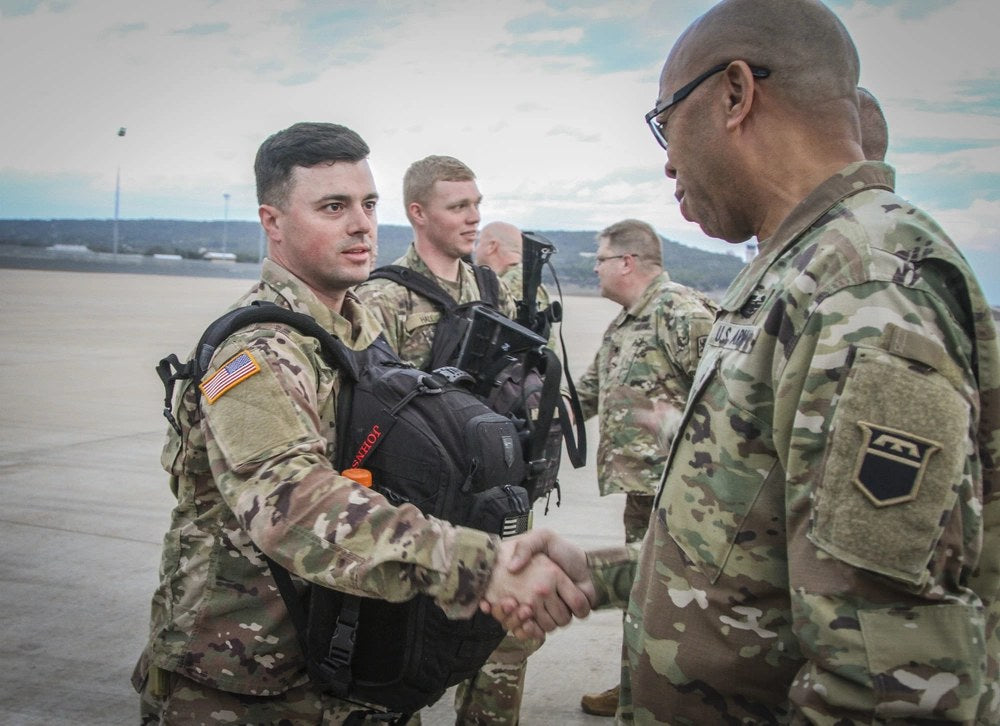
PHOTO CAPTION: U.S. Army Reserve soldiers prepare for an overseas deployment. A new lawsuit argues federal agencies are still applying outdated rules when determining differential pay for some mobilized federal employees who also serve in the Reserve.
An Army Reserve major who also works as a Department of Veterans Affairs attorney has sued the Office of Personnel Management, arguing the agency is still relying on outdated differential-pay guidance more than a year after the Supreme Court rejected the legal standard behind it.
Marcus Colicelli filed the lawsuit Aug. 12, seeking to force OPM to issue binding regulations and update its guidance for federal civilian employees who also serve in the military reserve components.
The dispute centers on reservist differential pay, a benefit Congress created in 2009 to help ensure federal civilian employees do not take a pay cut when they leave their government jobs for qualifying active-duty military service.
When a reservist's military pay is lower than what the employee would have earned in his or her federal civilian position, the differential-pay program can cover the difference.
OPM issued policy guidance in 2009, later updated in 2015, that required some reservists to show their active-duty service was substantially connected to a specific war or national emergency in order to qualify.
That interpretation was undercut by the Supreme Court in April 2025.
In Feliciano v. Department of Transportation, the court ruled 5-4 that a federal employee called to qualifying active duty during a declared national emergency does not also have to prove that the military service was directly connected to that emergency.
The case involved Nick Feliciano, a federal air traffic controller and Coast Guard reservist who spent years on active duty escorting military vessels and conducting security missions.
The Supreme Court concluded that the law requires a temporal connection — that the qualifying active duty occur during a declared national emergency — rather than the more restrictive direct-connection test previously applied by the federal government.
Colicelli's lawsuit argues OPM has still not issued regulations reflecting that decision.
According to the complaint, OPM's current guidance continues to direct federal agencies to apply standards that conflict with the Supreme Court's interpretation.
That can leave reservists seeking differential pay to first request the money from their employing agency, receive a denial and then pursue an appeal through the Merit Systems Protection Board.
Colicelli argues that process forces individual reservists to fight the same issue agency by agency and activation by activation instead of having a single government-wide rule.
The lawsuit does not itself award back pay to reservists, nor does it automatically establish that every federal employee who served on active duty is owed differential pay.
Eligibility still depends on the circumstances of the employee's military service, civilian salary and the statutory requirements governing differential pay.
But the Supreme Court's 2025 decision potentially expanded the group of federal civilian employees who may qualify by eliminating the requirement that their active-duty service be directly tied to the underlying national emergency.
Colicelli's attorneys say they are also preparing a class-action case before the Merit Systems Protection Board involving other federal employee reservists who may have been denied differential pay.
The dispute could have significant financial consequences for some service members. Differential-pay claims can involve substantial sums when a federal civilian employee spends months or years on military orders while earning less than in the employee's civilian position.
For Guard and Reserve members who also work for the federal government, the lawsuit now raises a simple question: whether agencies are still applying a pay standard the Supreme Court rejected more than a year ago.
(Source: OAF Nation)