Army Probes Fatal Black Hawk Crash
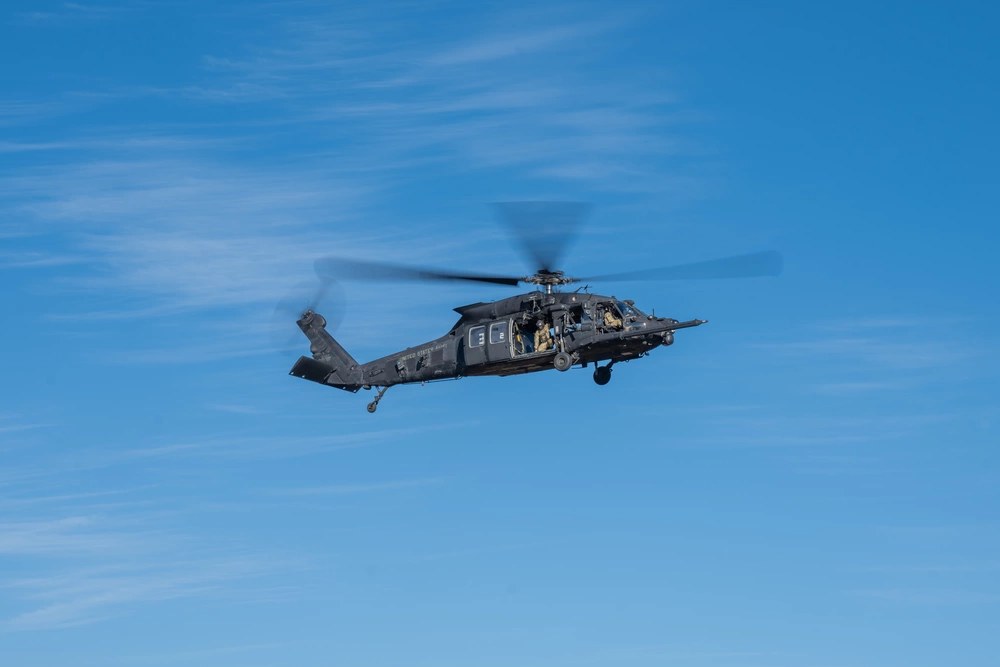
PHOTO CAPTION: A U.S. Army MH-60M Black Hawk helicopter assigned to the 160th Special Operations Aviation Regiment conducts training at Hurlburt Field, Florida, on January 10, 2024. Newly reported Army investigation records detail earlier aircraft problems and an impossible training deadline preceding a September 2025 helicopter crash in Washington that killed four Night Stalkers. The aircraft pictured was not involved in the crash. (U.S. Air Force photo by Airman 1st Class Hussein Enaya)
Newly obtained Army investigation records reveal that a Special Operations Black Hawk crew was assigned a deliberately impossible arrival time during a training mission, while the helicopter involved in the exercise had previously experienced reported autopilot problems.
The September 17, 2025, crash near Joint Base Lewis-McChord, Washington, killed four soldiers from the Army's elite 160th Special Operations Aviation Regiment, known as the Night Stalkers.
KIRO 7 News reported October 19 that documents from a 275-page military investigation described the training scenario, earlier aircraft malfunctions and questions involving communication of equipment deficiencies before the fatal flight.
The records do not establish that the training deadline or previously reported aircraft problems caused the crash.
Training Exercise Included Impossible Arrival Time
According to portions of the investigation obtained by KIRO 7, the helicopter was conducting nighttime training that involved flying from Joint Base Lewis-McChord to Ocean Shores Airport and returning.
The training plan included a deliberately unattainable arrival time.
The purpose was to give pilots experience managing an aircraft mission when running behind schedule, including discussing ways to recover lost time and prioritizing responsibilities in flight.
One portion of the report described the arrival time as deliberately impossible, allowing instructors to observe how the crew managed the scenario.
The report also states that the aircraft departed its planned route after leaving Ocean Shores Airport.
Chief Warrant Officer 3 Andrew Cully subsequently navigated between two converging ridgelines.
The aircraft later struck electrical transmission lines and crashed in Thurston County at approximately 9:30 p.m.
The available reporting does not establish whether the deliberately impossible schedule contributed to the crew's flight-path decisions.
Previous Pilot Reported Autopilot Problems
Investigators also interviewed a pilot who had previously flown the same aircraft.
That pilot described multiple concerning equipment problems, including instances in which the helicopter's autopilot selected an altitude substantially lower than the altitude commanded by the crew.
According to the report, the autopilot twice selected an altitude of approximately 3,000 feet during climbs toward an assigned altitude of 5,000 feet.
The pilot also reported that several radios were either inoperative, disconnected or not installed.
The precise timing of those malfunctions in relation to the fatal flight was not established in the published account.
The records do not establish that the autopilot malfunctioned during the final mission or that the previously reported deficiencies caused the helicopter to strike the power lines.
Questions About Aircraft Handover
The previously interviewed pilot told investigators that a brief handover had been provided concerning the aircraft's deficiencies.
However, that witness did not observe a face-to-face handover involving the pilots who later died in the crash.
The witness also did not see the accident crew conduct its own preflight inspection.
Those observations raise questions about how the equipment concerns were communicated, but they do not prove that the crew failed to receive the information or skipped required inspections.
KIRO 7's reporting did not establish whether the reported deficiencies had been corrected before the accident.
Four Night Stalkers Killed
The soldiers killed were assigned to the 4th Battalion, 160th Special Operations Aviation Regiment.
They were:
Chief Warrant Officer 3 Andrew Cully, 35, of Sparta, Missouri
Chief Warrant Officer 3 Andrew Kraus, 39, of Sanibel, Florida
Sgt. Donavon Scott, 24, of Tacoma, Washington
Sgt. Jadalyn Good, 23, of Mount Vernon, Washington
Cully and Kraus served as pilots, while Scott and Good were helicopter crew chiefs.
The 160th Special Operations Aviation Regiment specializes in demanding aviation missions, frequently conducted at night and in challenging operating environments.
Following the crash, Army Special Operations Command honored the four soldiers for their service, professionalism and dedication to their unit.
Cause of Crash Not Established by Published Excerpts
The newly reported records provide additional information about the conditions surrounding the September 2025 accident.
However, the complete investigation and its final conclusions were not available for independent review in the published account.
The documents cited by KIRO 7 do not establish that an autopilot failure, missed inspection or pressure to meet the training schedule caused the crash.
They do identify questions about training design, aircraft maintenance and the communication of known equipment concerns.
More than a year after four Night Stalkers lost their lives, those questions remain important to understanding the circumstances of the fatal training mission and what measures may be needed to prevent another loss.
(Source: OAF Nation)